News coverage gives a retail launch public visibility, searchable information, third-party context, and wider awareness across relevant audiences. In 2026, coverage also supports discovery through search engines, news platforms, social channels, and AI-generated answers.
A retail launch is the public introduction of a new product, store, collection, service, or retail concept. It creates an identifiable news event with a defined date, location, product category, and customer audience.
News coverage turns launch information into published media content. A retailer announces what is launching, where it is available, when customers can access it, and why the launch is relevant. Journalists and publishers then determine whether the information fits their editorial requirements.
Retail launches include several common events. Examples include a new supermarket opening in Manchester, a fashion collection launching in London, a technology product entering UK retail, and a high-street brand opening its first Welsh store.
In 2026, retail discovery occurs across multiple digital environments. Consumers search Google, browse news websites, use social platforms, read specialist publications, and interact with AI-powered search interfaces. Published coverage creates information that exists across these environments.
How has retail launch discovery changed in 2026?
Retail discovery now extends beyond physical stores and traditional advertising. Consumers encounter launch information through search results, digital news, specialist publications, social platforms, maps, and AI interfaces that organise information from published sources.
Search remains an important discovery mechanism for retail information. A consumer searching for a new shop, product release, or local opening encounters different content types. These include retailer pages, news articles, reviews, event listings, product pages, and local publications.
News articles provide a different information format from commercial product pages. A retailer’s website explains its own launch. A news article places the launch within an editorial context and identifies facts relevant to its audience.
AI search adds another layer. AI systems process information from websites and other published sources to generate responses to user questions. Clear, factual reporting gives these systems structured information about entities, events, locations, products, and dates.
What information does a retail launch article contain?
A useful retail launch article normally identifies:
- The retailer or brand
- The product, store, or service being launched
- The launch date
- The location or availability area
- The product category
- Relevant pricing information
- Customer access details
- Statements from relevant representatives
- Information explaining the significance of the launch
These details create a clear entity relationship between the retailer, product, location, event, and customer audience.
What types of retail launches benefit from news coverage?
Retail launches generate different news opportunities based on product category, location, customer relevance, investment, employment, innovation, and timing. Strong coverage begins with a clearly defined event and identifiable information.
Retail news applies to both physical and digital commerce. A launch does not require a new shop to qualify as a retail event.
Which retail launches commonly attract attention?
Common examples include:
- New store openings — A retailer opens a new location in a town or city.
- Product launches — A new product becomes available to UK consumers.
- Collection launches — Fashion or lifestyle retailers introduce a new collection.
- Market expansions — An established retailer enters a new UK region.
- Retail technology launches — Stores introduce new checkout, payment, fulfilment, or customer-service technology.
- Seasonal launches — Retailers introduce Christmas, summer, back-to-school, or other seasonal ranges.
- Flagship openings — A retailer launches a major location in a prominent UK market.
- Brand expansions — An international retailer enters the UK or expands its existing footprint.
Location adds an important regional dimension. A new store in Cardiff creates a local story. A national product launch creates a broader consumer story. A major retail expansion can contain both regional and national news elements.
How does news coverage work during a retail launch?
Retail launch coverage follows a defined information cycle: announcement, editorial evaluation, publication, indexing, distribution, and subsequent discovery. Each stage determines how audiences encounter the launch and how long the information remains accessible.
The process begins with the announcement. The retailer prepares factual information about the event, including the product or location, launch date, customer details, and relevant supporting information.
The information then enters an editorial environment. Publishers assess factors such as relevance, audience interest, geographic significance, originality, timing, and factual clarity.
Publication creates a permanent digital reference point. The article identifies the retail event and connects it with relevant entities such as the retailer, city, product category, and launch date.
Search engines then crawl and index published pages. News platforms and other discovery systems process the information according to their own technical and editorial systems.
Why does timing matter?
Timing connects the announcement with consumer attention.
A launch announcement published before opening gives audiences advance information. Coverage published around launch day captures immediate interest. Follow-up coverage after launch provides information about developments, customer response, expansion, or related activity.
For example, a new Birmingham fashion store opening on 15 September creates several relevant dates: the announcement date, opening date, and potential follow-up period.
What makes a retail launch newsworthy?
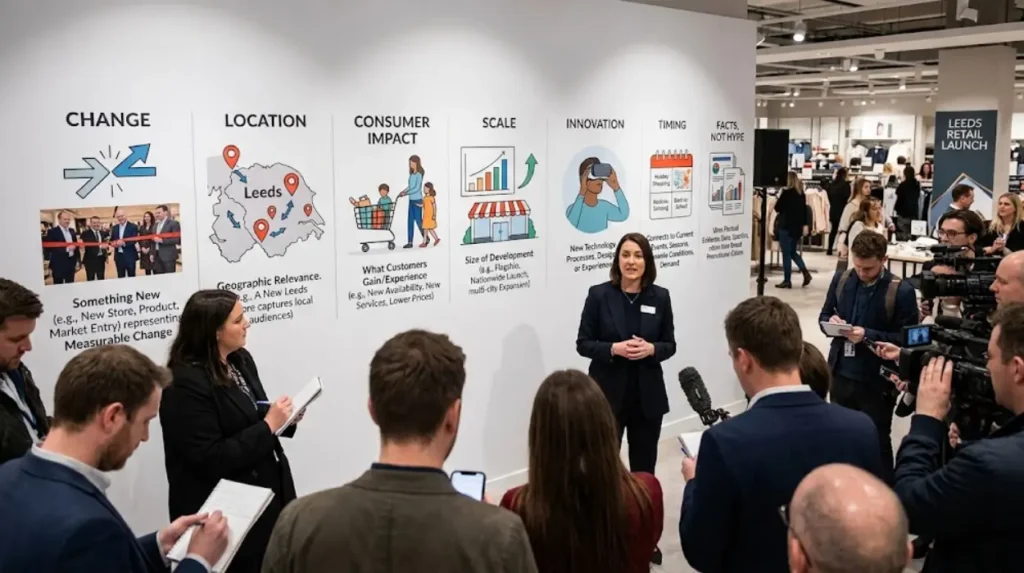
Newsworthiness comes from measurable relevance, change, location, consumer impact, scale, innovation, and timing. A retail announcement becomes clearer when it explains what changed, who is affected, where it happened, and when customers can respond.
Newsworthiness is an editorial concept. It describes the characteristics that make information relevant to a publication’s audience.
Retail announcements often contain several newsworthiness signals.
Which factors increase retail news relevance?
Change identifies something new. A new store, product, service, or market entry represents a measurable change.
Location establishes geographic relevance. A new store in Leeds has direct relevance for Leeds audiences.
Consumer impact explains what customers gain or experience. Examples include new product availability, extended opening hours, new services, or access to a previously unavailable brand.
Scale identifies the size of the development. A flagship store, nationwide product launch, or multi-city expansion carries a different level of significance from a single minor product update.
Innovation describes new technology, retail processes, product design, or customer experiences.
Timing connects the announcement to current events, seasons, economic conditions, or consumer demand.
A strong retail announcement uses factual evidence rather than broad promotional claims.
How does retail news coverage support search visibility?
Published retail coverage creates additional searchable pages containing retailer names, product terms, locations, dates, and related concepts. These pages expand the digital information environment surrounding a retail launch and improve discoverability across relevant searches.
Search visibility refers to how easily information appears when users search for relevant terms.
A retail launch creates several search entities. These include the retailer, product, location, category, opening date, and event.
For example, a Cardiff store opening can generate searches involving the retailer name, “new shop in Cardiff”, the shopping centre, the opening date, and the relevant product category.
News coverage places these entities within editorial content. Multiple factual references help establish relationships between them.
What role do backlinks play?
A backlink is a hyperlink from one website to another. Editorial coverage sometimes links to a retailer’s website, product page, location page, or other relevant resource.
Backlinks form part of the wider web relationship between sites. Their value depends on factors including source quality, relevance, context, and the nature of the link.
Coverage also creates brand mentions even when no hyperlink exists. Search visibility therefore involves more than counting links.
For readers exploring how launch coverage reaches product-focused audiences,
Retail launch coverage provides the next level of context.
Why is regional coverage important for UK retail launches?
Regional coverage connects retail launches with geographically relevant audiences. UK retail activity often has strong local significance because stores, employment, shopping destinations, and consumer access are tied to specific towns, cities, counties, and regions.
The UK contains distinct regional media markets. England, Scotland, Wales, and Northern Ireland each have national and regional publications serving different audiences.
A retailer opening in Cardiff has a different local news context from a retailer opening in Glasgow. A nationwide product launch has broader relevance, while a single-store opening has stronger geographic relevance.
Regional coverage can also strengthen location-based search visibility. Articles connect the retail entity with its city, county, shopping district, or region.
What does regional relevance look like?
Examples include:
- A supermarket opening in Swansea
- A fashion retailer opening in Bristol
- A technology shop launching in Edinburgh
- A department store expanding in Manchester
- A new independent retailer opening in Belfast
Each event has a defined location and audience.
How does retail launch coverage reach different audiences?
Retail launch information reaches audiences through national news, regional publications, specialist media, search engines, social platforms, and other digital channels. Each channel serves different information needs and geographic or commercial interests.
National publications address broad UK audiences. Regional publications focus on local developments. Retail trade publications focus on industry professionals. Consumer publications focus on products, shopping, trends, and customer interests.
The same retail launch can therefore support multiple information contexts.
A new grocery store provides local information about employment and shopping access. A retail industry publication focuses on expansion strategy and market activity. A consumer publication focuses on products and customer experience.
This segmentation makes audience relevance an important part of retail news coverage.
What benefits does retail launch coverage provide?
Retail launch coverage provides public awareness, searchable information, geographic relevance, editorial context, brand visibility, and additional digital references. These benefits support discovery before, during, and after a retail launch event.
The main benefits include:
- Awareness: More people encounter information about the launch.
- Search discovery: Published articles create additional pages that search engines can index.
- Regional visibility: Local publications connect launches with specific communities.
- Editorial context: Coverage presents launch facts within a news environment.
- Entity recognition: Articles connect retailers with products, places, dates, and categories.
- Longer information lifespan: Published pages remain accessible after launch day.
- Audience segmentation: Different publications reach different consumer and professional groups.
These outcomes relate to information distribution rather than advertising alone.
When should retailers consider news coverage for a launch?
Retailers benefit from planning news coverage around defined milestones, including announcement dates, opening dates, product availability, regional expansion, and significant developments. Early planning creates consistent factual information across the launch cycle.
Launch planning begins before the public event.
A retailer identifies the core announcement, supporting facts, target locations, product information, relevant dates, and available spokesperson details.
The information then remains consistent across published material. Consistency matters because consumers encounter the launch through multiple sources.
For a new store, the core facts include the address, opening date, store format, products, customer services, and relevant local information.
For a product launch, the core facts include the product name, category, availability date, retail locations, pricing, specifications, and customer access.
Readers looking for the full distribution context can explore:
15 UK news sites as a separate stage of the retail launch coverage journey.
What should retailers measure after launch coverage appears?
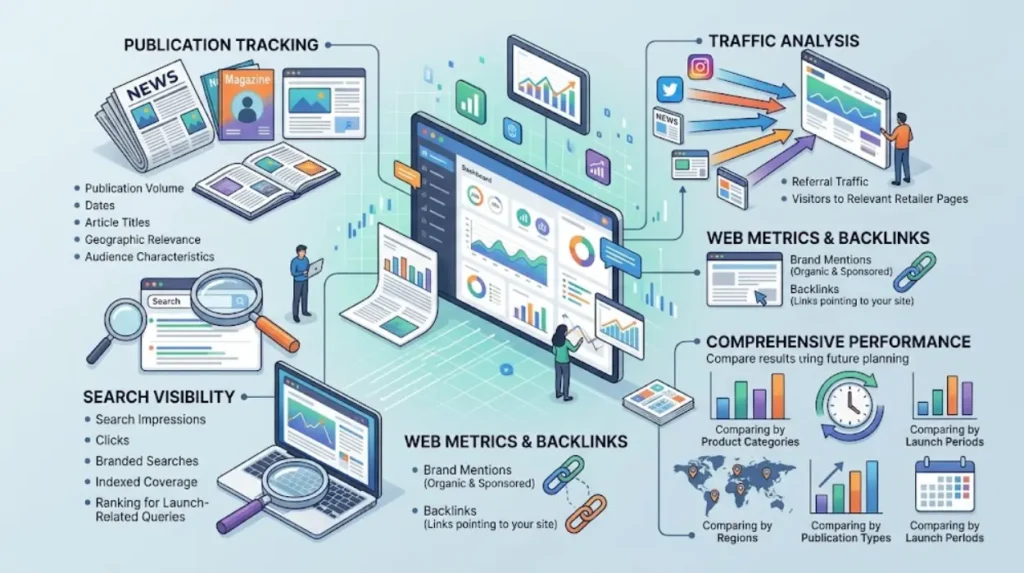
Retail launch coverage can be assessed through measurable indicators including publication volume, geographic distribution, referral traffic, search visibility, brand mentions, backlinks, indexed pages, and engagement with launch-related information.
Measurement begins with publication tracking.
Retailers can record where coverage appears, publication dates, article titles, geographic relevance, links, mentions, and estimated audience characteristics.
Search performance provides another measurement layer. Relevant indicators include impressions, clicks, branded searches, indexed coverage, and visibility for launch-related queries.
Traffic analysis identifies whether published articles send visitors to relevant retailer pages.
Coverage measurement also supports future launch planning. Comparing results across product categories, regions, publication types, and launch periods creates a factual record of which information channels generated the strongest visibility.
Why will news coverage remain relevant to retail launches in 2026?
News coverage remains relevant because retail discovery increasingly depends on searchable, authoritative, location-specific information. Published coverage gives launches durable digital references that connect retailers, products, places, dates, and consumer interests.
Retail launches are information events as well as commercial events. Customers need to know what is launching, where it is available, when it starts, and what distinguishes it from existing options.
News coverage places those facts into an independent publishing environment.
Explore More Expert Insights:
How Cardiff Events Reach 15 UK News Websites
5 Event Types That Win the Most News Coverage
In 2026, that information exists within a wider discovery ecosystem involving search engines, digital news, regional media, specialist publications, social platforms, and AI-powered interfaces.
The fundamental process remains factual: a retail development happens, information about the development is published, digital systems index that information, and audiences discover it through relevant channels.
For UK retailers, the combination of national relevance, regional significance, product information, location data, and timely publication makes news coverage an important part of the modern retail launch information cycle.