Event news coverage differs by event type because journalists assess audience relevance, timing, public interest, industry significance, location and available news angles. In 2026, corporate events, conferences, fintech events, healthcare events and real estate events create distinct opportunities for UK media reach.
Understanding these differences helps organisations select the right event format, prepare stronger news angles and evaluate realistic coverage outcomes. The comparison also connects event characteristics with national, regional and trade publication interest.
How does news coverage reach differ between event types in 2026?
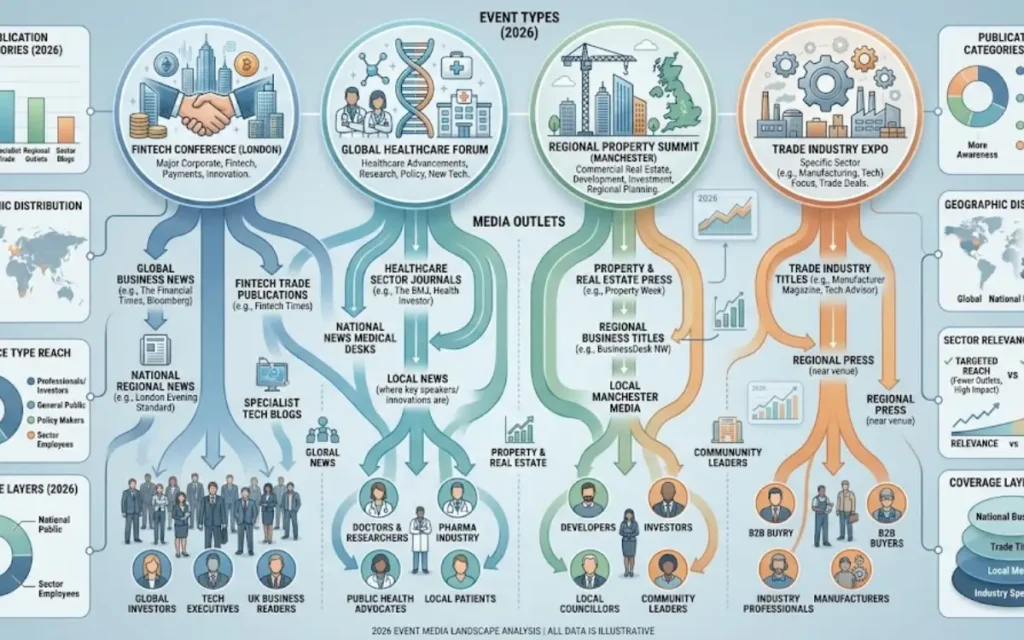
News coverage reach differs because each event type serves different audiences, publication categories and editorial interests. Conferences often attract trade coverage, while major corporate, fintech, healthcare and property events create distinct national, regional and specialist media opportunities across Britain.
Reach describes the size and range of audiences exposed to event-related news coverage. It includes publication reach, geographic distribution, sector relevance and audience type.
A single event can generate several coverage layers. A London conference can attract a national business publication, an industry trade title and regional outlets. A healthcare event can attract health-sector publications alongside local news media.
The number of outlets is not the only measurement. Coverage relevance also determines the value of media exposure. Ten specialist articles reaching the correct professional audience provide a different result from ten general-interest articles.
The educational comparison in news coverage explains why different events attract different levels of editorial attention.
What determines event coverage reach?
Five factors influence coverage reach:
- Event relevance to current news agendas
- Geographic location and community interest
- Industry or sector importance
- Strength of speakers, announcements and data
- Availability of clear editorial angles
These factors determine which publication categories have a reason to report the event.
Which five event types generate distinct UK news coverage opportunities?
The five event types are corporate events, conferences, fintech events, healthcare events and real estate events. Each has different editorial characteristics, audience segments and publication opportunities across UK national, regional and specialist media.
1. Corporate events
Corporate events include business launches, company milestones, leadership events, awards and major organisational announcements.
Coverage depends on the business significance of the event. A company announcing a major UK expansion creates a stronger news angle than a routine internal gathering.
Corporate events often connect with business, entrepreneurship and regional publications. A new office opening in Manchester creates a local business story. A significant investment programme creates a wider economic story.
2. Conferences
Conferences bring together professionals around a defined subject. Examples include technology conferences, sustainability conferences and business leadership conferences.
Their strongest coverage opportunities come from speakers, research findings, policy discussions and industry announcements.
Trade publications often provide an important coverage channel for conferences. Their audiences already follow the subject under discussion.
3. Fintech events
Fintech events focus on financial technology, digital banking, payments, investment technology, cybersecurity and financial regulation.
These events have strong connections with specialist financial and technology publications. Coverage becomes more relevant when the event introduces new research, partnerships, products, regulatory developments or investment activity.
A fintech conference in London, for example, creates a different media profile from a regional banking technology event.
4. Healthcare events
Healthcare events cover medical technology, healthcare management, pharmaceuticals, public health, digital health and clinical innovation.
Healthcare publications provide specialist reach. Regional news outlets become relevant when an event involves local hospitals, universities, healthcare providers or employment.
The subject also creates opportunities for expert commentary and research-based stories when the event contains credible evidence or measurable findings.
5. Real estate events
Real estate events cover property development, construction, investment, housing, commercial property and urban planning.
Coverage often has a strong geographic dimension. A property development event in Birmingham creates local relevance, while a major UK property investment announcement has broader business significance.
Real estate publications also provide specialist reach to developers, investors, consultants and construction professionals.
How does geographic reach compare across these five event types?
Geographic reach depends on the event’s location, audience and news relevance. Corporate and regional property events often produce strong local coverage, while fintech and specialist conferences frequently reach sector publications with national or international professional audiences.
Location establishes an initial editorial connection. London events have access to national business, financial and political media. Manchester, Birmingham, Edinburgh and other major cities provide strong regional news angles.
A national publication requires a national reason to cover the event. Geographic location alone does not create national news value.
How does regional coverage work?
Regional coverage focuses on local economic, social and community relevance.
A Birmingham construction conference featuring a major local development creates a clear regional story. An Edinburgh technology event involving local universities creates another local angle.
Regional coverage can reach audiences directly connected to the event location. This makes it an important component of a balanced distribution strategy.
How does national coverage work?
National coverage focuses on issues affecting a broader UK audience.
A fintech event announcing a major payments partnership has national relevance. A healthcare conference releasing new research about NHS efficiency also has wider significance.
National publications typically require a stronger news proposition than a location-based announcement.
Why does publication type affect the value of event coverage?
Publication type affects coverage value because national newspapers, regional outlets, trade publications and specialist websites serve different audiences. Effective event coverage aligns the event’s subject with the publication’s editorial focus and reader interests.
A trade publication targets professionals within a specific sector. Examples include financial technology, healthcare, construction and property publications.
Regional publications target geographically defined communities. Their coverage often focuses on local businesses, developments, employment and community activity.
National publications target broader UK audiences. Their editorial requirements typically include stronger public interest, business significance or national relevance.
What is the difference between reach and relevance?
Reach measures the size and distribution of an audience. Relevance measures how closely that audience matches the event’s intended stakeholders.
A healthcare event covered by a specialist healthcare publication reaches a highly relevant professional audience. A general news article can produce broader exposure but less sector-specific relevance.
Both measurements belong in an event coverage evaluation.
How should organisations compare news coverage reach before choosing an event strategy?
Organisations should compare event coverage by publication category, geographic distribution, audience relevance, news angle, expected outlet diversity and measurable exposure. This creates a structured basis for comparing events instead of judging performance only by the number of published articles.
A useful comparison considers the following components:
- Event type
- Primary audience
- Geographic relevance
- National news potential
- Trade publication relevance
- Regional publication potential
- Announcement strength
- Speaker authority
- Supporting data
- Coverage measurement
These criteria establish a consistent evaluation framework.
For example, a fintech event can score highly for specialist financial coverage but require a strong announcement for general national coverage. A property event can score highly for regional relevance when it involves a major local development.
What role do event announcements play in increasing coverage reach?
Event announcements provide the factual basis for coverage. Strong announcements contain specific information, named organisations, measurable developments, relevant dates, locations and clear consequences for the target audience.
Journalists require a usable news angle rather than an event description alone.

An announcement stating that a company is hosting a conference provides limited information. An announcement stating that the conference will release a new industry report, feature recognised experts and address a current regulatory issue provides multiple editorial angles.
Which event elements create stronger news angles?
Useful elements include:
- New research or survey findings
- Major business partnerships
- Investment announcements
- Product or technology launches
- Policy discussions
- Industry awards
- Significant speakers
- Local economic impact
- Employment commitments
- Large-scale developments
Each element provides a factual basis for different publication categories.
How can organisations measure event coverage reach in 2026?
Organisations can measure event coverage reach through outlet count, estimated publication audience, geographic spread, sector distribution, article placement, referral traffic, backlinks and branded search activity. These metrics provide a broader assessment than article volume alone.
Coverage measurement starts with identifying every published placement.
The next step categorises each placement by publication type and geography. For example, coverage can be grouped into national, regional, financial, technology, healthcare, construction and property publications.
Organisations can then evaluate audience relevance and digital performance.
Backlinks provide an additional SEO measurement. A relevant editorial link from a recognised publication creates a connection between the publisher and the organisation’s website.
The event coverage pricing framework provides a further way to assess distribution options across different coverage levels.
Which event type is best for a specific UK media objective?
The best event type depends on the intended media objective. Corporate events suit business and regional narratives, conferences suit specialist industry coverage, fintech events suit financial technology media, healthcare events suit health publications, and real estate events suit property and construction audiences.
The decision starts with the intended audience.
A company seeking financial technology visibility needs sector-specific relevance. A property developer seeking regional awareness needs location-based news value. A healthcare organisation seeking professional visibility needs specialist publication alignment.
The event format must support the intended news angle.
How should event types be matched with media objectives?
Corporate events align with business milestones and organisational news.
Conferences align with expertise, research and industry discussions.
Fintech events align with financial innovation, payments, regulation and technology.
Healthcare events align with medical innovation, healthcare delivery and research.
Real estate events align with development, investment, construction and regional economic activity.
This alignment improves the consistency between event content and media targeting.
What does the 2026 comparison reveal about event coverage reach?
The strongest event coverage strategy matches news value with publication relevance. Corporate events offer broad reach, conferences provide multiple editorial angles, fintech and healthcare offer specialist visibility, and property events deliver strong regional and sector-specific coverage.
In 2026, event coverage reach is increasingly a multi-dimensional measurement. Publication volume remains relevant, but it does not operate independently from editorial relevance, geography, sector alignment, and search visibility.
Organisers evaluating distribution options need to compare these components against the event’s communication objective.
Explore More Expert Insights:
How Event Photography Strengthens Coverage on 15 News Sites
How Nonprofit Events Get Covered on a Small Budget
The next stage is understanding the commercial structure behind different publication coverage packages. Organisations comparing service levels can review event coverage pricing to assess how coverage scope, publication count, and distribution tiers differ.
The central distinction remains clear: reach is not simply the number of websites carrying an event story. Reach is the combination of publication access, audience relevance, geographic exposure, specialist relevance, and discoverability.