
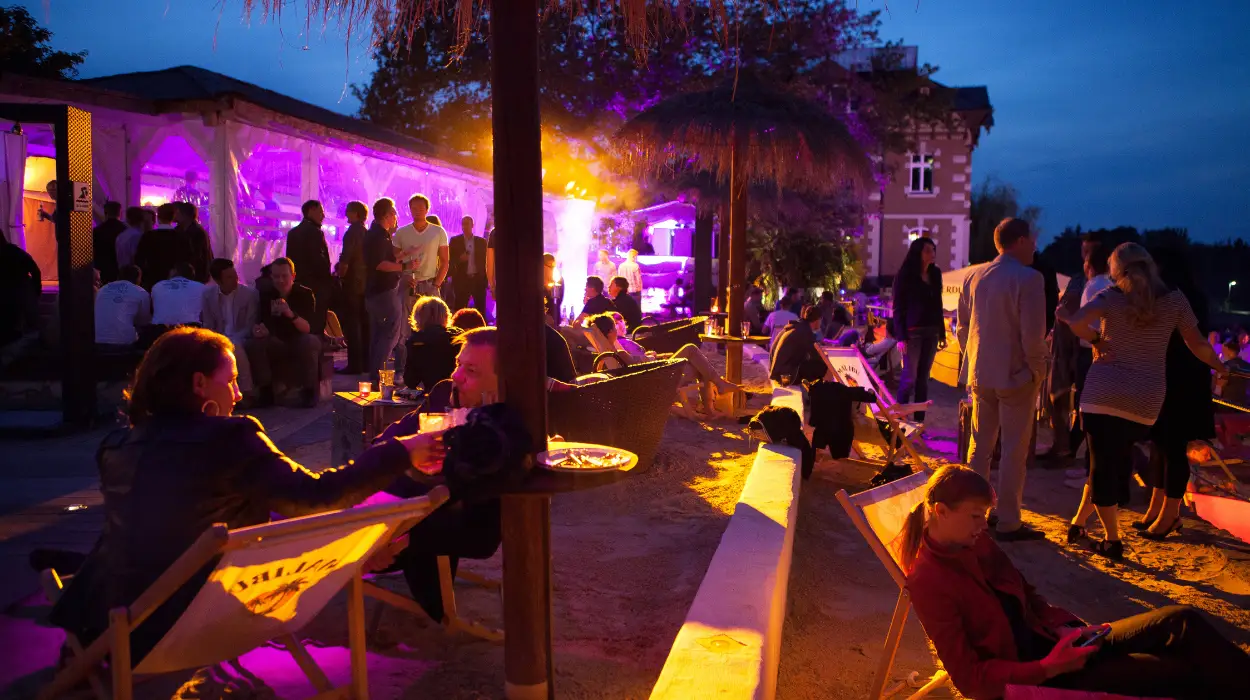
Event photography is the professional capture of people, activities, branding, venues, and key moments at an event for editorial use. It gives UK news publishers visual evidence that supports event stories and strengthens coverage across multiple publications.
Event photography turns an event into usable visual content for news websites. Photographers capture the moments that communicate what happened, who attended, and why the event matters.
For UK organisations seeking coverage, photographs serve a practical editorial function. A news story with relevant images gives publishers visual material alongside written information.
The strongest event photography focuses on identifiable people, meaningful activities, speakers, audience interaction, venue details, and branded elements. These images provide context without replacing the written story.
Organisations targeting coverage across 15 UK news sites need photography prepared for digital publishing. Images require suitable resolution, accurate captions, clear filenames, and appropriate usage rights.
For decision-makers comparing event coverage options,
Event photography strengthens coverage by improving the amount and quality of visual material available to publishers.
How does event photography support coverage across 15 UK news sites?
Event photography supports coverage across 15 UK news sites by supplying consistent, publication-ready images that complement press releases. A coordinated image set gives editors relevant visual assets while maintaining accurate event details, branding, captions, and usage information.
The process begins before the event. The organisation identifies priority moments, people, locations, and visual details. The photographer then builds a shot list around the editorial purpose of the event.
During the event, photography follows the programme. Important moments receive coverage at the correct time. Speakers, guests, demonstrations, awards, launches, networking sessions, and audience reactions provide different editorial images.
After the event, photographs are selected and prepared for distribution. The final collection focuses on images that communicate the event clearly and meet digital publishing requirements.
A multi-site news distribution service then uses the available assets as part of the broader coverage process. Each publication receives content suited to its editorial format and audience.
What does a typical 15-site coverage package contain?
A structured package contains several connected elements:
- Professional event photography
- A selection of high-resolution editorial images
- Captions identifying people and activities
- Press release or news copy
- Event facts and dates
- Organisation information
- Image usage permissions
- Distribution to 15 UK news sites
- Coverage reporting and published URLs where available
The exact publication mix depends on the selected distribution service and campaign requirements.
Which photographs are most valuable for news publication?
The most valuable photographs show identifiable people, significant event activity, speakers, audience engagement, branded settings, and key outcomes. These images give editors clear visual evidence while helping readers understand the event without relying entirely on written descriptions.
Speaker and presenter photographs
Speakers provide strong editorial subjects. Photographs show the person delivering the message and establish the event’s professional context.
A useful speaker image captures the individual during the presentation. The frame includes enough of the setting to establish where the activity occurred.
Audience engagement photographs
Audience images demonstrate participation. They show attendance, interaction, discussion, and response.
For example, a technology conference photograph showing attendees participating in a panel discussion communicates more information than an empty venue photograph.
Networking photographs
Networking images demonstrate professional interaction. They work well for business events, conferences, trade exhibitions, property launches, and corporate gatherings.
The strongest networking photographs identify participants where appropriate and show genuine interaction rather than staged group arrangements.
Branding and venue photographs
Branding establishes the identity of the event. Venue photographs establish location and scale.
Examples include a branded conference stage, event signage, exhibition stands, product displays, or a property development launch environment.
Key-moment photographs
Awards, announcements, demonstrations, launches, performances, and presentations create specific news moments.
These images connect directly with the event narrative. They also give editors photographs that match particular sections of the story.
How does professional event photography improve editorial readiness?
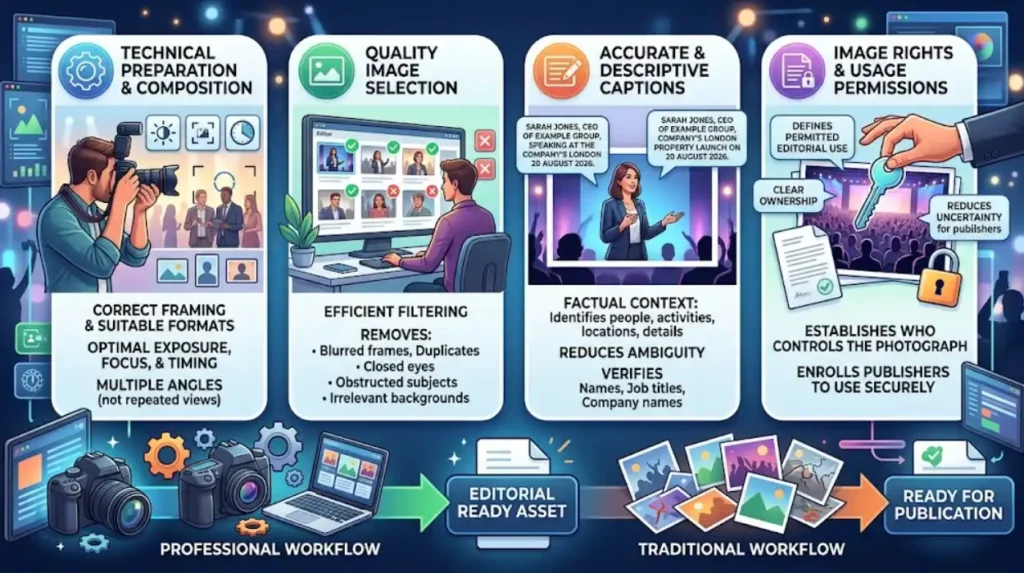
Professional event photography improves editorial readiness by giving publishers correctly framed, technically suitable, clearly identified images with relevant captions and usage permissions. Editors receive visual assets that require less preparation before publication across digital news platforms.
Editorial readiness matters because publishers work with production requirements. An image needs to display correctly on websites and match the accompanying story.
Professional photographers manage composition, exposure, focus, timing, and subject positioning. They also capture multiple formats rather than producing one repeated view of the same event.
Image selection then removes unsuitable photographs. Blurred frames, duplicate images, closed eyes, obstructed subjects, and irrelevant backgrounds are excluded.
Why do captions matter?
Captions provide factual context. They identify people, activities, locations, and event details.
A caption such as “Sarah Jones, CEO of Example Group, speaking at the company’s London property launch on 20 August 2026” gives an editor usable information.
Accurate captions also reduce ambiguity. Names, job titles, company names, and event details require verification before distribution.
Why do image rights matter?
Image rights establish who controls the photograph and where it can be used. A professional event photography service defines the permitted editorial use before distribution.
This information helps publishers use images without uncertainty about ownership or permissions.
What does event photography add to a UK press release?
Event photography adds visual evidence to a UK press release by showing the people, location, activity, and outcomes described in the written announcement. It transforms a text-only release into a more complete editorial asset for publishers.
A press release provides facts. Photography provides visual context.
The two formats work together. A property launch release describes the development, while photographs show the site, launch event, speakers, and attendees.
A charity event release explains the campaign. Photographs show volunteers, organisers, beneficiaries, fundraising activity, and event participation.
A corporate announcement explains the business development. Images show executives, employees, products, facilities, or the event itself.
This combination creates a more complete media package. Publishers receive both the information required for a story and the visual material required to present it effectively.
How can organisations prepare event photography for 15 UK news sites?
Organisations can prepare event photography by defining editorial priorities, briefing the photographer, confirming permissions, collecting accurate captions, selecting publication-ready images, and matching photographs with the final press release before distribution begins.
Preparation starts with an editorial brief. The brief identifies the event purpose and priority subjects.
The photography plan then follows the event schedule. This prevents important moments from being missed.
Organisations also prepare names and job titles before publication. This improves caption accuracy and reduces post-event administration.
What should the photography brief include?
A practical brief includes:
- Event name and date
- Venue and location
- Main speakers
- Key attendees
- Important activities
- Branding requirements
- Priority photographs
- Image usage permissions
- Required delivery format
- Distribution deadline
This information gives the photographer a defined editorial objective.
Which UK events benefit from photography-led news coverage?
Photography-led news coverage works across corporate events, conferences, charity events, property launches, business announcements, award ceremonies, exhibitions, product launches, healthcare events, and industry gatherings where visual activity supports the news story.
Corporate events
Corporate events benefit from photographs showing executives, employees, presentations, and company activity.
Property launches
Property launches require images of the development, launch venue, project representatives, and relevant guests. These photographs connect the announcement with a physical location.
Charity events
Charity events use photography to document participation, fundraising activity, organisers, volunteers, and campaign messages.
Conferences
Conference photography captures keynote speakers, panels, delegates, networking, exhibition areas, and sponsor branding.
Award ceremonies
Awards generate clear editorial moments. Winners receiving awards provide identifiable photographs that directly support event coverage.
How do organisations evaluate an event photography and news coverage service?
Organisations can evaluate an event photography and news coverage service by checking site distribution, photography quality, editorial preparation, image rights, turnaround times, reporting, publication evidence, and total campaign cost against defined coverage objectives.
A service comparison needs measurable criteria.
Does the service cover the required UK sites?
Check the distribution network. Confirm the number and type of UK publications included.
A package covering 15 sites requires clear information about the publications targeted and the distribution process used.
Does the service provide professional photography?
Review the photographer’s portfolio and event experience. Check whether the service includes image selection, editing, captions, and delivery.
Are usage rights clear?
Confirm the organisation’s rights to use the photographs across websites, social media, marketing materials, and future communications.
Is coverage reporting included?
A useful report identifies published coverage and provides relevant publication details. This information supports campaign evaluation.
Is the pricing aligned with the campaign?
Compare the total cost against included photography, distribution, editing, reporting, and additional services.
For organisations seeking a defined outcome, a:
news coverage service provides a decision framework based on distribution, visual assets, publication requirements, and reporting.
How does event photography affect the overall value of 15-site news coverage?
Event photography increases the practical value of 15-site news coverage by supplying publishers with visual material that supports the story, improves presentation, documents participation, and creates reusable assets for the organisation’s wider communications activity.
The value extends beyond the event date.
Published photographs provide evidence of participation and activity. Organisations also retain professional images for owned media channels, social media, newsletters, websites, investor communications, and future promotional materials.
A single event therefore produces multiple content assets.
The strongest campaigns connect photography with a clear news angle. The photographs reinforce the story instead of functioning as unrelated event pictures.
What should organisations do before booking event photography and news coverage?

Organisations should define the news angle, confirm the 15-site distribution requirement, establish photography priorities, verify image rights, prepare accurate event information, set delivery deadlines, and confirm reporting before booking the coverage service.
Start with the desired editorial outcome. Define the announcement, event significance, audience, and target publications.
Next, establish the photography requirements. Identify the people and moments that require coverage.
Then confirm the distribution package. Check the number of sites, publication types, turnaround, reporting, and included services.
Finally, confirm all commercial terms in writing. Clear deliverables prevent gaps between photography, content production, distribution, and reporting.
Explore More Expert Insights:
Affordable Nonprofit Event Coverage on 15 UK Sites 2026
Property Launch Coverage on 15 UK News Sites
For UK organisations using events as media opportunities, combining professional photography with structured distribution creates a complete coverage workflow. The photography documents the event. The news content explains its significance. The distribution places the story before relevant UK audiences.
When these elements operate together, event photography becomes a core part of the news coverage process rather than an additional event expense.



