

Nonprofit events earn news coverage when organisers present a clear public-interest story, provide useful information to journalists, and connect the event to a timely issue. Small budgets require focused outreach, strong news angles, local relevance, accurate media materials, and efficient timing.
What makes a nonprofit event newsworthy?
A nonprofit event becomes newsworthy when it contains a clear development, affects a defined community, involves credible people, and connects to a current issue. Journalists prioritise information with public relevance, measurable impact, strong local connections, and clear evidence.
Newsworthiness describes the qualities that make an event suitable for journalistic coverage. A charity fundraiser, community campaign, awareness event, volunteer programme, conference, or public initiative needs a specific story beyond the event itself.
Several factors create news value:
- Public impact: The event addresses a recognised community issue.
- Timeliness: The announcement relates to an upcoming event, current issue, or recent development.
- Local relevance: The event directly affects a town, city, county, or defined community.
- Human interest: Participants have relevant experiences connected to the event.
- Expertise: Organisers or speakers provide credible information about the topic.
- Measurable results: The organisation provides figures, targets, attendance records, fundraising totals, or community outcomes.
For example, a food bank fundraising walk involving 500 local participants has stronger local news value when organisers provide the fundraising target, the number of families supported, the event location, and a relevant spokesperson.
Why is the event itself not always enough?
An event date does not automatically create a news story. Journalists need a reason to publish information about it.
“Charity holds annual fundraising dinner” describes an activity. “Local charity launches £50,000 campaign to support 1,000 households facing food insecurity” communicates a specific development.
The second example contains a defined issue, financial target, audience, and measurable objective. These details provide stronger material for a news report.
How can a nonprofit create a strong news angle?
A strong nonprofit news angle identifies one specific development and explains its relevance to the public. Organisers can focus on fundraising targets, community impact, new programmes, notable speakers, research findings, milestones, partnerships, or urgent local issues.
The news angle is the central reason a journalist covers an event. It turns event information into a reportable development.
Organisers can identify the angle by asking five questions:
- What has changed?
- Who is affected?
- Why does it matter now?
- What evidence supports the claim?
- What makes the event relevant to the publication’s audience?
A nonprofit launching a youth employment programme has several potential angles. The strongest angle depends on the publication.
A local newspaper can focus on the number of young people supported in its area. A business publication can focus on employer participation. A community publication can focus on local skills development.
What types of nonprofit events attract media interest?
Different event types produce different news angles. Examples include:
- Charity fundraising campaigns
- Community festivals
- Awareness walks
- Volunteer initiatives
- Public lectures
- Charity auctions
- Social impact conferences
- Educational workshops
- Health awareness events
- Environmental campaigns
Each event requires a specific reason for coverage.
A charity auction becomes more newsworthy when it includes a significant fundraising target or notable donated item. A community festival gains stronger relevance when it involves a major local initiative, new community facility, or measurable social objective.
How can nonprofits use local relevance to earn coverage?
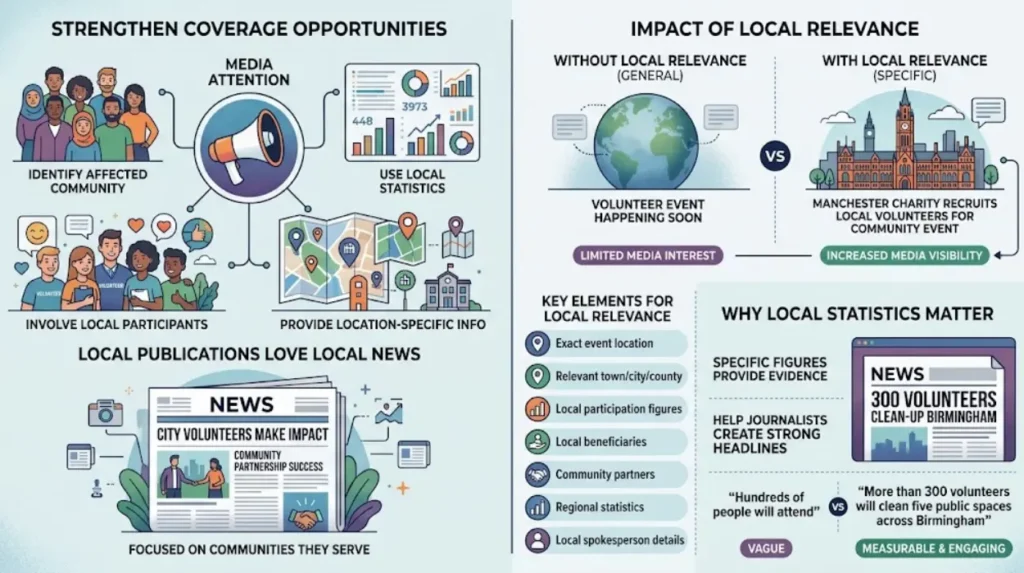
Local relevance gives nonprofit events a defined audience and a clear geographic connection. Organisers can strengthen coverage opportunities by identifying the affected community, using local statistics, involving local participants, and providing accurate location-specific information.
Local publications often organise coverage around communities they serve. A nonprofit does not need a national story to achieve useful media visibility.
A Manchester charity organising a volunteer event can focus on Manchester residents, local volunteers, community partners, and measurable outcomes in Greater Manchester. The same event becomes less relevant when its announcement contains only general statements about charitable activity.
Local relevance becomes stronger when the release includes:
- The exact event location
- The relevant town, city, or county
- Local participation figures
- Local beneficiaries
- Community partners
- Regional statistics
- Local spokesperson details
For example, a Birmingham charity hosting a 300-person community clean-up can provide the number of volunteers, streets covered, estimated waste collected, and local environmental objective.
Why do local statistics matter?
Specific figures provide evidence. They also give journalists concrete information for headlines, introductions, and supporting paragraphs.
“Hundreds of people will attend” provides limited information. “More than 300 volunteers will clean five public spaces across Birmingham” provides a measurable description.
Numbers also help distinguish an individual event from generic organisational promotion.
How can nonprofits prepare a media-ready event announcement?
A media-ready announcement gives journalists the essential facts in a clear format. It includes the news angle, event details, public-interest context, relevant figures, spokesperson information, quotations, images, contact details, and supporting background information.
A concise press release reduces the time required to understand the story.
The opening paragraph needs to explain the main development. The following paragraphs provide evidence and context.
Essential event information includes:
- What: The event or development
- Who: The nonprofit, participants, speakers, or beneficiaries
- When: Date and relevant times
- Where: Venue and location
- Why: Public or community significance
- How: Event activity and participation process
- Evidence: Relevant statistics or measurable outcomes
The announcement also needs a clear contact point. Journalists require a reliable person who can confirm information and respond to questions.
What should a nonprofit include in its press release?
A basic structure includes:
- A factual headline
- A concise opening paragraph
- Supporting event details
- Relevant statistics
- A quotation from an appropriate spokesperson
- Background information
- Event date, time, and location
- Media contact details
- Relevant website or registration information
The headline needs to communicate the development rather than simply describe the event.
“Charity Hosts Community Event in Leeds” identifies an activity. “Leeds Charity Launches £25,000 Campaign to Support Local Young Carers” identifies a development and its measurable objective.
How can nonprofits build media interest without a large budget?
Small nonprofit budgets work best when organisers prioritise targeted media outreach instead of broad, unfocused promotion. A defined publication list, relevant journalist contacts, strong materials, local angles, and accurate timing reduce unnecessary outreach costs.
Effective media outreach starts with relevance.
A nonprofit event in Edinburgh needs different media targets from an event in Bristol. A youth employment conference requires different publications from an environmental clean-up.
Organisers can categorise relevant media into:
- Local newspapers
- Regional publications
- Community news websites
- Sector publications
- Charity and nonprofit publications
- Business publications
- Specialist magazines
- Local radio and television outlets
The objective is not to contact every publication. The objective is to identify publications whose audiences have a clear connection to the story.
How does targeted outreach reduce costs?
Targeted outreach reduces wasted effort because each publication receives information relevant to its audience.
A charity running an environmental event can prioritise environmental publications and local outlets in the affected area. A nonprofit hosting a social care conference can focus on social care, community, healthcare, and regional media.
This approach also improves message relevance. A journalist receives a story that fits the publication rather than a generic announcement sent to unrelated outlets.
How important is timing for nonprofit event coverage?
Timing affects whether journalists can use an event announcement before the event occurs. Nonprofits need to distribute information early enough for editorial planning while retaining a clear news angle close to the event date.
Journalists work with publication schedules, deadlines, planned features, and breaking news. An announcement sent after an event has finished loses its advance-news value.
For planned events, organisers need to separate different coverage opportunities.
Before the event: Promote attendance, speakers, fundraising targets, community participation, and the event purpose.
During the event: Provide photographs, attendance figures, notable developments, and direct observations.
After the event: Report verified outcomes, fundraising totals, participation figures, and measurable results.
For example, a charity walk can generate a pre-event announcement about a £20,000 fundraising target and a post-event story about the final amount raised.
What happens when an event has multiple news angles?
An event can produce several distinct stories when each angle focuses on a different development.
A charity conference can generate coverage about a new research report, a community partnership, a fundraising milestone, and a new programme launch.
Each angle requires accurate supporting information. Repeating the same message across every stage reduces its news value.
How can nonprofits use people and data to strengthen coverage?
People and data provide evidence that makes nonprofit event stories more specific. Organisers can use credible spokespeople, participant experiences, attendance figures, fundraising totals, research findings, and measurable community outcomes to support the central news angle.
A spokesperson gives journalists an identifiable source. Data gives the story measurable context.
A nonprofit can identify suitable spokespeople such as:
- Chief executives
- Programme directors
- Campaign leaders
- Researchers
- Community representatives
- Event organisers
- Relevant subject specialists
Participant stories provide another form of evidence when they directly relate to the event’s purpose.
For example, an education charity can combine a programme director’s statement with the number of students supported and a participant’s experience. The combination creates a more complete news story.
Why are accurate figures important?
Accuracy is essential for credible reporting. Fundraising totals, participant numbers, dates, locations, and programme statistics need verification before distribution.
A nonprofit claiming that an event supports 1,000 people needs evidence for that figure. Unsupported claims weaken the reliability of the announcement.
What role do photographs and supporting materials play?
Good supporting materials help journalists understand and illustrate a nonprofit event. Organisers can prepare high-quality photographs, captions, logos, speaker information, event schedules, statistics, and background notes before contacting media outlets.
Visual material is particularly relevant for community events, fundraising activities, public campaigns, and events involving identifiable participants.
Photographs need useful captions. A caption can identify the people shown, their roles, the location, and the activity taking place.
Supporting material also needs consistent factual information. The event date, location, speaker names, organisational name, and statistics need to match across the press release and supporting documents.
What benefits can small-budget nonprofit news coverage provide?
News coverage can increase public awareness, communicate community impact, support event attendance, strengthen credibility, and create searchable records of nonprofit activity. The value increases when coverage reaches audiences directly connected to the organisation’s mission.
Media coverage provides information beyond an organisation’s own channels. A published article gives audiences an independent editorial context for the event.
Potential benefits include:
- Increased awareness
- Greater event visibility
- More public engagement
- Stronger community recognition
- Additional fundraising exposure
- Increased stakeholder awareness
- Search visibility for the organisation and event
Coverage also creates a permanent digital reference when an article remains accessible online.
For nonprofits operating with limited budgets, focused media activity provides a structured way to communicate specific developments without relying entirely on paid advertising.
How can nonprofits turn one event into several news opportunities?
One nonprofit event can generate several legitimate stories when organisers identify separate developments before, during, and after the event. Each story needs a distinct angle, verified information, relevant evidence, and a clear reason for publication.
A single event can follow a simple coverage sequence.
Before the event, the organisation announces the initiative. During the event, journalists receive timely updates and visual material. After the event, the organisation reports verified results.
For example, a £30,000 charity campaign can produce:
- A launch announcement explaining the campaign.
- A local participation story before the event.
- An event-day update featuring attendance.
- A post-event report showing the final fundraising total.
- A follow-up story about how the funds will support beneficiaries.
This approach keeps each announcement connected to a real development.
Nonprofits seeking to understand the practical process can explore:
Nonprofit Events. Organisations comparing broader media distribution approaches can explore:
What is the simplest process for earning nonprofit event coverage on a small budget?
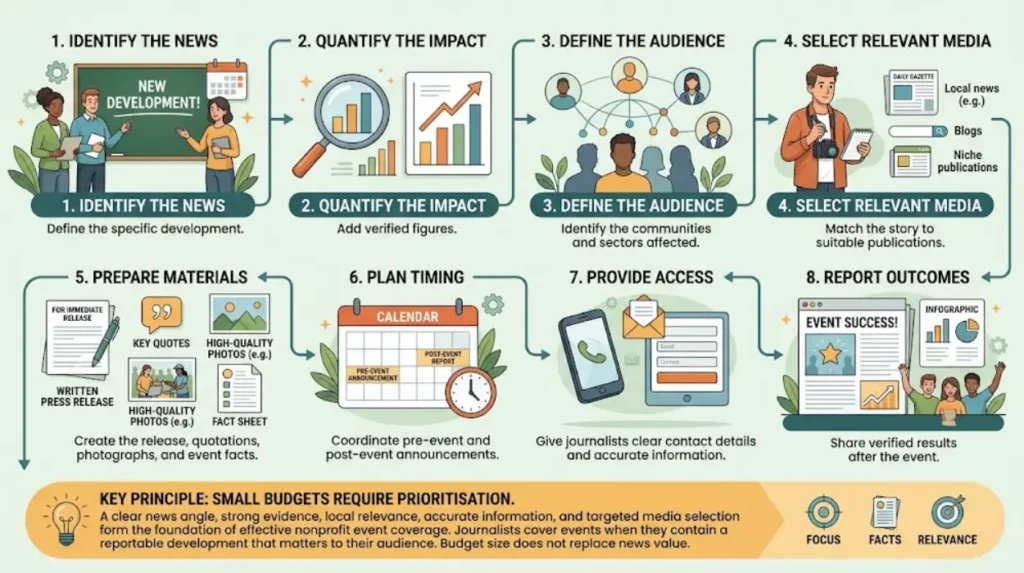
The process starts with identifying a newsworthy development, defining the target audience, preparing accurate media materials, selecting relevant publications, contacting journalists at suitable times, and providing verified updates before and after the event.
A practical sequence is:
- Identify the news: Define the specific development.
- Quantify the impact: Add verified figures.
- Define the audience: Identify the communities and sectors affected.
- Select relevant media: Match the story to suitable publications.
- Prepare materials: Create the release, quotations, photographs, and event facts.
- Plan timing: Coordinate pre-event and post-event announcements.
- Provide access: Give journalists clear contact details and accurate information.
- Report outcomes: Share verified results after the event.
Explore More Expert Insights:
Why Property Launches Need News Coverage in 2026
How Award Winners Become Stories on 15 News Sites
Small budgets require prioritisation. A clear news angle, strong evidence, local relevance, accurate information, and targeted media selection form the foundation of effective nonprofit event coverage.
The central principle remains factual: journalists cover nonprofit events when the event contains a reportable development that matters to their audience. Budget size does not replace news value. Strong preparation helps organisations present that news value clearly and efficiently.



