

Property launch coverage is the process of turning a new residential, commercial, mixed-use, or regeneration development into a structured news story for relevant UK audiences. Effective coverage connects property announcements with real estate readers through editorial distribution, search visibility, regional relevance, and timely publication.
For developers, agents, investors, architects, construction firms, and property professionals, coverage provides a route from launch announcement to wider market awareness. The process involves identifying the news value, preparing a media-ready release, selecting relevant publications, distributing the story, and monitoring resulting coverage.
Understanding how this process works helps property businesses evaluate different approaches to UK property PR and media distribution. It also clarifies how a launch announcement reaches audiences beyond an organisation’s existing website, email database, or social media channels.
How does property launch coverage reach UK real estate readers?
Property launch coverage reaches UK real estate readers through targeted news distribution, relevant property publications, regional media, search engines, and industry channels that publish launch information where developers, investors, agents, and property professionals actively seek news.
A property launch begins with a defined news event. This includes the announcement of a new development, planning approval, construction start, sales launch, completion milestone, investment deal, or regeneration project.
The announcement is then structured around facts that matter to the property market. These facts include development size, location, property type, investment value, construction timeline, sustainability features, housing numbers, commercial space, and organisations involved.
The finished story enters media distribution channels. Relevant publications receive the information and determine whether it fits their editorial requirements. Published coverage then becomes accessible through publication websites, Google search results, news discovery systems, social platforms, and professional networks.
This process differs from publishing an announcement solely on a corporate website. A company website reaches people already looking for the organisation. News coverage introduces the development to audiences following property, investment, construction, housing, planning, and regional business news.
Readers interested in the wider educational context can explore:
Property launch coverage to understand why news visibility forms part of a broader launch strategy.
What information makes a property launch newsworthy?
A property launch becomes newsworthy when its announcement contains specific facts about location, scale, investment, housing, commercial activity, planning, construction, sustainability, or economic impact that give UK property audiences a clear reason to follow the story.
Location
Location establishes immediate relevance. A London residential development targets a different readership from a regeneration project in Manchester or a logistics scheme in Birmingham.
Specific geographic information improves editorial clarity. A release can identify the borough, town, city, neighbourhood, or wider region involved.
Development scale
Scale gives readers measurable information. Useful details include:
- Number of residential units
- Commercial floor space
- Site acreage
- Investment value
- Number of buildings
- Construction phases
- Expected completion date
For example, stating that a development contains 240 homes across three buildings provides stronger news information than describing it as a large residential project.
Market relevance
Property audiences follow developments connected to market activity. Examples include build-to-rent schemes, affordable housing projects, office developments, retail destinations, logistics parks, student accommodation, and mixed-use regeneration.
Economic and community impact
Employment figures, new homes, infrastructure investment, public facilities, and local regeneration provide additional context. These details help readers understand why a development matters beyond the developer itself.
How is a property launch prepared for media distribution?

A property launch is prepared for media distribution by converting project information into a factual news release, establishing the announcement date, identifying relevant audiences, adding supporting assets, checking claims, and creating a publication-ready story for selected UK media outlets.
The preparation stage determines how clearly the development communicates its news value.
Define the announcement
The first step identifies the actual event. A property company launching a new development needs a clear announcement rather than a general description of its business.
Examples include:
- New residential scheme launched
- Planning permission secured
- Construction begins
- Development reaches completion
- New investment secured
- Sales phase opens
- Regeneration partnership announced
Build the factual structure
A strong property release answers the essential questions early. These include who is involved, what has happened, where it happened, when it happened, why it matters, and how large the project is.
The opening paragraph establishes the main event. Supporting paragraphs then provide project details, quotes, background information, and relevant figures.
Prepare supporting assets
Images increase the usefulness of property coverage. Suitable assets include architectural renders, completed development photography, construction images, site photographs, maps, and professional headshots.
Image captions also provide useful context. They identify the development, location, organisations, and relevant project stages.
Which UK media channels carry property launch coverage?
UK property launch coverage reaches audiences through national news publications, regional newspapers, property trade media, construction publications, business websites, specialist real estate platforms, and digital news channels serving defined professional and geographic audiences.
Different media categories reach different segments of the property market.
National news publications
National publications provide broad exposure across the UK. Their audiences include investors, business professionals, homeowners, policymakers, and general readers interested in major property developments.
National coverage becomes particularly relevant for projects involving substantial investment, large housing numbers, major regeneration, prominent locations, or significant corporate activity.
Regional media
Regional publications provide location-specific reach. A development in Leeds, for example, has stronger geographic relevance to Yorkshire media than to publications covering unrelated regions.
Regional coverage helps connect property announcements with local audiences, businesses, residents, and professional communities.
Property trade publications
Trade publications serve specialist audiences. Examples include developers, estate agents, surveyors, architects, investors, planners, contractors, and property consultants.
These publications focus on industry information rather than general consumer news. A commercial development, planning decision, investment transaction, or construction milestone therefore fits naturally within their subject areas.
Construction and business media
Construction publications focus on development activity, contractors, infrastructure, project delivery, and building activity. Business publications focus more heavily on investment, corporate activity, employment, and economic significance.
Selecting media according to the story improves audience relevance.
How does regional targeting affect property launch coverage?
Regional targeting connects property launches with readers in the locations where developments operate, improving relevance for local property markets, regional businesses, investors, residents, councils, construction professionals, and organisations following economic activity.
A UK property announcement often has a strong geographic dimension.
A new housing development in Bristol concerns Bristol’s property market. A regeneration project in Liverpool concerns Liverpool’s business and development environment. A commercial scheme in Glasgow connects with Scotland’s property and investment audience.
Regional targeting therefore starts with the development’s physical location.
City-level relevance
City-specific publications provide direct geographic relevance. They cover local planning decisions, development projects, construction activity, housing supply, investment, and commercial property.
Regional economic context
Property developments influence local economies through construction employment, business activity, housing supply, infrastructure, and investment.
Including measurable local information gives journalists and readers useful context.
Local search visibility
Regional stories also support discovery through searches containing geographic terms. Searchers frequently combine property topics with locations, such as “new homes in Manchester”, “commercial property Birmingham”, or “property development Leeds”.
A clear location within the headline, introduction, and supporting content improves topical clarity.
How does SEO extend the reach of property launch coverage?
SEO extends property launch coverage by making published stories discoverable through relevant search queries, location-based searches, property terminology, organisation names, development names, and project information that readers use when researching UK real estate.
Search visibility adds another route between publication and reader.
A property launch story can appear for searches connected with the development, developer, location, project type, investment, or planning activity. This creates opportunities for readers to discover the announcement after its initial publication date.
Entity clarity
Search systems interpret entities through identifiable information. A release therefore benefits from clear references to:
- Development name
- Developer
- Location
- Project partners
- Property type
- Development size
- Investment value
- Completion date
For example, “240-home build-to-rent development in Birmingham” communicates a specific property entity and project category.
Search-focused terminology
Relevant terminology helps establish the subject of the article. Terms such as residential development, commercial property, regeneration, build-to-rent, planning permission, real estate investment, housing development, and construction project create clear topical relationships.
Keyword repetition is not the objective. Consistent subject terminology is more useful.
What role does timing play in property launch coverage?
Timing determines when property launch information enters the news cycle, allowing announcements to align with launch dates, planning milestones, investment announcements, construction stages, sales activity, and other events that create immediate relevance for UK real estate readers.
A launch announcement requires a defined publication window.
Publishing too early can separate coverage from the actual announcement. Publishing too late reduces the connection between the story and the event.
Launch timing
Developers often coordinate media activity with a sales launch, planning decision, construction milestone, or public announcement.
The release schedule needs to reflect the confirmed announcement date.
News-cycle timing
Property news competes with other business, economic, political, and construction stories. A clearly defined announcement with accurate information gives media teams a stronger basis for distribution.
Embargoed announcements
An embargo sets a specific date and time before which journalists do not publish the information. This approach coordinates simultaneous announcements across participating publications.
What benefits does multi-publication property coverage provide?
Multi-publication property coverage expands audience reach by placing one verified development announcement across multiple relevant media environments, creating exposure among national, regional, property, construction, investment, and business audiences.
A single publication reaches one defined audience. A multi-publication approach creates broader distribution across different readership groups.
For example, a residential development can have relevance to a regional newspaper, a property trade publication, a construction website, and a business news platform. Each channel reaches readers with a different relationship to the project.
Audience diversification
Investors seek financial and development information. Agents follow market activity. Construction professionals monitor projects. Local readers follow developments in their communities.
Different media environments therefore provide different forms of audience exposure.
Repeated discovery
Readers do not consume news through one channel. A development can appear through a publication website, search results, professional sharing, and industry discussions.
Multiple credible publication references increase the number of routes through which the announcement is discovered.
Readers assessing implementation options can also explore:
Property launch coverage on UK news sites for a more specific view of multi-publication distribution.
Which property launches benefit most from targeted media coverage?
Targeted media coverage suits property launches with clear news events, measurable project details, identifiable audiences, strong geographic relevance, significant investment, development milestones, or market information that supports a factual and timely news story.
Residential developments
Housing launches provide clear information through unit numbers, location, tenure, pricing, amenities, construction stages, and completion dates.
Commercial developments
Office, retail, industrial, and logistics projects connect with business and property audiences through floor space, investment, occupiers, employment, and economic activity.
Regeneration projects
Regeneration schemes involve multiple stakeholders and often have strong regional relevance. Coverage can explain project scale, infrastructure, public benefits, investment, and development phases.
Investment announcements
Property investment stories focus on transaction value, investors, assets, locations, strategic objectives, and market significance.
The common factor is a defined news event supported by verifiable project information.
How can property businesses evaluate their coverage approach?
Property businesses can evaluate coverage approaches by comparing audience relevance, publication quality, geographic targeting, industry reach, search visibility, publication timing, content requirements, reporting, and distribution scope against the objectives of each property launch.
A useful evaluation framework focuses on measurable criteria.
| Evaluation area | Key question |
|---|---|
| Audience | Does the publication reach relevant property readers? |
| Geography | Does coverage reach the development’s target region? |
| Industry | Does the outlet serve real estate or related professionals? |
| Timing | Does publication align with the announcement? |
| Content | Does the release communicate verified project facts? |
| Search | Is the published story discoverable through relevant searches? |
| Distribution | How many relevant media environments receive the story? |
| Reporting | Can published coverage be identified and reviewed? |
This framework separates media volume from audience relevance. Ten unrelated publications do not provide the same value as targeted coverage across publications serving the correct property, business, construction, investment, and regional audiences.
What is the overall process for reaching UK real estate readers?
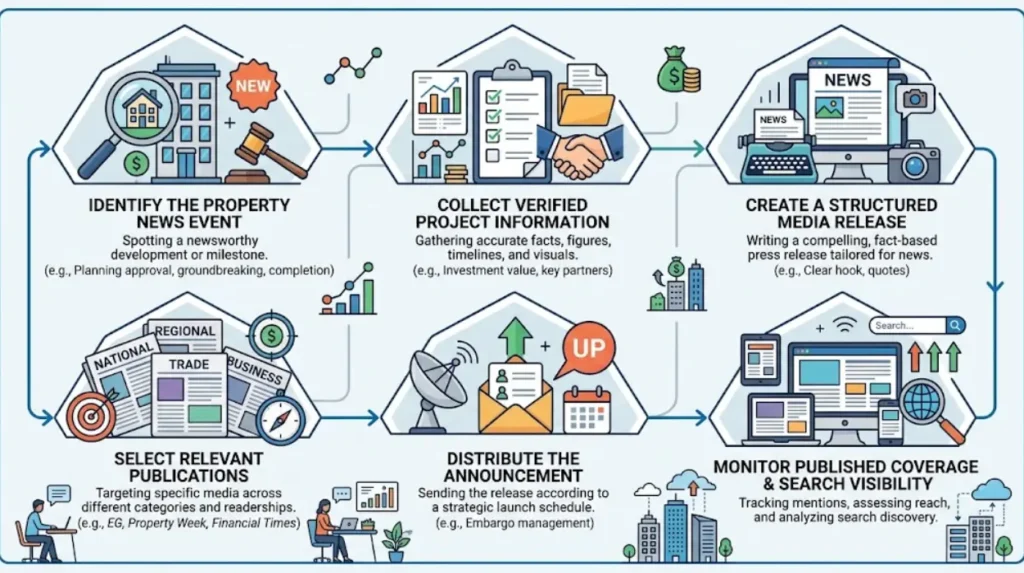
The process begins with a newsworthy property event, continues through factual release preparation and targeted media selection, and ends with publication, search discovery, audience exposure, and coverage monitoring across relevant UK real estate news environments.
The process can be summarised in six stages:
- Identify the property news event.
- Collect verified project information.
- Create a structured media release.
- Select relevant national, regional, trade, and business publications.
- Distribute the announcement according to its launch schedule.
- Monitor published coverage and search visibility.
Property launch coverage therefore operates as a structured media process rather than a single publishing action. Its effectiveness depends on the relationship between the development, the news value, the selected audiences, the publication channels, and the timing of distribution.
Explore More Expert Insights:
How Award Winners Get Covered Across 15 UK News Sites
How Embargoes Time Event Coverage Across 15 News Sites
For UK property businesses, this structure provides a practical way to assess how a launch announcement moves from internal project information to publicly discoverable real estate news.



