

Winning an award creates a strong media opportunity, but recognition alone does not guarantee news coverage. Awards coverage across 15 UK news sites today requires timely distribution, a newsworthy announcement, accurate award details, relevant media targeting, and content structured for both journalists and search engines.
For businesses, founders, professionals, charities, and organisations, award coverage provides more than visibility. A coordinated campaign creates multiple publication placements that document the achievement across national, regional, business, and specialist UK media.
This decision-stage approach builds on the principles explained in:
Award winners covered across UK news sites. The next step is selecting a distribution process that delivers measurable publication reach.
What does awards coverage across 15 UK news sites mean?
Awards coverage across 15 UK news sites means distributing one award announcement through a targeted media campaign that secures publication opportunities across 15 relevant UK news websites, creating measurable visibility and searchable coverage for the winner.
The 15-site model focuses on coordinated distribution rather than publishing the same announcement without targeting. Each publication represents an additional media touchpoint.
A campaign can target different publication categories. Examples include UK business news, regional news, entrepreneurship publications, professional trade media, and industry-specific websites.
The award announcement remains the central source story. The distribution strategy determines where that story appears and how audiences discover it.
For example, a London technology company winning a national innovation award can position the announcement around the company achievement, award category, business location, and industry relevance.
How does an award announcement become coverage on 15 UK news sites?
An award announcement becomes coverage across 15 UK news sites through editorial preparation, media targeting, distribution, publication monitoring, and verification, with each stage designed to connect the award story with relevant UK publications and their intended audiences.
1. Prepare the award story
The announcement needs a clear news angle. The award name alone does not provide the complete story.
A strong release identifies:
- Award winner
- Award category
- Award organisation
- Achievement being recognised
- Winner’s location
- Industry
- Business significance
- Supporting statistics
- Relevant spokesperson quote
- Website or contact information
2. Build the media target
The distribution list identifies suitable UK news websites. A campaign targeting 15 sites needs deliberate publication selection.
For example, a construction company receiving a sustainability award can target construction publications, business media, regional outlets, and sustainability-focused news sites.
3. Distribute the announcement
The completed release enters the distribution process. Timing matters because award announcements compete with other news stories, corporate announcements, and industry developments.
4. Monitor publication results
Coverage monitoring confirms which websites published the announcement. It also identifies publication URLs, headlines, dates, and other measurable details.
5. Verify the final coverage
A completed campaign report separates confirmed publication coverage from distribution activity. This distinction provides a clearer view of actual media results.
What should an award-winning business include in its UK media release?
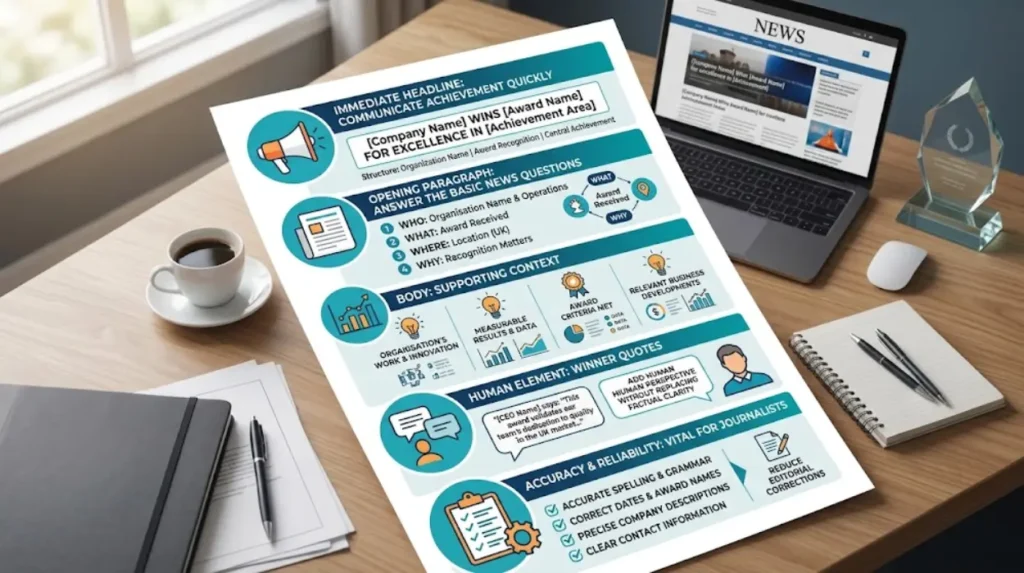
An award-winning business needs a factual headline, award details, winner information, evidence of achievement, location, industry context, quotations, supporting facts, and relevant links so journalists and publishers can understand the announcement quickly.
The headline needs to communicate the achievement immediately.
A useful structure includes the organisation name, award recognition, and central achievement.
The opening paragraph answers the basic news questions: who won, what award was received, where the organisation operates, and why the recognition matters.
The body provides supporting context. This includes the organisation’s work, measurable results, award criteria, and relevant business developments.
Quotes add a human element while preserving factual clarity. A quote from the winner explains the significance of the recognition without replacing the core news information.
The release also needs accurate spelling, dates, award names, company descriptions, and contact information. Accuracy supports publication quality and reduces editorial corrections.
Why does coverage across 15 UK news sites matter for award winners?
Coverage across 15 UK news sites creates multiple digital media references to the same achievement, increasing the number of places where customers, partners, journalists, employees, and search engines encounter the award winner and its associated news story.
A single publication creates one media reference. Fifteen publications create a broader digital footprint.
The value comes from distribution across relevant audiences. A regional publication reaches a local audience. A business publication reaches commercial readers. A trade publication reaches professionals within a specific sector.
The campaign also creates a record of the achievement. Businesses can use verified coverage in media pages, award announcements, investor communications, company updates, and sales materials where appropriate.
Coverage also supports search visibility
Published award stories create indexed pages containing the organisation name, award, executives, location, industry, and related entities.
This creates additional searchable references to the organisation.
For example, someone searching for a company’s award recognition can encounter the original company announcement alongside independent publication pages covering the same achievement.
How can you choose the right 15 UK news sites for awards coverage?
The right 15 UK news sites match the award winner’s industry, location, audience, authority, and story relevance, rather than relying only on publication volume or general website popularity when selecting media targets.
Media selection needs to reflect the story.
A national award for a Manchester fintech company requires different targeting from a regional hospitality award in Edinburgh.
Relevant selection factors include:
- Geographic relevance
- Industry relevance
- Business audience
- Publication category
- Editorial fit
- Search visibility
- Existing coverage patterns
- Audience relevance
A campaign also benefits from category diversity when the announcement supports multiple audiences.
For example, a healthcare award can connect with healthcare trade media, regional publications, business news websites, and professional publications.
The objective remains relevance. Fifteen suitable publications provide stronger contextual alignment than a larger list of unrelated websites.
What results can businesses expect from a 15-site awards coverage campaign?
A 15-site awards coverage campaign delivers a measurable set of publication outcomes, including confirmed URLs, publication dates, headlines, media references, audience opportunities, and searchable content associated with the award-winning organisation.
Results need to be measured through published coverage rather than distribution volume alone.
A campaign report can track:
- Number of confirmed publications
- Publication names
- Coverage URLs
- Publication dates
- Article headlines
- Award-related keywords
- Geographic coverage
- Industry publication coverage
- Search visibility opportunities
- Coverage status
This information gives businesses a practical record of campaign performance.
It also makes future PR planning more precise. Teams can identify which publication categories generated coverage and use those findings when planning subsequent announcements.
How does awards coverage support SEO and AI search visibility?
Awards coverage supports SEO and AI search visibility by creating additional authoritative references containing consistent information about an organisation, its award, its industry, its location, and its achievements across multiple indexed UK publication environments.
Search engines process information across many digital sources. Consistent organisation names, award details, locations, and industry references strengthen entity understanding.
AI-powered search systems also rely on publicly available information when identifying organisations and summarising their achievements.
A distributed award announcement gives these systems more publicly accessible sources containing the same core facts.
The content still needs accuracy. Duplicate information without editorial relevance does not replace strong news value.
The strongest approach combines a clear award story with relevant publication targeting, factual consistency, and structured information.
When is the best time to distribute an award announcement?
The best time to distribute an award announcement is immediately after the recognition becomes publicly shareable, with release timing coordinated around embargoes, award schedules, business activity, and UK media publishing patterns.
Timing determines how quickly the story enters the news cycle.
If an award organisation imposes an embargo, the announcement needs to respect the stated publication time.
For same-day recognition, preparation before the ceremony helps reduce delays. The release, quotes, images, company information, and distribution list can be prepared in advance.
A timely announcement also gives publishers a clear reason to cover the achievement while the award remains current.
For businesses seeking coverage today, preparation and distribution readiness become operational priorities.
How can a business secure awards coverage across 15 UK news sites today?
A business can pursue same-day awards coverage by preparing a publication-ready release, confirming award facts, selecting 15 relevant UK media targets, coordinating distribution, monitoring live placements, and reviewing verified coverage as publications update their websites.
A practical same-day workflow starts with the announcement.
Step 1: Confirm the award
Verify the award title, category, awarding organisation, winner name, date, and publication permissions.
Step 2: Finalise the release
Keep the story factual and focused. Add a strong headline, concise introduction, supporting evidence, and an authorised quotation.
Step 3: Select 15 UK publications
Prioritise media relevance based on sector, location, audience, and editorial fit.
Step 4: Distribute the release
Use a professional PR distribution service with UK media targeting capabilities.
Step 5: Monitor live coverage
Track publication activity and identify confirmed article URLs.
Step 6: Review the campaign
Compare the planned 15-site target with confirmed coverage. Record publication details for internal reporting and future PR campaigns.
What should businesses look for in an awards coverage service?
Businesses choosing an awards coverage service need clear UK publication targeting, transparent distribution processes, verified coverage reporting, relevant media selection, responsive campaign management, and defined deliverables that distinguish distribution from confirmed publication results.
The service needs to explain exactly what the campaign includes.
Important questions include:
- Which UK publications are targeted?
- Is the 15-site target defined in advance?
- How is publication coverage verified?
- Are coverage URLs included in the report?
- How quickly are results reported?
- Does the service support award announcements?
- Can the campaign target regional and industry publications?
- How are editorial requirements handled?
For decision-makers, measurable deliverables provide stronger accountability than broad claims about media reach.
A provider offering a defined 15-site awards coverage campaign also gives the business a clear benchmark for evaluating performance.
Is 15-site awards coverage suitable for every UK award announcement?
A 15-site campaign is suitable when an award has genuine news value, the winner has a relevant audience, and the announcement contains sufficient factual information for media publication across appropriate UK publication categories and geographic markets.
Not every award story requires identical distribution.
A national industry award has broader media relevance than an internal company recognition.
The award’s credibility also matters. The announcement needs a clear awarding body, defined category, and verifiable achievement.
Examples include:
- National business awards
- Industry awards
- Innovation awards
- Sustainability awards
- Technology awards
- Healthcare awards
- Construction awards
- Entrepreneurship awards
- Regional business awards
The strongest campaigns match distribution scale with the importance and relevance of the award.
How can you turn today’s award win into long-term media value?
Businesses turn an award win into long-term media value by securing verified coverage, preserving publication links, repurposing factual achievements across owned channels, updating company profiles, and using the coverage record to support future communications and credibility.
The award announcement becomes a permanent business asset when coverage is documented correctly.
Published articles can support a company’s media coverage page and corporate communications. Award details can also appear in relevant company profiles, executive biographies, case studies, and future announcements.
The campaign creates a chronological record of external recognition.
For businesses planning further PR activity, the results also provide evidence about which UK media categories respond to their stories.
Award coverage service provides a natural next step for organisations evaluating a specific distribution solution.
Why choose Time Intelligence Media Group for awards coverage across 15 UK news sites?
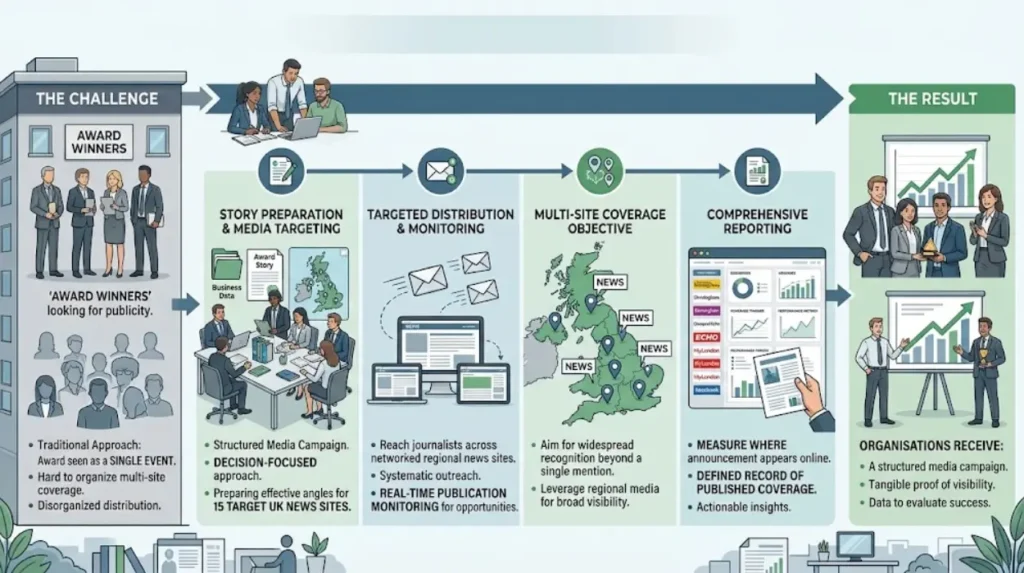
Time Intelligence Media Group provides a decision-focused approach to UK awards coverage by combining targeted distribution, publication monitoring, multi-site coverage objectives, and reporting designed to help organisations measure where their award announcement appears online.
The service approach focuses on turning an award announcement into a structured media campaign.
For a business seeking 15 UK publication opportunities, the process starts with story preparation and media targeting. The campaign then moves through distribution and coverage monitoring.
The final reporting stage provides a record of published coverage and relevant publication information.
This structure gives organisations a defined workflow instead of treating award recognition as a single publicity event.
What is the next step after winning a UK award?
The next step is to confirm the award announcement, prepare a publication-ready release, identify 15 relevant UK news targets, select a distribution service, and begin coverage monitoring immediately after the award becomes publicly announceable.
Award recognition creates the news event. Strategic distribution determines its digital reach.
A 15-site campaign gives businesses a defined media target, measurable publication outcomes, and multiple opportunities to place the award achievement in front of relevant UK audiences.
Explore More Expert Insights:
Get a Free Event Coverage Audit From Times Intelligence
International Event Coverage on 15 UK News Sites
For organisations ready to act today, the priority is straightforward: confirm the award facts, prepare the story, select relevant UK publications, distribute through a suitable media service, and verify every resulting placement.
This process turns an award announcement into a documented UK media coverage campaign with measurable outputs and lasting search visibility.



