A full event coverage package combines event reporting, editorial content, media distribution, publication placement, digital assets, and performance reporting across 15 UK news sites to create structured visibility for one event.
Event coverage is a media service that turns an event into publishable news content. The package starts with information about the event and ends with published articles across multiple relevant websites.
A complete package contains several connected stages. These include event information collection, content preparation, editorial review, publication, distribution, and reporting.
For example, a technology conference can generate coverage focused on keynote announcements, product launches, executive interviews, industry developments, and event outcomes.
The 15-site model creates broader digital distribution than publishing one article on one website. It also gives brands a structured way to measure where coverage appears and how audiences interact with it.
Organisations assessing their options often begin with the fundamentals explained in:
What does the event coverage process include?
The event coverage process moves from event briefing to content production, editorial preparation, publication across 15 sites, URL collection, and performance reporting, creating a defined workflow for converting event information into measurable UK media coverage.
1. Event briefing
The process begins with an event brief. The brief establishes the information required for accurate reporting.
Typical inputs include:
- Event name and location
- Event date and schedule
- Organiser information
- Speakers and exhibitors
- Key announcements
- Product or service launches
- Relevant statistics
- Quotes
- Photography
- Official website details
A detailed brief reduces factual gaps during content production.
2. Content preparation
The supplied information is organised into a news-focused article. The content structure prioritises the event’s strongest news points.
For example, a fintech event can focus on a new payment platform, a regulatory announcement, or a major partnership announced during the programme.
3. Editorial preparation
The article is checked for clarity, factual accuracy, structure, grammar, and publication suitability. Editorial preparation separates event information from promotional copy and gives the story a clearer news format.
4. Distribution and publication
The approved article moves into the media distribution stage. The coverage is published across the selected network of 15 UK sites according to the package specification.
5. Reporting
Publication records are collected after distribution. A professional report identifies the published URLs and relevant coverage details.
What content does a 15-site event coverage package contain?
A 15-site event coverage package normally contains a central news article, event-specific information, editorially structured messaging, supporting media assets, publication links, and reporting data that documents the resulting coverage.
The central article is the main content asset. It presents the event as a news story rather than as a simple promotional announcement.
Supporting information gives the article factual depth. This includes speaker names, event themes, announcements, business developments, dates, locations, and relevant organisational information.
News article
The article provides the core narrative. Its headline identifies the primary news angle. The introduction establishes what happened, where it happened, and why it matters.
Event details
Accurate event details provide context. A London business conference, for example, requires clear information about its location, programme, organisers, speakers, and business purpose.
Quotes and statements
Quotes provide attributable information from executives, speakers, organisers, or participating companies. A direct statement from a chief executive can establish the organisation’s position on a product launch or industry announcement.
Digital assets
Photography and other approved assets support the story where the publication format permits them. Suitable assets include event photographs, speaker images, company logos, product images, and approved graphics.
Publication records
The final package includes the URLs or publication records associated with the distributed coverage. These records provide evidence of where the content appeared.
How are 15 UK news sites used within the package?
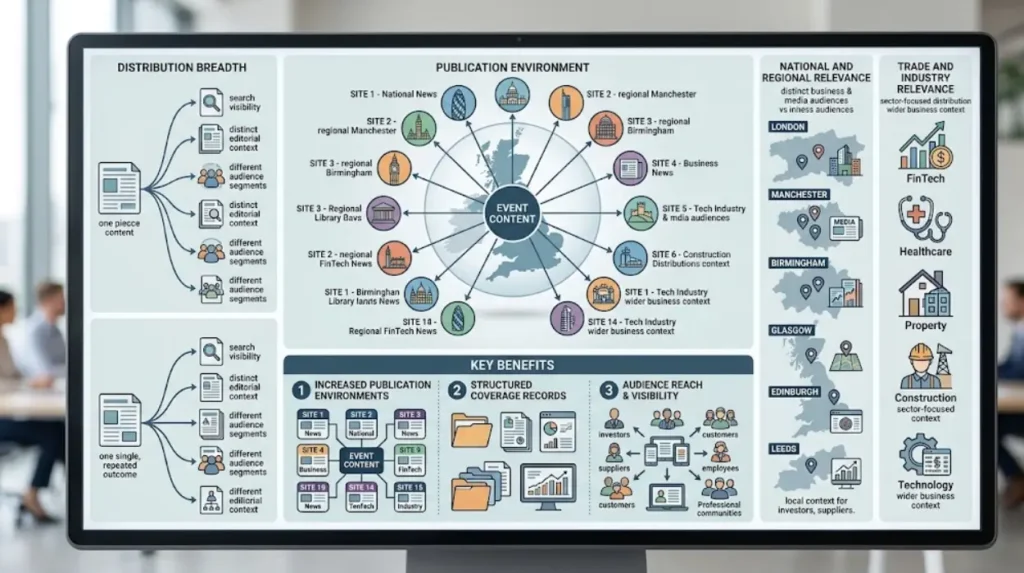
The 15-site model distributes event content across multiple UK news destinations, increasing the number of publication environments associated with the event while creating a structured set of coverage records for marketing, communications, and reporting teams.
Each website represents a separate publication environment. The sites can provide different audiences, geographic relevance, editorial contexts, and search visibility.
The value of a multi-site package comes from distribution breadth rather than simply repeating the same publication outcome.
For example, a Manchester technology exhibition can receive coverage that reaches audiences beyond the physical venue. A Birmingham construction conference can also receive digital visibility outside the local event audience.
National and regional relevance
UK event coverage benefits from geographic context. London, Manchester, Birmingham, Glasgow, Edinburgh, Leeds, and other locations have distinct business and media audiences.
Regional relevance becomes particularly important for events targeting local investors, suppliers, customers, employers, or professional communities.
Trade and industry relevance
Some events serve specific professional sectors. Examples include fintech conferences, healthcare exhibitions, property forums, construction events, and technology expos.
Sector-focused distribution helps connect event stories with the wider business context surrounding the event.
What makes a multi-site event coverage package different from one publication?
A multi-site package creates a wider publication footprint than a single placement by distributing one event story across 15 separate websites, producing multiple publication records and broader digital exposure for the same underlying event.
A single publication gives an event one digital destination. A 15-site package creates a larger set of destinations.
The distinction also affects reporting. A single placement produces one URL and one publication record. Fifteen placements produce a broader coverage dataset.
This structure supports communication teams that need documented media activity following an event.
It also creates reusable coverage assets. Teams can reference published articles in post-event communications, stakeholder updates, social media activity, sales materials, and internal reports.
How does event coverage support SEO and AI search visibility?
Event coverage supports digital visibility by creating published news content around named organisations, events, speakers, locations, products, and announcements, giving search systems structured textual context about the entities associated with an event.
Search visibility depends on the quality, relevance, accessibility, and context of published information. Event coverage contributes additional web documents that describe the organisation and its activities.
Entity visibility
An event article can connect several entities within one document. These include:
- Organisation
- Event
- Location
- Speaker
- Product
- Industry
- Announcement
- Date
For example, an article about a UK fintech conference can connect the conference organiser with its speakers, participating companies, announced products, and sector developments.
Search-friendly information
Clear headlines and factual descriptions help search systems identify the subject of an article. Consistent naming also helps establish relationships between entities.
AI citation context
AI search systems rely on accessible online information when identifying entities and answering questions. Multiple relevant publications provide additional textual contexts around an event, organisation, or announcement.
Coverage does not guarantee a specific ranking or AI citation. Its role is to create additional published information that search systems can process.
What should an event coverage package include in its reporting?
Event coverage reporting should document publication outcomes clearly, including published URLs, publication names, coverage dates, article titles, and other available metrics that allow communications teams to verify and evaluate the completed distribution.
Reporting converts publication activity into measurable records.
A useful report includes:
- Publication name
- Article headline
- Published URL
- Publication date
- Coverage status
- Relevant performance information where available
Coverage verification
The first reporting function is verification. Teams can confirm whether the agreed coverage appeared on the specified sites.
Campaign documentation
The report creates a permanent record of the media campaign. This supports internal communications, client reporting, stakeholder updates, and post-event analysis.
Performance review
Where analytics are available, teams can assess traffic, engagement, referrals, and other measurable outcomes. These metrics provide additional context beyond the number of publications.
When is a 15-site event coverage package useful?
A 15-site event coverage package is useful when an organisation needs documented UK media visibility for conferences, exhibitions, launches, corporate events, industry forums, seminars, or other events that generate a defined news story.
Corporate events
Companies can use coverage to document major announcements, executive appearances, partnerships, milestones, and business developments.
Conferences
Conference organisers can turn keynote announcements, expert discussions, research findings, and industry insights into publishable stories.
Exhibitions and expos
Exhibitors can use coverage to highlight product launches, demonstrations, partnerships, and participation in major industry events.
Product launches
A product launch within an event creates a specific news angle. Coverage can explain what was launched, who introduced it, and which market it serves.
Regional events
Regional events benefit from coverage that extends visibility beyond the physical location. A Leeds business event, for example, can receive digital exposure across a broader UK audience.
How can organisations evaluate an event coverage package?
Organisations can evaluate an event coverage package by checking the number of sites, publication relevance, content scope, editorial process, distribution workflow, reporting format, expected deliverables, and the relationship between coverage objectives and measurable outcomes.
The number 15 provides a clear distribution quantity, but quantity alone does not define package quality.
Evaluation starts with the publication network. Organisations need to know which sites receive the content and whether those publications fit the event’s audience.
The content process also requires attention. A defined editorial workflow provides greater clarity than an unspecified publication process.
Reporting is another important component. A package with documented URLs and publication records provides stronger evidence of delivery.
Finally, organisations need to connect distribution with their communication objectives. A technology launch, charity conference, property exhibition, and healthcare event have different audiences and news angles.
For teams comparing service models,
UK event coverage provides the next stage of consideration before evaluating specific providers.
What are the main benefits of a full event coverage package?
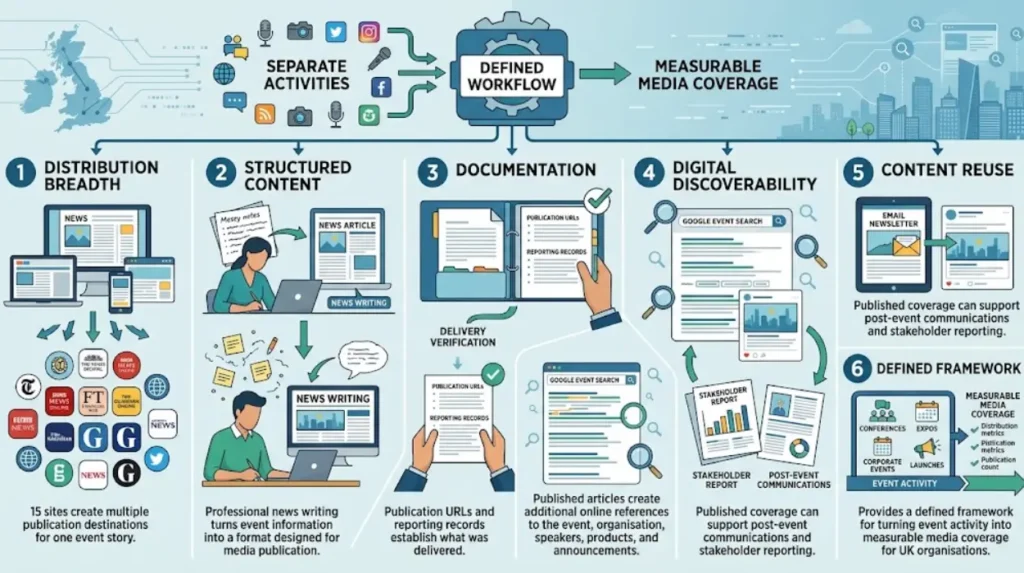
The main benefits are broader UK publication reach, structured news content, documented media placements, stronger event discoverability, reusable coverage assets, and a measurable distribution record across 15 publication environments.
A full package brings separate media activities into one defined workflow.
The first benefit is distribution breadth. Fifteen sites create multiple publication destinations for one event story.
The second benefit is structured content. Professional news writing turns event information into a format designed for media publication.
The third benefit is documentation. Publication URLs and reporting records establish what was delivered.
The fourth benefit is digital discoverability. Published articles create additional online references to the event, organisation, speakers, products, and announcements.
Explore More Expert Insights:
How Expo Coverage Turns Booths Into 15 News Stories
How Glasgow Event Coverage Secures UK-Wide Placements
The fifth benefit is content reuse. Published coverage can support post-event communications and stakeholder reporting.
For UK organisations running conferences, expos, corporate events, and launches, the package provides a defined framework for turning event activity into measurable media coverage.