

An exhibition booth creates a physical brand presence, but expo news coverage turns that presence into searchable media content. For UK exhibitors, structured coverage converts one event appearance into multiple news stories distributed across relevant publications and digital audiences.
Brands attending exhibitions often invest heavily in stand design, product demonstrations, speaker sessions, launches and networking. These activities generate newsworthy material. The challenge is converting those activities into structured stories that fit editorial formats.
Expo coverage provides that process. It identifies the strongest announcements, develops separate editorial angles and distributes the resulting stories across multiple news websites. A 15-site campaign therefore focuses on content transformation rather than simply publishing the same event announcement repeatedly.
Brands researching the wider value of this approach can first explore:
What does expo coverage turn a booth into?
Expo coverage turns a booth into structured news by identifying announcements, demonstrations, launches, speakers, products and business developments, then converting those elements into publication-ready stories for relevant UK news audiences across multiple digital media outlets.
A booth contains several potential news elements. These include a new product, partnership announcement, executive presentation, customer demonstration or company milestone. Each element provides a separate editorial focus.
For example, a technology company exhibiting at London Tech Week can promote a product launch, discuss an industry trend and announce a strategic partnership. These are three distinct story angles from one exhibition presence.
What makes an expo activity newsworthy?
Newsworthiness comes from information that provides a clear development, event, announcement or business consequence. A simple statement that a company attended an exhibition contains limited editorial information.
A product launch provides a stronger angle. A partnership announcement provides another. An executive appointment announced at the exhibition creates another story opportunity.
The strongest coverage uses factual details. These include product names, launch dates, partnership details, speaker names, exhibition locations and measurable business developments.
How does one exhibition booth produce 15 news stories?
One exhibition booth produces 15 news stories through multiple editorial angles, supporting information and publication formats. Each story focuses on a defined news point, while the wider campaign maintains consistent facts, branding, terminology and event context across all placements.
The process begins before the exhibition. The brand identifies announcements and prepares verified information. Content teams then map those details against potential story angles.
A single booth does not require 15 unrelated announcements. The campaign instead develops different editorial treatments from the available information.
For example, an engineering company exhibiting at an industrial trade show can create stories around a product demonstration, sustainability initiative, executive interview, technology application and industry forecast.
What are the main story angles?
Common expo story angles include:
- Product launches
- Partnership announcements
- Executive appearances
- Industry insights
- Technology demonstrations
- Business milestones
- Sustainability initiatives
- Investment announcements
- Customer case studies
- Event participation
- Speaker sessions
- Market developments
Each angle serves a specific search and editorial context.
A product launch targets readers interested in the product category. An executive interview targets business audiences. A sustainability announcement targets environmental and corporate responsibility topics.
This approach creates semantic breadth while keeping the campaign connected to one identifiable event.
How are 15 expo stories structured for UK news websites?
Fifteen expo stories require consistent factual foundations with distinct headlines, introductions, angles and supporting details. Each publication receives content structured around its audience, while core company information remains accurate and consistent throughout the campaign.
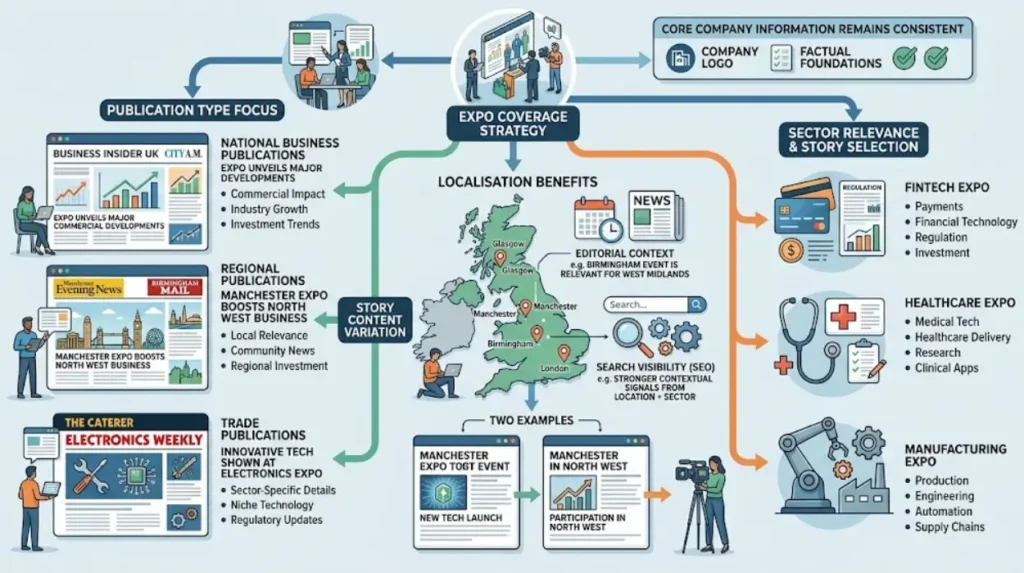
UK news websites use different editorial structures. National business publications focus on commercial developments. Regional publications focus on local relevance. Trade publications focus on sector-specific information.
An effective expo coverage campaign recognises these differences.
How does localisation improve expo coverage?
Location creates an immediate editorial context. A Birmingham exhibition provides relevance for West Midlands business audiences. A Glasgow event provides relevance for Scottish companies and organisations.
Regionalisation also supports search visibility. A story containing the exhibition location, sector, company and event name provides stronger contextual signals than a generic event announcement.
For example, a construction company exhibiting at an event in Manchester can develop a story focused on its construction technology launch and another focused on its participation in the North West business community.
How does sector relevance affect story selection?
Sector relevance determines which details receive prominence.
A fintech exhibition story focuses on payments, financial technology, regulation and investment. A healthcare exhibition story focuses on medical technology, healthcare delivery, research and clinical applications. A manufacturing exhibition story focuses on production, engineering, automation and supply chains.
This distinction helps match stories with relevant publication categories.
How does expo coverage separate one announcement into multiple angles?
Expo coverage separates one announcement by identifying its different factual components, audiences and business implications. The resulting stories use distinct editorial priorities while preserving the same verified source information, company identity, event details and publication context.
A partnership announcement illustrates this process clearly. The initial announcement identifies the companies involved. A second angle can focus on the technology involved. A third can focus on the market served.
The facts remain consistent. The editorial emphasis changes.
What information can create separate stories?
A single announcement often contains several information layers:
- The announcement — what happened.
- The participants — which organisations or people are involved.
- The product or service — what is being introduced.
- The market — which sector or audience is affected.
- The location — where the development was presented.
- The business impact — what the announcement changes.
- The event context — why the announcement happened at the expo.
These layers create separate editorial entry points.
For example, a software company announcing an AI platform at an exhibition can produce a launch story, an AI industry story, a business growth story and a technology demonstration story.
What role does SEO play in expo news coverage?
SEO gives expo coverage lasting search value by connecting event stories with relevant entities, keywords, locations, sectors and announcements. Structured coverage creates multiple indexed pages that reinforce the company’s digital presence around specific exhibition and business topics.
Expo coverage and SEO operate through connected entities. These include the company, event, product, location, industry and announcement.
Search engines process these relationships through textual context. Clear terminology therefore matters.
A story about a London exhibition should identify the event, participating company, sector and relevant announcement. A story about a product launch should identify the product category and business purpose.
Which keywords belong in expo coverage?
Keyword selection follows the actual news subject. Relevant terms include:
- Expo news coverage
- Exhibition news
- UK expo coverage
- Trade show news
- Exhibition press coverage
- Product launch at an expo
- UK business event coverage
- Exhibition media coverage
- Event news distribution
- Industry exhibition news
These terms work alongside entity names and topical vocabulary. Repetition without context reduces content quality.
The objective is comprehensive topical coverage rather than repeated keyword placement.
How do 15 news placements strengthen an expo campaign?
Fifteen news placements expand the number of digital locations carrying an exhibition story. This increases brand exposure, creates additional indexed content and provides multiple opportunities for audiences, journalists, customers and search systems to discover the same business development.
Multiple placements create distribution breadth. One publication reaches one audience segment. Fifteen publications create a wider media footprint.
The value also comes from contextual diversity. A business story can appear alongside national business coverage, regional reporting and sector-specific content.
What benefits come from multi-site coverage?
Multi-site expo coverage provides several measurable outputs:
- More publication placements
- Broader audience exposure
- Greater event visibility
- Additional indexed URLs
- More branded search opportunities
- Stronger topical associations
- Greater regional reach
- More opportunities for referral traffic
- Expanded media presence
The outcomes depend on the quality and relevance of the selected publications.
A campaign targeting 15 relevant UK news websites provides a clearer distribution structure than an undefined list of outlets.
How should brands compare expo coverage options?
Brands comparing expo coverage options need to assess publication relevance, story development, distribution volume, editorial quality, reporting and search visibility. A defined 15-site model provides measurable scope and makes campaign outputs easier to evaluate after exhibition completion.
Research focuses on selecting an appropriate coverage model. The key distinction is between simply distributing one announcement and developing a structured media campaign.
A distribution service sends content to selected outlets. A broader expo coverage solution can include editorial development, story angles, publication selection and reporting.
What should a UK exhibitor assess?
A practical evaluation includes:
- Number of target publications
- Publication relevance
- UK geographic coverage
- Industry publication access
- Content development process
- Story angle strategy
- Publication verification
- Reporting format
- URL documentation
- Campaign turnaround
- SEO considerations
These factors define the actual scope of an expo coverage campaign.
The number 15 provides a clear distribution target. The quality of those 15 publications determines the practical value of the coverage.
How can expo coverage support different types of UK exhibitors?
Expo coverage supports exhibitors by adapting stories to their sector, location, announcement type and target audience. Technology companies, manufacturers, healthcare organisations, financial firms and professional services businesses each require different editorial angles and supporting information.
Different exhibitors create different forms of news.
A technology company can focus on software launches and demonstrations. A manufacturer can focus on production technology. A financial services company can focus on partnerships, investment or market developments.
Which exhibitors benefit from multiple story angles?
Multiple-angle coverage applies to:
- Technology exhibitors
- Manufacturing companies
- Fintech businesses
- Healthcare organisations
- Property companies
- Construction firms
- Professional services providers
- Education organisations
- Retail brands
- Energy businesses
For example, a UK property company exhibiting at a real estate expo can create coverage around a development announcement, sustainability programme, market insight and executive presentation.
Each story remains connected to the same exhibition appearance.
How does expo coverage turn event activity into lasting media assets?
Expo coverage turns temporary exhibition activity into lasting digital media assets by creating published stories, indexed URLs, branded references and searchable event content. These assets continue documenting the company’s exhibition participation after the physical event has ended.
An exhibition lasts for a limited period. Published news stories remain accessible online after the event.
This distinction makes content development important. A booth generates activity during the event. Media coverage records that activity in searchable form.
What should an expo coverage campaign measure?
A campaign report can track:
- Number of published stories
- Publication names
- Published URLs
- Story topics
- Geographic coverage
- Industry relevance
- Publication dates
- Brand mentions
- Product mentions
- Event references
These metrics provide a factual record of campaign delivery.
For brands evaluating specific distribution solutions,
Expo news coverage services provides a natural next step from awareness into supplier and service evaluation.
What is the practical value of turning one booth into 15 news stories?
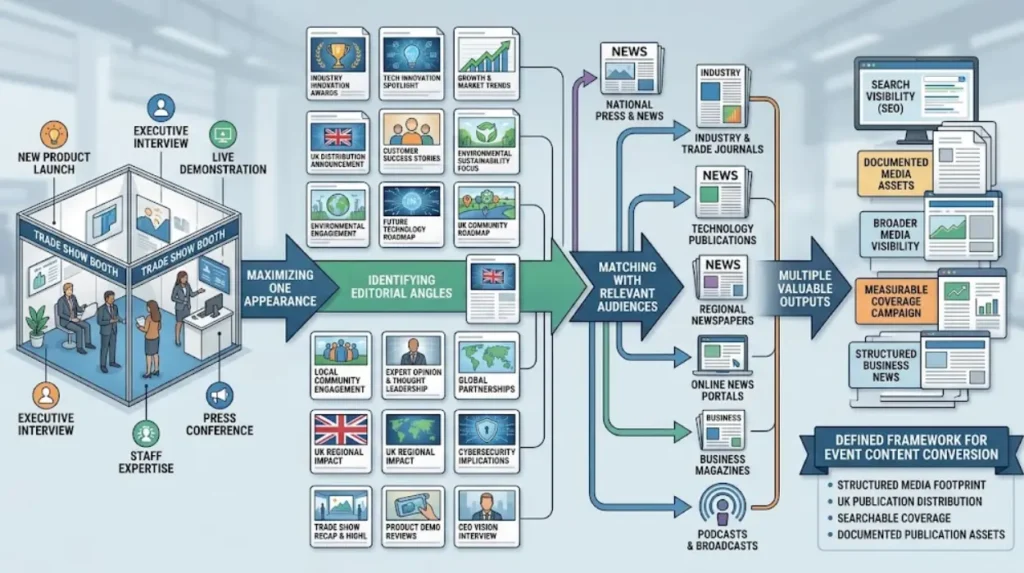
Turning one booth into 15 news stories creates a structured media footprint from a single exhibition appearance. It combines multiple editorial angles, UK publication distribution, search visibility and documented media assets into one measurable coverage campaign.
The process starts with the booth. The booth contains products, people, announcements, demonstrations and business information.
The next stage identifies the strongest factual angles. Those angles become individual stories. Publication selection then matches each story with relevant audiences.
The final stage records the published coverage.
Explore More Expert Insights:
How Glasgow Event Coverage Secures UK-Wide Placements
How Bristol Event Coverage Reaches 15 News Sites Affordably
For UK exhibitors, this process changes the role of event participation. The exhibition becomes a source of structured business news rather than a single physical marketing activity.
A 15-story approach therefore provides a defined framework for converting exhibition content into broader media visibility, searchable coverage and documented publication assets.



