Startup launch coverage connects a new company announcement with relevant UK technology audiences through editorial publication, digital distribution, search visibility, and topic relevance. The process turns launch information into publishable news that reaches founders, investors, developers, journalists, and technology buyers.
What is startup launch coverage?
Startup launch coverage is editorial reporting or publication about a company launching a product, service, platform, funding initiative, or business. UK technology publications distribute this information through websites, search results, newsletters, and social channels.
A startup launch becomes media content when it contains a clear news event. The announcement needs identifiable facts, a defined company, a specific development, and information relevant to a technology audience.
Common launch events include:
- A software platform entering the UK market.
- A fintech startup launching a payment product.
- A health technology company releasing a digital service.
- A cybersecurity company introducing a security platform.
- A technology startup announcing seed or Series A funding.
- A SaaS company launching an enterprise product.
The media audience differs by publication. A fintech launch attracts financial technology readers. A cybersecurity launch attracts security professionals. A developer platform attracts engineering and software audiences.
This distinction makes audience relevance central to startup launch coverage. Publication on a technology-focused website places the announcement within an established topical environment.
How does launch coverage differ from a press release?
A press release is company-produced communication. News coverage is editorial content published for a publication’s audience. A distributed release supplies information, while coverage gives that information a media context.
The distinction affects credibility, visibility, and audience discovery. A company announcement hosted on its own website primarily reaches existing audiences. Media publication introduces the launch to people who discover information through independent news sources, search engines, industry browsing, and publication networks.
How does startup launch coverage reach UK technology audiences?
Startup launch coverage reaches UK tech readers through relevant publications, search engines, syndicated content, newsletters, social distribution, and specialist technology channels. Audience reach increases when publication matches the startup’s sector, location, topic, and reader interests.
The distribution process contains several connected stages.
1. The launch story is defined
The first stage identifies the actual news event. The announcement needs a specific subject.
For example, “London fintech startup launches an automated business payments platform” provides a clearer news subject than “innovative technology company announces exciting plans.”
The story definition establishes the entities involved. These include the startup, founders, product, sector, location, customers, investors, and technology category.
2. The announcement is prepared for media publication
The content is structured around the most important facts. A standard launch announcement includes the company name, launch date, product description, market information, founder or executive statement, relevant statistics, and supporting company details.
The opening paragraph establishes the news event. Supporting paragraphs explain its market context.
3. Relevant UK publications are identified
Publication selection determines audience alignment. A general UK technology publication serves a broader technology audience. A specialist publication serves a narrower professional segment.
For example, a fintech launch fits financial technology publications, while an enterprise software launch fits B2B technology media.
4. The story enters digital publication channels
Once published, the story becomes accessible through the publication website. Readers discover it directly through the publication, search engines, newsletters, social platforms, and links from other websites.
This creates multiple discovery paths rather than relying exclusively on the startup’s existing audience.
Which components determine whether UK tech readers find a launch story?
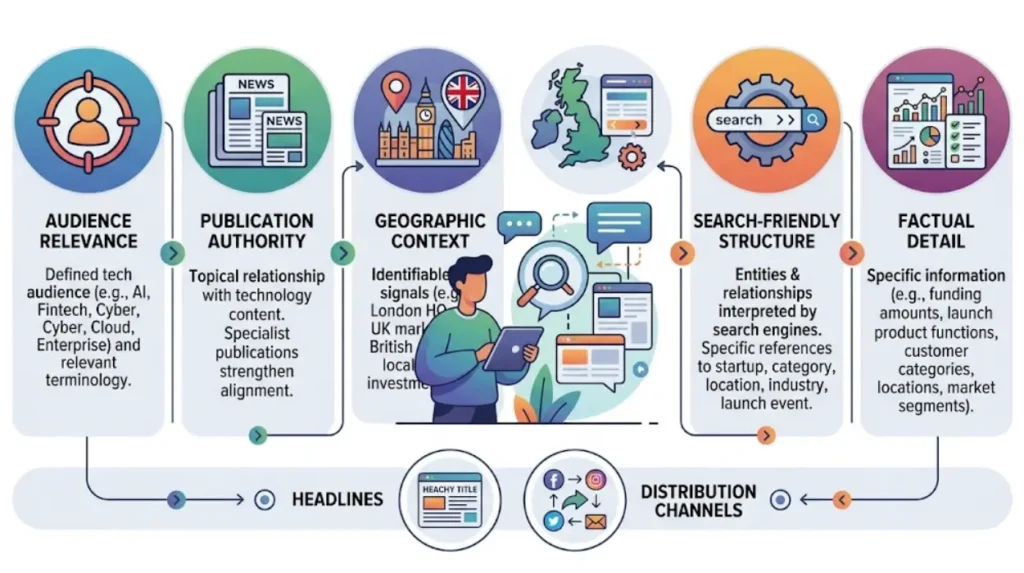
Audience relevance, publication authority, search-friendly structure, sector terminology, geographic context, factual detail, headlines, and distribution channels determine how effectively startup launch coverage reaches UK technology readers. Each component serves a specific discovery function.
Audience relevance
The story needs a defined technology audience. A launch involving artificial intelligence, fintech, cybersecurity, cloud software, or enterprise technology requires terminology relevant to those readers.
Publication relevance
The publication needs a subject relationship with the announcement. A technology reader expects technology-related content. Specialist publication strengthens topical alignment.
Geographic relevance
UK readers respond to identifiable UK context. Useful signals include London headquarters, UK market entry, British customers, UK investment, local employment, or regulatory developments.
Geographic specificity also separates UK coverage from generic international announcements.
Search relevance
Search engines interpret entities and relationships across the article. Clear references to the startup, product category, location, industry, and launch event create a stronger semantic structure.
A headline such as “London fintech startup launches automated payment platform” establishes several entities immediately.
Factual depth
Specific information gives readers reasons to continue. Launch coverage becomes more useful when it contains funding amounts, launch dates, product functions, customer categories, locations, market segments, or executive information.
How does search visibility affect startup launch coverage?
Search visibility allows UK technology readers to discover startup launch coverage after publication. Relevant keywords, identifiable entities, descriptive headlines, structured information, and topical authority help search systems connect launch stories with relevant technology queries.
Search visibility extends the life of launch coverage beyond the initial publication date.
A reader searching for “UK fintech startup payment platform” can encounter relevant launch coverage when the article clearly establishes those entities and relationships.
What role do keywords play?
Keywords identify the subjects discussed in a story. They include the startup name, product name, industry term, location, technology category, and launch-related phrases.
Semantic coverage goes beyond repeating one keyword. It connects related entities.
For a cybersecurity launch, relevant terminology includes cybersecurity startup, threat detection, security platform, enterprise security, UK technology, and digital risk.
The terms provide search engines with contextual information about the article.
Why do headlines matter?
The headline is one of the strongest initial signals for readers and search systems. It needs to communicate the news event accurately.
A useful structure is:
[Location or company] + [startup category] + [launch event] + [product or market]
For example:
“Manchester cybersecurity startup launches AI threat detection platform.”
The headline immediately identifies the company type, location, technology, and action.
How can businesses compare startup launch coverage options?
Businesses can compare launch coverage options by assessing publication relevance, UK audience fit, sector coverage, distribution breadth, editorial format, search visibility, reporting, and measurable outcomes rather than judging distribution by publication count alone.
MOFU evaluation focuses on selecting an appropriate coverage model.
Single-publication coverage
A startup can target one highly relevant publication. This approach focuses on audience quality and editorial relevance.
A cybersecurity startup targeting security professionals can prioritise specialist security media instead of broad technology websites.
Multi-publication coverage
A launch can appear across several relevant publications and distribution channels. This expands the number of digital environments where readers encounter the announcement.
For example, a UK fintech launch can target technology media, fintech publications, business publications, and regional outlets where geographic relevance exists.
Specialist versus broad technology media
Specialist media provides deeper audience alignment. Broad technology media provides wider topical exposure.
The correct choice depends on the launch objective. A developer tool requires technical readers. A consumer application requires broader technology and consumer audiences.
What measurable outcomes can startup launch coverage produce?
Startup launch coverage produces measurable outcomes through publication volume, referral traffic, search impressions, branded searches, backlinks, audience engagement, geographic reach, and coverage quality. Measurement connects media activity with defined communication objectives.
Measurement starts with a baseline.
Relevant indicators include:
- Number of published articles.
- Number of UK publications carrying the story.
- Referral sessions from media websites.
- Search impressions for branded launch terms.
- New backlinks from published coverage.
- Branded search activity.
- Engagement with launch-related pages.
- Geographic traffic from the UK.
- Coverage across relevant technology sectors.
For example, a London SaaS startup can track referral traffic from technology publications to its product page. It can also monitor branded searches for the company name after launch publication.
Coverage volume alone does not establish effectiveness. Ten irrelevant publications provide less audience alignment than several publications read by the startup’s target technology segment.
When is startup launch coverage most useful for UK startups?
Startup launch coverage is most useful when a company has a specific news event and needs to introduce that development to audiences beyond its existing channels. Launches, funding announcements, product releases, market entries, and strategic technology developments fit this model.
Product launches
A new product provides a clear editorial event. Coverage explains what the product does, who it serves, and where it enters the market.
Funding announcements
Investment announcements create measurable business news. Coverage identifies the funding amount, investors, company stage, intended use of capital, and market sector.
UK market entry
International technology companies entering Britain can use UK-focused coverage to establish local relevance. The story can include UK operations, customers, employees, partnerships, or market objectives.
Founder-led launches
Founder-led announcements introduce leadership entities alongside the company and product. The founder’s role becomes part of the news structure when it directly relates to the launch.
How should startups evaluate a launch coverage strategy?
Startups should evaluate coverage strategies against their target readers, news event, sector, geographic market, publication relevance, search objectives, distribution scope, and measurement framework. This creates a structured basis for comparing media coverage approaches before selecting a solution.
The evaluation starts with the audience.
A startup needs to define whether it wants to reach investors, technology professionals, developers, enterprise buyers, consumers, founders, or journalists.
The second step identifies the relevant publication categories. The third establishes geographic requirements. The fourth defines measurable outcomes.
This evaluation also connects educational research with practical solution selection. Businesses examining:
Startup launch coverage can compare publication types, distribution models, audience targeting, and reporting requirements before moving toward a specific implementation.
For readers evaluating the next stage,
Startup launch coverage on 15 UK news sites provides a more specific view of multi-publication distribution and its practical coverage structure.
What is the overall process for reaching UK tech readers?
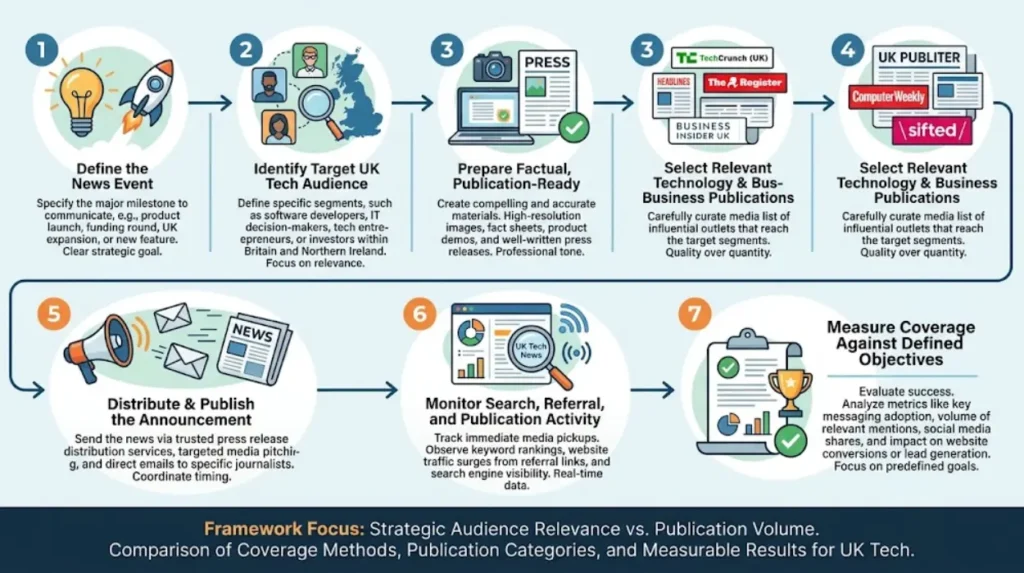
The complete process starts with defining the launch event, preparing factual content, selecting relevant UK publications, distributing the story, supporting search discovery, monitoring coverage, and measuring audience outcomes against predefined communication objectives.
The process follows seven connected stages:
- Define the news event.
- Identify the target UK technology audience.
- Prepare factual, publication-ready content.
- Select relevant technology and business publications.
- Distribute and publish the announcement.
- Monitor search, referral, and publication activity.
- Measure coverage against defined objectives.
Explore More Expert Insights:
How Charity Gala Coverage Reaches 15 UK News Sites
Earned vs Paid Event Coverage: What Delivers Better ROI
This framework keeps startup launch coverage focused on audience relevance rather than publication volume alone. It also gives businesses a practical basis for comparing coverage methods, publication categories, distribution scope, and measurable results within the UK technology market.