

Real estate event coverage reaches UK property readers through a structured path from event information to editorial publication, search visibility, social distribution, newsletters, trade channels, and specialist property audiences across national and regional media.
Real estate event coverage is the process of turning information from property conferences, exhibitions, investment forums, development events, and industry meetings into news content that reaches relevant audiences.
The process involves several stages. Event information is collected and assessed for news value. Journalists or editorial teams identify relevant developments. Content is then produced for suitable media channels. Search engines, social platforms, newsletters, and publication networks extend its reach.
For UK property audiences, relevance depends on the subject of the event. A residential development announcement attracts a different readership from a commercial property investment forum. Planning policy, construction, PropTech, housing, logistics, retail property, and sustainability each have distinct media audiences.
Understanding this process helps organisations evaluate real estate event coverage as a communication and visibility activity rather than treating publication as the only outcome.
What happens between a UK real estate event and media coverage?
The route from a real estate event to media coverage usually includes event monitoring, story selection, information verification, editorial preparation, distribution, publication, search indexing, social sharing, and subsequent discovery by relevant UK property audiences.
How is event information converted into a news story?
Event information starts with factual material. This includes the event name, location, participating organisations, speakers, announcements, projects, investment figures, policy developments, research findings, and quotations.
Not every event detail has equal editorial relevance. A new development agreement, investment announcement, planning decision, market report, or executive appointment provides a clearer news angle than a general description of an event.
A structured event story answers several basic questions:
- What happened?
- Who was involved?
- Where did it happen?
- When did it happen?
- Why is it relevant to the property sector?
- What measurable information supports the announcement?
These details create an editorial basis for publication.
How does distribution extend the story?
Once content is prepared, it enters relevant distribution channels. These channels include property publications, business media, regional news websites, specialist trade publications, company newsrooms, newsletters, and social platforms.
Distribution does not guarantee identical publication across every channel. Each publication has its own editorial requirements, audience, and content priorities.
This distinction is important when assessing the reach of UK real estate event coverage. A story appearing in one specialist property publication reaches a different audience from a story indexed across several regional and national news environments.
Which UK property audiences receive real estate event coverage?
UK real estate event coverage reaches multiple audience groups, including property investors, developers, estate agents, planners, architects, construction professionals, landlords, occupiers, policymakers, finance professionals, and property researchers.
Audience segmentation determines where event coverage gains practical relevance.
Who reads property trade coverage?
Property trade readers include professionals who require sector-specific information. They follow development activity, investment transactions, planning decisions, construction projects, property technology, leasing activity, and market research.
For example, a commercial property conference discussing office occupancy trends has direct relevance to developers, investors, landlords, agents, and corporate occupiers.
Who reads regional property coverage?
Regional publications connect real estate events with specific geographic markets. A development event in Manchester, Birmingham, Leeds, Bristol, or Glasgow has stronger relevance when the coverage includes local investment, employment, regeneration, housing supply, or infrastructure information.
Regional coverage also supports discovery among readers who monitor property activity within a particular city or region.
Who reads national business coverage?
National business audiences focus on information with wider economic significance. Large investment announcements, major regeneration projects, significant housing initiatives, infrastructure developments, and corporate property transactions fit this context.
The same event therefore supports different editorial angles across specialist, regional, and national audiences.
How does search visibility help UK property readers discover event coverage?
Search visibility allows UK property readers to discover event coverage after publication through Google results, news searches, branded queries, property-sector searches, location-based searches, and specific searches for projects, companies, speakers, and announcements.
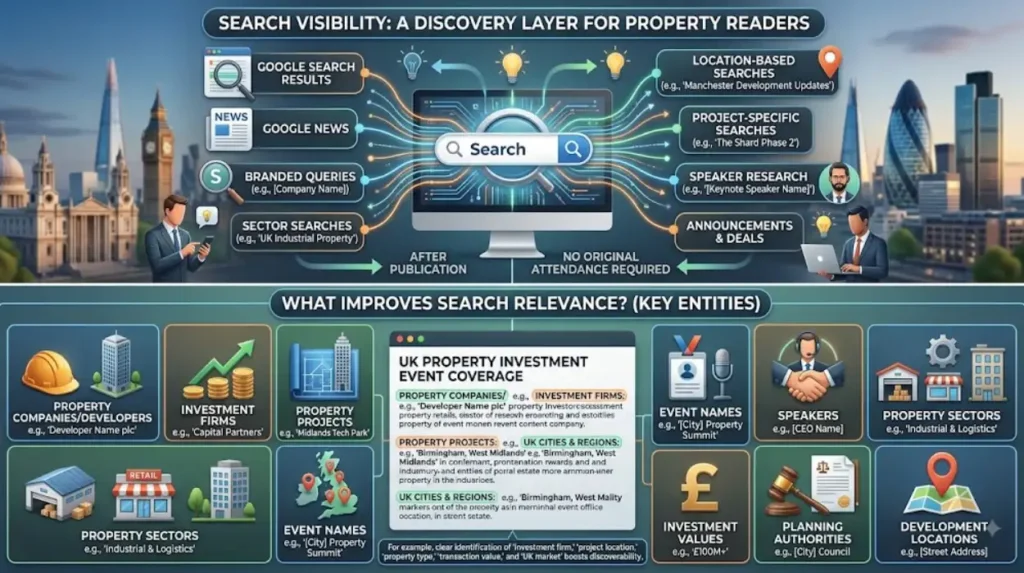
Search creates an additional discovery layer after publication.
A reader does not need to attend the original event or follow the organisation that hosted it. They can discover the resulting coverage while researching a company, development, investment announcement, market trend, or property topic.
Which information improves search relevance?
Search-relevant event coverage contains specific entities and factual relationships. Important entities include:
- Property companies
- Developers
- Investment firms
- Property projects
- UK cities and regions
- Event names
- Industry organisations
- Speakers
- Property sectors
- Investment values
- Planning authorities
- Development locations
For example, an article about a property investment event becomes more discoverable when it clearly identifies the investment firm, project location, property type, transaction value, and relevant UK market.
Keyword usage also matters. Terms such as UK real estate events, property event coverage, UK property news, real estate investment, commercial property, property development, and real estate conference provide topical signals when used naturally within relevant factual content.
Readers interested in the broader role of coverage can also explore:
UK real estate event coverage to understand what news coverage adds before assessing distribution routes.
How do national, regional, and trade publications differ in real estate event coverage?
National, regional, and trade publications differ primarily by audience, editorial scope, geographic relevance, specialist depth, and news criteria, so effective real estate event coverage uses channel selection based on the subject and intended UK property readership.
What does national coverage provide?
National coverage provides access to broader business and economic audiences. It is most relevant when an event produces information with national significance.
Examples include major institutional investment, large-scale housing programmes, infrastructure projects, significant corporate acquisitions, and changes affecting the UK property market.
What does regional coverage provide?
Regional coverage creates geographic relevance. It connects an event announcement with local property markets, development pipelines, regeneration schemes, employment, infrastructure, and community impact.
A Birmingham property event, for example, has stronger regional relevance when its coverage includes Birmingham development activity rather than presenting only generic conference information.
What does trade coverage provide?
Trade publications provide specialist context. Their readers understand property terminology and often seek detailed information about transactions, development, construction, planning, investment, asset classes, and professional services.
Trade coverage therefore supports deeper sector relevance than general business reporting.
How can organisations evaluate the quality of real estate event coverage?
Organisations can evaluate real estate event coverage by measuring publication volume, publication quality, audience relevance, geographic distribution, search visibility, referral activity, message accuracy, and the presence of coverage across appropriate property and business channels.
Counting articles alone does not provide a complete assessment.
Which coverage metrics matter?
Useful metrics include:
- Publication count – the number of published articles or placements.
- Audience relevance – alignment between each publication and the intended property audience.
- Geographic coverage – representation across relevant UK regions.
- Search visibility – discovery through search engines and news results.
- Referral traffic – visits generated from published coverage.
- Message accuracy – consistency of factual information across publications.
- Entity visibility – inclusion of companies, projects, locations, speakers, and other important entities.
- Coverage longevity – continued availability and discoverability after the event.
A property event aimed at investors requires different measurement criteria from a regional development conference. The evaluation framework must match the communication objective.
How does event timing affect UK property media coverage?
Event timing affects coverage because journalists operate around publication schedules, competing news, industry calendars, parliamentary activity, market announcements, and seasonal changes in UK business and property attention.
Timing has two distinct stages.
The first is pre-event visibility. This focuses on announcements, speakers, agendas, research, and expected developments.
The second is post-event coverage. This focuses on announcements made during the event, quotations, transactions, research findings, project updates, and measurable outcomes.
Rapid publication after a significant announcement keeps the information closely connected to the event. Later coverage supports continued discovery when the story contains durable information such as investment data, development plans, market research, or policy developments.
How does real estate event coverage support different property use cases?
Real estate event coverage supports investment announcements, development launches, planning discussions, industry research, corporate events, PropTech demonstrations, property conferences, regeneration programmes, and market updates by connecting each story with relevant UK audiences.
Which events generate strong property news angles?
Common examples include:
- Property investment conferences
- Commercial real estate exhibitions
- Residential development forums
- Construction and infrastructure events
- Planning conferences
- PropTech events
- Real estate investment summits
- Housing policy forums
- Regeneration conferences
- Sustainability and green-building events
Each event category creates different editorial opportunities.
A PropTech event can produce coverage around technology adoption and property operations. A housing conference can focus on supply, affordability, planning, or development. An investment summit can focus on capital flows, transactions, or asset classes.
The editorial angle determines the most relevant readership.
How should organisations choose a real estate event coverage approach?
Organisations can choose a real estate event coverage approach by defining the target audience, identifying the strongest news angle, selecting appropriate publication types, preparing factual content, distributing it through relevant channels, and measuring resulting visibility.
The first decision is audience definition. A story designed for property investors requires different distribution priorities from one designed for local stakeholders.
The second decision is editorial relevance. The strongest event coverage identifies a concrete development, announcement, finding, transaction, or industry change.
The third decision is channel selection. National, regional, business, and trade publications each serve different readership groups.
The fourth decision is measurement. Coverage needs assessment across publication relevance, geographic reach, search visibility, referral activity, and continued discoverability.
For organisations evaluating specific publication networks,
UK real estate news sites provides the next stage of comparison by examining where real estate event coverage appears across relevant UK media environments.
What is the overall path from a real estate event to UK property readers?
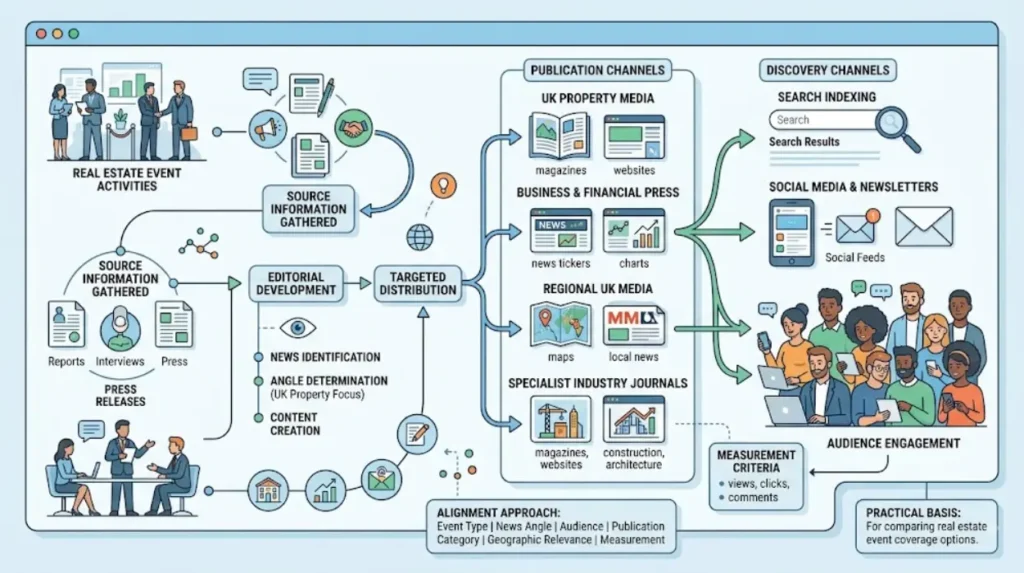
The complete path runs from event activity to news identification, editorial development, targeted distribution, publication, search indexing, social and newsletter discovery, and audience engagement across UK property, business, regional, and specialist media environments.
Real estate event coverage works through multiple connected discovery channels. The event provides the source information. Editorial selection determines the news angle. Distribution connects the story with suitable publications. Search allows readers to find the content later.
Explore More Expert Insights:
How Healthcare Event Coverage Meets UK Editorial Standards
How Fintech Event Coverage Reaches UK Business Readers
The strongest approach aligns event type, news angle, audience, publication category, geographic relevance, and measurement criteria.
This framework also provides a practical basis for comparing real estate event coverage options before selecting specific UK media distribution routes.



