

Fintech event coverage reaches UK business readers through targeted editorial distribution, relevant publication selection, search visibility, and business-focused messaging. The process connects event announcements with national, regional, financial, technology, and specialist publications read by UK decision-makers.
Fintech event coverage refers to editorial reporting, announcements, interviews, event summaries, and related stories about financial technology events. These events include conferences, exhibitions, summits, investor gatherings, product showcases, and industry forums.
UK business readers include founders, financial executives, investors, technology professionals, procurement teams, regulators, and corporate decision-makers. They consume information through business newspapers, fintech publications, technology media, financial websites, and specialist trade publications.
The effectiveness of coverage depends on relevance. A fintech event story needs a clear business angle. It also needs accurate information about the event, participating organisations, speakers, themes, and industry significance.
This makes publication selection an important part of the process. A campaign focused on UK business readers requires media outlets that already publish financial technology and business content.
Readers exploring:
Fintech event coverage can also understand how broader event news gains stronger editorial attention before evaluating specific distribution approaches.
What counts as fintech event coverage?
Fintech event coverage includes several content formats:
- Event announcements
- Conference previews
- Speaker announcements
- Industry interviews
- Event reports
- Product or partnership announcements made at events
- Panel discussion summaries
- Investment and funding stories linked to events
- Technology demonstrations
- Post-event business updates
For example, a UK payments conference announcing a new fraud-prevention platform creates several editorial angles. A publication can focus on payments technology, financial security, investment, regulation, or the companies involved.
Which UK publications reach fintech and business audiences?
UK fintech audiences are reached through publications covering finance, banking, technology, business, investment, regulation, and specialist financial services. Each publication serves a distinct readership, so media selection determines which business segments encounter event coverage.
UK media is divided into national business publications, financial publications, technology media, regional outlets, and trade publications. Each category provides a different audience context.
National business publications address broad corporate audiences. Financial publications focus on banking, markets, investment, payments, and financial services. Technology publications cover software, artificial intelligence, cybersecurity, cloud infrastructure, and digital transformation.
Fintech trade publications provide more specialised exposure. Their readers often include professionals working directly in financial technology.
Which publication categories matter most?
A structured fintech media campaign can consider:
- Business publications — Reach founders, executives, investors, and corporate professionals.
- Financial publications — Reach banking, investment, payments, and financial-services audiences.
- Technology publications — Reach technology leaders and digital transformation teams.
- Fintech publications — Reach specialists working directly in financial technology.
- Regional publications — Reach business communities in specific UK cities and regions.
- Trade media — Reach specialised professional audiences.
For example, an event focused on open banking needs financial and fintech publications. A conference focused on artificial intelligence in banking also benefits from technology media.
Publication relevance is therefore more important than simply increasing the number of placements.
How is a fintech event story prepared for UK media?
A fintech event story is prepared by identifying its strongest news angle, defining the intended business audience, verifying event facts, creating an editorial headline, and structuring information around developments that matter to UK financial and technology professionals.
The preparation stage determines how clearly journalists and readers understand the event.
A basic event announcement often contains the event name, date, venue, organisers, speakers, agenda, and registration information. Business-focused coverage requires stronger context.
The story needs a reason for business readers to pay attention. That reason can involve a market development, technology launch, investment announcement, regulatory issue, partnership, research finding, or significant industry discussion.
What information belongs in the story?
A strong fintech event story normally contains:
- Event name
- Event date
- UK location or relevant market
- Organiser information
- Speaker details
- Main discussion topics
- Key business development
- Supporting statistics
- Quotes from relevant executives
- Links to supporting information
- Clear contact information
Facts need to remain consistent across the announcement and supporting materials.
For example, if a London fintech summit focuses on payment fraud, the story needs to explain the problem, identify the event’s contribution, and specify the professionals involved.
This creates a stronger connection between the event and the business issue.
How does publication targeting affect fintech event reach?
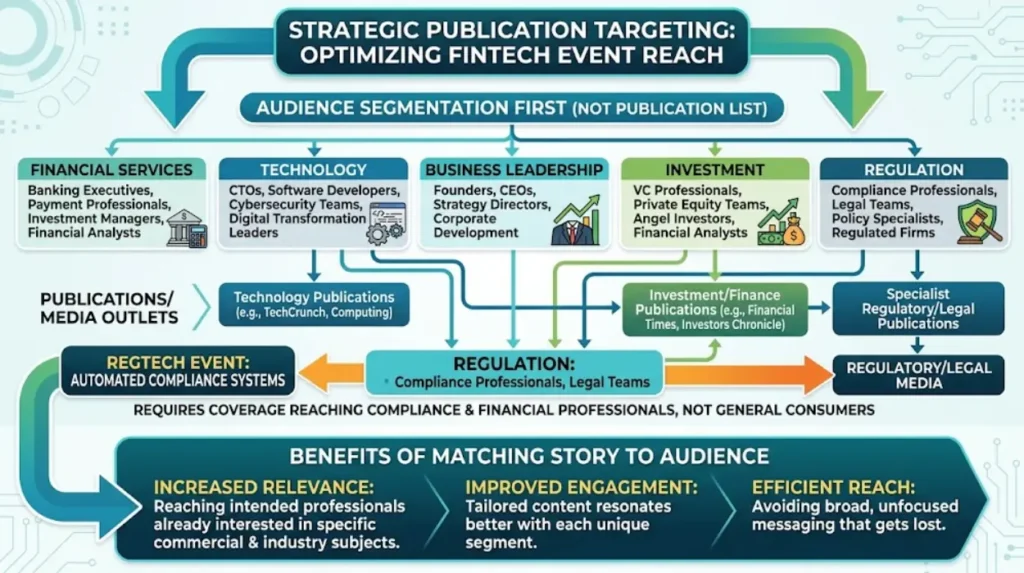
Publication targeting determines which UK business audiences encounter fintech event coverage. Matching the story with financial, technology, regional, and specialist publications improves relevance because each publication already serves readers interested in specific commercial and industry subjects.
Targeting begins with the audience rather than the publication list.
A fintech event aimed at banking executives has different media requirements from an event aimed at software developers. A payments conference has a different audience from a cryptocurrency compliance forum.
This distinction affects both publication selection and editorial positioning.
How can audiences be segmented?
Fintech event audiences can be segmented by professional role and subject interest.
Financial services: Banking executives, payment professionals, investment managers, and financial analysts.
Technology: Chief technology officers, software professionals, cybersecurity teams, and digital transformation leaders.
Business leadership: Founders, chief executives, strategy directors, and corporate development teams.
Investment: Venture capital professionals, private equity teams, angel investors, and financial analysts.
Regulation: Compliance professionals, legal teams, policy specialists, and regulated financial organisations.
For example, a regtech event discussing automated compliance systems requires coverage that reaches compliance and financial-services professionals rather than a general consumer audience.
How does SEO help fintech event coverage reach business readers?
SEO helps fintech event coverage appear when UK business readers search for relevant companies, events, technologies, financial trends, speakers, and industry topics. Clear entities, descriptive headings, relevant terminology, and factual information improve discoverability across search environments.
Search visibility extends the life of event coverage beyond the initial publication period.
A reader can discover an event story through searches for its event name, company, speaker, technology, sector, or topic. Search engines also connect related concepts within the article.
For this reason, the content needs clear entity definitions.
An entity is a distinct person, organisation, event, product, technology, or location that search systems can identify. Examples include a fintech company, a UK banking conference, a payment platform, or a named industry executive.
Which keywords support event discoverability?
Relevant semantic terms include:
- UK fintech events
- fintech event coverage
- fintech conference news
- financial technology events
- UK fintech news
- fintech business news
- financial services events
- banking technology conferences
- payments industry events
- fintech conference coverage
These terms work alongside specific entities and factual descriptions.
Keyword repetition is not the primary objective. Contextual relevance matters. An article about a UK fintech event needs terminology that accurately describes the event, its industry, its participants, and its commercial significance.
What makes fintech event coverage useful after publication?
Useful fintech event coverage provides verifiable information that business readers can understand, search engines can interpret, and organisations can reference later. Event details, business context, named entities, quotes, statistics, and relevant links make coverage more useful after publication.
Publication is only one stage of the coverage process.
A well-structured article creates a permanent reference point for the event. Readers can return to it when researching speakers, companies, technologies, announcements, or industry developments.
This creates value for event organisers and participating businesses without turning the article into direct advertising.
What information increases reference value?
Useful coverage often includes:
- Named speakers
- Company names
- Event dates
- Location details
- Industry statistics
- Specific announcements
- Relevant quotations
- Research findings
- Product information
- Clear explanations of technical subjects
For example, a report about a UK payments event becomes more useful when it identifies the payment technology discussed, explains its business application, and names the organisations involved.
This information also creates stronger connections between the event and broader fintech topics.
How can organisations compare fintech event coverage options?
Organisations can compare fintech event coverage options by examining publication relevance, audience alignment, editorial formats, geographic reach, search visibility, reporting quality, campaign timing, and post-publication reporting rather than evaluating distribution volume alone.
MOFU buyers often compare different approaches before selecting a media distribution solution.
The main options include direct journalist outreach, specialist fintech media relations, broader PR distribution, event-focused media campaigns, and combined approaches.
Each method has a different operating model.
Direct outreach focuses on individual journalists and specific editorial relationships. Specialist campaigns focus on relevant publications and sector audiences. Distribution campaigns provide structured delivery across selected media networks.
What should organisations evaluate?
A practical comparison includes six areas:
- Audience fit — Does the publication reach the intended UK business audience?
- Sector relevance — Does it regularly cover fintech, finance, banking, or technology?
- Geographic relevance — Does it reach UK readers?
- Editorial format — Does the campaign support announcements, interviews, reports, or other formats?
- Search visibility — Does published content remain discoverable through search?
- Reporting — Does the campaign provide identifiable publication results?
The number of placements alone does not establish campaign quality.
For example, 15 highly relevant UK business and fintech publications can provide more useful audience alignment than a larger list containing unrelated websites.
Organisations reviewing:
Fintech event news coverage services can use these criteria to assess whether a distribution model matches their event objectives.
When is a multi-publication approach useful for fintech events?
A multi-publication approach is useful when an event has several relevant business angles and needs exposure across different UK audience segments. It distributes one core story across selected financial, technology, business, fintech, and regional publication categories.
Fintech events frequently involve multiple subjects.
A single event can address payments, artificial intelligence, cybersecurity, open banking, investment, compliance, digital banking, and financial regulation. Different publications focus on different parts of that subject range.
A multi-publication strategy creates broader contextual reach.
Which events benefit from broader coverage?
This approach fits events such as:
- UK fintech conferences
- Banking technology summits
- Payments exhibitions
- Regtech forums
- Insurtech events
- Investment and fintech conferences
- Digital banking events
- Financial cybersecurity conferences
- AI and financial services events
For example, a fintech conference covering AI-driven fraud detection can attract technology publications for the AI angle, financial publications for the fraud issue, and business publications for the commercial impact.
The central event remains the same. The audience context changes.
How can fintech event coverage be measured?
Fintech event coverage can be measured through publication placements, audience relevance, geographic reach, referral activity, search visibility, indexed coverage, engagement, and business outcomes connected to the campaign. Measurement needs defined objectives established before distribution begins.
Coverage reporting provides evidence of where the story appeared and which media categories carried it.
A useful report separates publication information from performance indicators. Publication information identifies where the story appeared. Performance indicators show what happened after publication.
Which metrics matter?
Key metrics include:
- Number of relevant UK publications
- Number of fintech and financial publications
- National versus regional coverage
- Publication dates
- Search indexing status
- Referral traffic
- Event registration activity
- Brand or company mentions
- Backlink activity where applicable
- Leads or enquiries attributed to coverage
The correct metric depends on the campaign objective.
An event focused on registrations needs different measurement from an event focused on corporate visibility or investor awareness.
This makes measurement part of campaign planning rather than a final reporting exercise.
What is the next step after understanding fintech event coverage?

The next step is to define the event audience, identify relevant UK publication categories, establish the strongest news angle, prepare factual media content, select an appropriate distribution model, and establish measurable coverage objectives before launching the campaign.
A structured process prevents publication selection from becoming disconnected from audience requirements.
Start with the event. Define its subject, participants, location, commercial relevance, and intended audience. Then identify the media categories that already reach those readers.
Next, prepare the story around a specific news angle. Use factual information, named entities, relevant statistics, and clear quotations.
Finally, establish measurement criteria before publication.
Explore More Expert Insights:
How Conference Coverage Reaches 15 Publications in One Campaign
How UK Corporate Events Get Covered Across 15 News Sites
This approach connects event activity with media relevance, search visibility, and business readership.
Fintech event coverage works best when every stage serves the same objective: placing relevant information in front of UK readers who actively follow financial technology, business, finance, and related professional subjects.



