

Event coverage in Birmingham moves through a defined editorial process before publication. Organisers provide event details, media-ready assets and news angles. Journalists or distribution teams then review, prepare, distribute and publish the story across relevant UK news channels.
For event organisers, the 48-hour timeframe depends on how quickly the information is prepared, how clearly the story is positioned and how efficiently it reaches appropriate media outlets. A structured workflow reduces delays between an event taking place and its appearance in online news coverage.
Understanding this process helps businesses, event organisers, charities and professional organisations assess different approaches to Birmingham event coverage and select a process that matches their publication goals.
What does Birmingham event coverage mean?
Birmingham event coverage is published news content about an event, including its purpose, speakers, activities, outcomes and relevance to audiences. It converts event information into an editorially structured story suitable for news websites and digital publications.
Event coverage differs from a basic event listing. An event listing provides practical information such as the date, venue and ticket details. News coverage provides an editorial account of what happened and why the event matters.
A Birmingham event can generate coverage when it contains a clear news angle. Examples include a major business conference, a charity fundraising event, a technology launch, a cultural programme or a public-sector initiative.
The location also provides important context. Birmingham is a major UK business, cultural and professional centre. Events held at venues such as the NEC Birmingham, Birmingham Conference & Events Centre or city-centre locations can have local, regional or sector-specific relevance.
What information does event coverage contain?
A publishable event story commonly includes:
- Event name and location
- Date and time
- Organiser information
- Purpose of the event
- Key speakers or participants
- Important announcements
- Attendance information
- Event outcomes
- Relevant quotations
- Professional photographs
- Links to supporting information
These elements provide the factual foundation for the article. Strong event coverage presents the most important information early in the story.
How can Birmingham event coverage be published within 48 hours?
Birmingham event coverage reaches publication within 48 hours through rapid preparation, editorial review, media targeting, content distribution and publication monitoring. Each stage requires accurate information, usable assets and a clearly defined news angle to prevent avoidable delays.
The process begins before or immediately after the event. Organisers prepare the information required for publication. This includes the event description, key developments, quotations, photographs and supporting facts.
The next stage involves editorial preparation. The information is organised into a news format with a headline, introduction, supporting paragraphs and relevant quotations.
Media targeting follows. The story is matched with suitable publication categories. A Birmingham technology event, for example, fits technology, business and regional media more closely than unrelated lifestyle publications.
Distribution then places the prepared content in front of relevant media channels. Publication timing depends on editorial workflows, content acceptance, technical processing and the relevance of the story.
Monitoring completes the process. Published URLs, publication names and coverage details are recorded so the organiser can confirm where the event story appeared.
Why does preparation affect the 48-hour timeframe?
Incomplete information creates additional editorial work. Missing names, incorrect dates, unavailable photographs or unclear quotations slow preparation.
A complete media pack removes these obstacles. It gives the editorial team the core information required to produce and distribute the story without repeatedly requesting basic details.
What happens during the first six hours after a Birmingham event?
During the first six hours, organisers consolidate event facts, photographs, quotations and outcomes. The content is checked for accuracy and transformed into a structured news story with a clear Birmingham relevance and publication-ready headline.
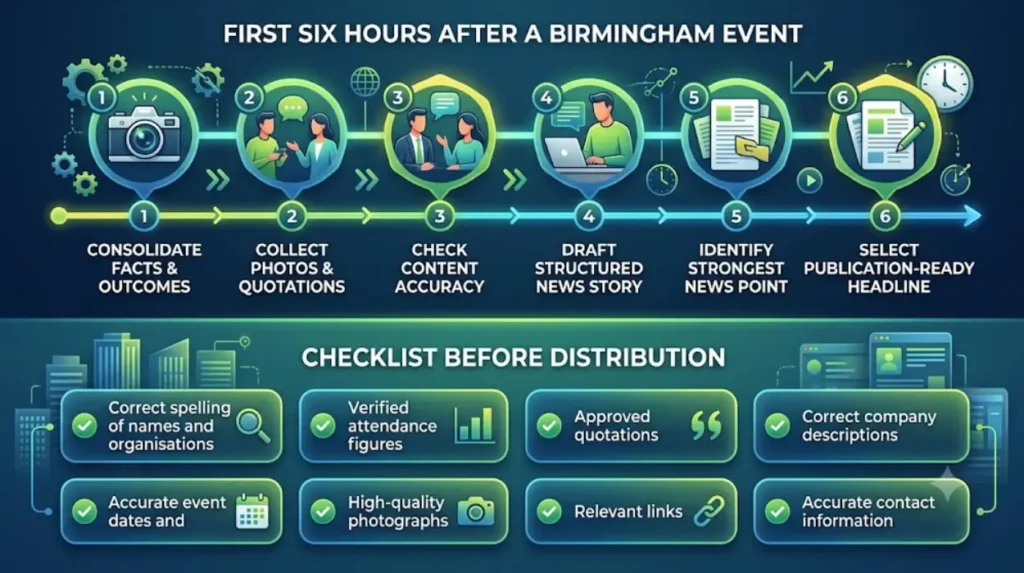
The first six hours establish the factual foundation of the coverage.
Immediately after the event, organisers collect the final attendance figures, confirmed outcomes and approved quotations. Photographs are selected based on relevance and quality.
The editorial team then identifies the strongest news point. This point determines the headline and opening paragraph.
For example, a Birmingham business conference that announces a new investment programme has a stronger news angle than a generic description of networking activities.
What should be checked before distribution?
Key checks include:
- Correct spelling of names and organisations.
- Accurate event dates and locations.
- Verified attendance figures.
- Approved quotations.
- Correct company descriptions.
- High-quality photographs.
- Relevant links.
- Accurate contact information.
These checks reduce corrections after publication and protect the credibility of the coverage.
How is a Birmingham event story prepared for UK news websites?
A Birmingham event story is prepared for UK news websites by converting event information into concise editorial content. The structure normally includes a headline, opening news statement, supporting facts, quotations, event context and relevant organisational information.
Editorial structure affects how quickly a story can move through the publication process.
The headline identifies the central development. The opening paragraph answers the basic questions of what happened, where it happened and why it matters.
Supporting paragraphs provide evidence and context. Quotations add statements from organisers, speakers or participants. The final sections provide additional information about the organisation or event.
What makes the story suitable for multiple publications?
A multi-publication story needs factual clarity and broad relevance.
For example, a Birmingham sustainability conference can contain business, environmental, technology and regional angles. Each angle provides contextual relevance for a different publication category.
The underlying facts remain consistent. The editorial relevance changes according to the publication’s audience.
This approach supports wider distribution without requiring the story to lose its Birmingham identity.
How does media distribution affect the 48-hour publication process?
Media distribution connects prepared Birmingham event content with relevant news publications. Effective distribution uses publication categories, regional relevance and sector alignment to move a completed story through multiple media channels within the required publication timeframe.
Distribution is the operational stage between finished content and media publication.
A distribution strategy identifies suitable outlets based on the subject of the event. Regional publications focus on Birmingham and the wider West Midlands. Trade publications focus on specific sectors such as finance, technology, construction or healthcare.
National publications operate at a broader level and require stronger national relevance.
What publication categories can Birmingham events target?
Relevant categories include:
- Birmingham and West Midlands news
- UK business media
- Technology publications
- Financial media
- Construction publications
- Healthcare media
- Education publications
- Hospitality and tourism media
- Arts and culture publications
For example, a Birmingham property conference can target regional business publications and property trade media. A Birmingham technology launch can target technology and business publications.
This category-based approach improves relevance and reduces distribution to unsuitable audiences.
What factors determine whether Birmingham event coverage appears within 48 hours?
Publication within 48 hours depends on content readiness, editorial relevance, distribution speed, media availability and monitoring. Accurate information and suitable media targeting reduce processing time, while incomplete assets or weak news angles create additional editorial delays.
The 48-hour target is influenced by several connected factors.
Content readiness
A completed article with approved quotations and photographs enters the workflow faster than incomplete material.
News relevance
A clear development gives editors a reason to publish the story. Event information without a defined news angle provides weaker editorial value.
Distribution timing
The time at which the story enters distribution affects when publications receive it. Early submission provides more time for processing and publication.
Media suitability
A story targeted towards relevant publications has a stronger chance of entering appropriate editorial workflows.
Monitoring
Publication monitoring confirms when and where the story appears. It also identifies delays that require follow-up.
How can organisations compare Birmingham event coverage options?
Organisations can compare Birmingham event coverage options by examining publication reach, turnaround time, media relevance, editorial support, reporting and distribution structure. These factors show whether a coverage approach supports local visibility, sector exposure or wider UK media reach.
Different coverage approaches serve different objectives.
An organisation seeking local awareness can prioritise Birmingham and West Midlands publications. A company launching a national initiative can require broader UK media distribution.
Editorial support also differs between approaches. Some models focus on content preparation. Others combine writing, distribution and coverage monitoring.
What should organisations evaluate?
A practical comparison includes:
| Factor | What to examine |
|---|---|
| Turnaround | Time from submission to publication |
| Media reach | Number and type of target publications |
| Regional relevance | Birmingham and West Midlands coverage |
| Sector relevance | Trade and specialist publication access |
| Editorial support | Writing, editing and content preparation |
| Monitoring | Published URLs and coverage reporting |
| Distribution | Number and range of media channels |
| Reporting | Evidence of completed coverage |
This framework helps organisations compare options using measurable criteria rather than relying only on general claims about media exposure.
How does Birmingham event coverage support wider audience reach?
Birmingham event coverage extends an event beyond its physical audience by placing verified information across digital news channels. Published articles create additional discovery points for businesses, speakers, organisations and event outcomes after the original event has ended.
An event has a limited physical attendance capacity. Online coverage removes that geographical restriction.
A Birmingham conference attended by 300 professionals can generate digital visibility beyond those attendees when its outcomes appear in online publications.
Coverage also creates searchable content. People researching an organisation, speaker, event or announcement can discover published articles through search engines and news platforms.
This connects with the broader educational discussion in:
Birmingham Events Reach Wider Audiences.
What happens after publication?
Published coverage can continue attracting attention after the event.
Articles provide:
- Searchable event information
- Third-party publication references
- Additional visibility for speakers
- Evidence of organisational activity
- Digital assets for communications
- Potential discovery through news searches
The value therefore extends beyond the event date. Publication creates a lasting digital record of the event and its key developments.
When is rapid Birmingham event coverage most useful?
Rapid Birmingham event coverage is most useful when an announcement, event outcome or organisational development has immediate relevance. Timely publication preserves news value and gives audiences access to information while the event remains recent and actively discussed.
Several event types benefit from rapid publication.
A business conference can announce a partnership immediately after its closing session. A charity event can publish confirmed fundraising results. A technology event can announce a product launch. A cultural event can report attendance or programme outcomes.
The common factor is the connection between timing and news relevance.
What are common use cases?
Business events: Conferences, leadership forums and corporate networking events often require rapid coverage of announcements and participation.
Charity events: Fundraising totals, campaigns and community initiatives provide measurable outcomes for news stories.
Technology events: Product launches, demonstrations and industry announcements require timely communication.
Cultural events: Exhibitions, festivals and performances generate local and sector-specific interest.
Professional events: Seminars, awards and industry forums provide opportunities to report speakers, achievements and organisational developments.
Explore More Expert Insights:
Manchester Event Coverage: How It Appears Across UK News
How London Event Coverage Reaches 15 News Sites Simultaneously
What is the next step after understanding the 48-hour process?
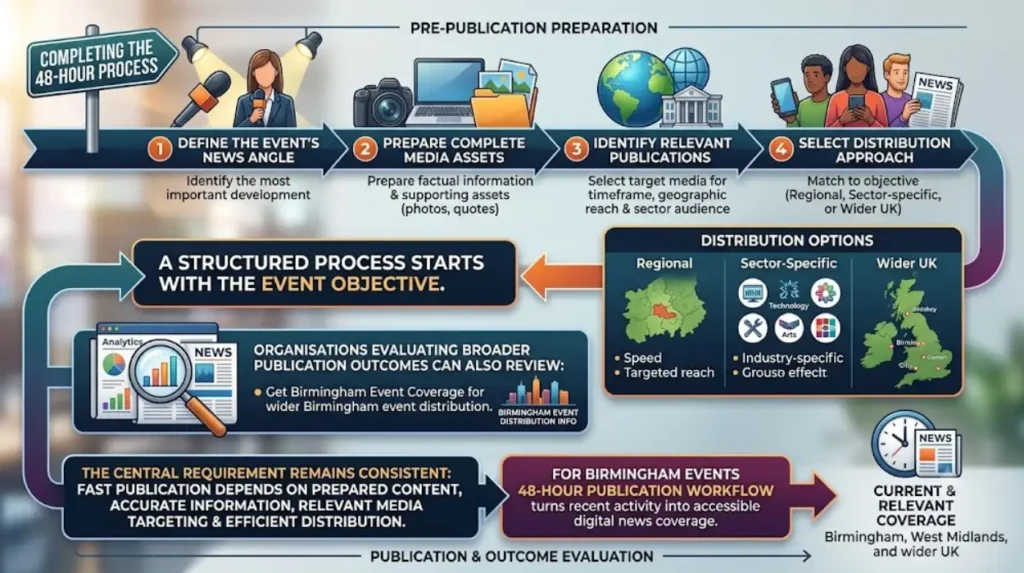
The next step is to define the event’s news angle, prepare complete media assets, identify relevant publications and select a distribution approach that matches the required timeframe, geographic reach and sector audience before publication begins.
A structured process starts with the event objective.
Organisers first identify the most important development. They then prepare the factual information and supporting assets. The next decision involves choosing regional, sector-specific or wider UK distribution.
Organisations evaluating broader publication outcomes can also review:
Get Birmingham Event Coverage for information about wider Birmingham event distribution.
The central requirement remains consistent: fast publication depends on prepared content, accurate information, relevant media targeting and efficient distribution.
For Birmingham events, a 48-hour publication workflow turns recent event activity into accessible digital news coverage while the information remains current and relevant to audiences across Birmingham, the West Midlands and the wider UK.



