Manchester event coverage is the publication of event-related information across relevant UK news channels, including national, regional, business, trade, and local media. Coverage formats include news stories, event reports, interviews, announcements, photographs, and syndicated content.
Manchester is one of the UK’s major centres for business, culture, sport, technology, education, and entertainment. Events held in the city generate information with relevance beyond Greater Manchester.
Manchester event coverage connects an individual event with different sections of the UK media landscape. A business conference can attract business publications. A technology summit can reach technology media. A cultural event can interest regional and national publications.
The coverage depends on the event’s subject, news value, audience, timing, content quality, and distribution strategy.
What types of Manchester events receive UK news coverage?
Common examples include:
- Business conferences and corporate events
- Technology and innovation events
- Music and cultural festivals
- Sporting events
- Charity and community events
- Product launches
- Industry exhibitions
- Academic and research conferences
- Property and construction events
- Tourism and hospitality events
Each category has different media relevance. A technology conference featuring a significant industry announcement has a different editorial profile from a community fundraising event.
How does Manchester event coverage move across UK news outlets?
Manchester event coverage moves through a combination of editorial relevance, press release distribution, media relationships, syndication, regional reporting, and publication-specific selection. The process starts with event information and ends with relevant news outlets publishing or referencing the story.
The process normally begins with a newsworthy event announcement or post-event story. The content is prepared around the central news point rather than the event schedule alone.
The distribution stage then places the story in front of media organisations relevant to the subject.
UK news coverage operates across several media layers:
- Manchester and Greater Manchester media – Focus on local developments and community relevance.
- Regional UK publications – Cover stories with relevance to specific regions or wider regional audiences.
- National news organisations – Select stories with broader public or economic significance.
- Business publications – Focus on investment, companies, employment, markets, and commercial developments.
- Trade publications – Serve defined industries such as technology, construction, healthcare, finance, and events.
- Online news publications – Publish digital-first announcements, reports, interviews, and event stories.
This structure means Manchester event coverage does not follow one publication path. Different outlets assess the same event according to their own editorial criteria.
What happens after a Manchester event press release is distributed?
A press release enters the media ecosystem after distribution. Journalists, editors, publishers, and relevant news platforms receive information about the announcement.
Some outlets publish the supplied story. Others rewrite the information. Some use individual details as background for separate reporting.
The resulting coverage can therefore appear in different formats. These include full press release publication, edited news reports, event listings, interviews, company announcements, and industry-focused articles.
Which UK news channels can publish Manchester event stories?
Manchester event stories can appear across local newspapers, regional publications, national news websites, business media, trade journals, specialist publications, and digital news platforms. The appropriate channel depends on the event topic, audience, location, and strength of its news value.
Media selection is an important part of event coverage planning. A story about a Manchester fintech conference has stronger relevance to financial and technology publications than to unrelated entertainment media.
Similarly, a major cultural festival has stronger relevance to arts, entertainment, tourism, and regional publications.
How does regional media differ from national media?
Regional media focuses on geographical relevance. Manchester-based publications often prioritise events involving local businesses, communities, venues, organisations, and people.
National media focuses on wider UK relevance. A Manchester event gains national relevance when its subject connects with broader economic, cultural, political, technological, or social developments.
For example, a Manchester technology event featuring a significant UK investment announcement has a stronger national news angle than an event announcement containing only attendance details.
How do trade publications contribute to event visibility?
Trade publications provide specialist coverage for defined professional audiences.
Examples include technology publications covering software conferences, construction publications covering property events, and financial publications covering investment or fintech events.
Trade coverage provides subject-specific visibility. It also places event information in front of professionals who already understand the relevant industry.
What factors determine how widely a Manchester event is covered?
Coverage breadth depends on news value, audience relevance, timing, content quality, media targeting, available information, and distribution. Strong coverage combines a clear news angle with accurate facts, useful supporting details, relevant media selection, and timely publication.
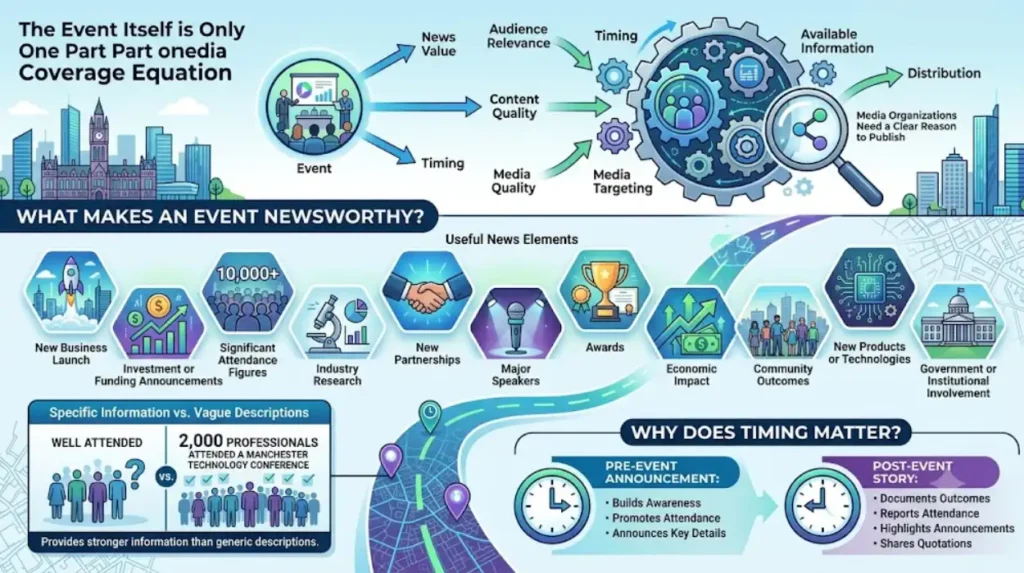
The event itself is only one part of the coverage equation. Media organisations need a clear reason to publish the story.
What makes an event newsworthy?
Newsworthiness comes from identifiable developments and measurable information.
Useful news elements include:
- A new business launch
- Investment or funding announcements
- Significant attendance figures
- Industry research
- New partnerships
- Major speakers
- Awards
- Economic impact
- Community outcomes
- New products or technologies
- Government or institutional involvement
Specific information gives journalists material that can support a factual story.
For example, stating that 2,000 professionals attended a Manchester technology conference provides stronger information than describing the event as “well attended.”
Why does timing matter?
Timing affects the relevance of event announcements and post-event coverage.
A pre-event announcement gives audiences information about what is happening. A post-event story provides outcomes, attendance, announcements, results, or quotations.
The two formats serve different purposes.
Pre-event coverage supports awareness and attendance. Post-event coverage documents what happened and provides evidence of the event’s significance.
How does a Manchester event story become more suitable for multiple news sites?
A Manchester event story becomes more suitable for multiple news sites when its core information is clear, factual, relevant, and adaptable to different editorial audiences. Strong structure allows regional, national, business, and trade publications to identify usable information quickly.
A multi-outlet approach requires more than repeating an event title across media channels.
The story needs a clear central announcement. Supporting facts then establish context and relevance.
Which elements belong in a strong event story?
A structured event story normally includes:
- A precise headline
- A clear opening paragraph
- Event name and location
- Date and time
- Organiser information
- Purpose of the event
- Key speakers or participants
- Attendance information
- Major announcements
- Relevant quotations
- Supporting statistics
- Contact information
The opening paragraph carries the primary news point. Supporting paragraphs provide evidence and context.
This structure helps media professionals assess the story efficiently.
How does localisation improve Manchester event coverage?
Localisation connects the event to its Manchester setting.
Useful local details include the venue, Manchester district, participating organisations, economic relevance, local employment impact, and community involvement.
For example, an event hosted at Manchester Central can include information about the venue, expected attendance, participating organisations, and its relevance to Manchester’s business or cultural ecosystem.
Local details create stronger relevance for regional publications while supporting wider context for national outlets.
How does media distribution differ from guaranteed publication?
Media distribution sends an event story to selected media channels, while publication depends on each outlet’s editorial process. Distribution expands access to relevant media organisations, but individual publishers retain control over whether and how they publish supplied information.
This distinction matters when evaluating Manchester event coverage services.
A distribution provider can organise delivery across a defined media network. Publication remains an editorial decision at the receiving outlet.
Different coverage models therefore produce different outcomes.
What are the main Manchester event coverage models?
Common approaches include:
Direct media outreach:
A PR team contacts individual journalists and publications based on the event’s subject.
Press release distribution:
A prepared release is distributed across a network of relevant media outlets.
Syndication:
The same or substantially similar news content appears across participating digital publications.
Editorial pitching:
A specific story angle is presented to selected journalists for potential independent coverage.
Integrated distribution:
A campaign combines press release distribution, targeted outreach, interviews, and supporting media assets.
Each model has a different purpose. Direct outreach prioritises targeted relationships. Distribution prioritises reach. Syndication increases the number of locations where the information appears.
What benefits does wider Manchester event coverage provide?
Wider Manchester event coverage increases the number of media environments where an event, organisation, speaker, or announcement appears. It supports discoverability, creates third-party references, provides searchable coverage, and connects the event with relevant UK audiences.
Coverage provides several measurable communication benefits.
How does coverage support search visibility?
Published event stories create indexable references across news websites.
Relevant coverage can contain the event name, organisation name, speaker names, venue, city, topic, and announcement details.
These entities help search engines understand relationships between the event and its surrounding context.
For organisations using search as part of their communication strategy, consistent factual references provide useful supporting signals.
This connects with the educational discussion in:
Manchester Events National News Coverage
How does coverage support credibility?
Third-party publication gives an event information a media context separate from the organiser’s own website.
A published article can provide another source where audiences encounter the event or organisation.
The value depends on the relevance and quality of the publication. A relevant trade publication provides specialist context. A Manchester publication provides local context. A national publication provides broader UK exposure.
Which Manchester events benefit most from a multi-channel approach?
Events with clear business, cultural, technological, sporting, educational, or community relevance benefit from media coverage across multiple channel types. The strongest approach matches the event’s subject with publications whose audiences already consume related information.
Different event categories require different media priorities.
Which business events fit this approach?
Business conferences, leadership events, investment forums, networking events, and corporate launches often require business and regional coverage.
A Manchester technology conference, for example, can target technology publications, business media, regional outlets, and specialist industry websites.
Which cultural and entertainment events fit this approach?
Festivals, exhibitions, performances, arts programmes, and major cultural events can target regional media, entertainment publications, tourism outlets, and lifestyle news websites.
The strongest stories contain specific information about performers, attendance, programme details, venue activity, or cultural impact.
Which professional events fit this approach?
Professional conferences and exhibitions often benefit from trade publication coverage.
Examples include construction exhibitions, healthcare conferences, financial technology events, engineering forums, and education conferences.
Trade media provides direct access to specialist audiences while regional coverage establishes the Manchester connection.
How can organisations evaluate Manchester event coverage options?
Organisations can evaluate event coverage options by comparing media reach, publication relevance, distribution method, reporting transparency, targeting capabilities, turnaround times, and campaign objectives. The evaluation focuses on measurable coverage requirements rather than publication volume alone.
A useful evaluation framework includes six areas.
- Media relevance: Does the network include publications related to the event?
- Geographical reach: Does coverage include Manchester, regional UK, national, or specialist outlets?
- Distribution model: Does the provider offer direct outreach, syndication, distribution, or a combined approach?
- Reporting: Does the campaign provide publication details and coverage records?
- Content support: Does the service support headlines, formatting, quotes, and media assets?
- Objective alignment: Does the coverage model match awareness, attendance, reputation, search visibility, or post-event reporting goals?
This evaluation creates a clearer basis for comparing event coverage solutions before selecting a provider.
For organisations ready to assess a specific service option,
Manchester Event News Coverage
What does effective Manchester event coverage look like in practice?
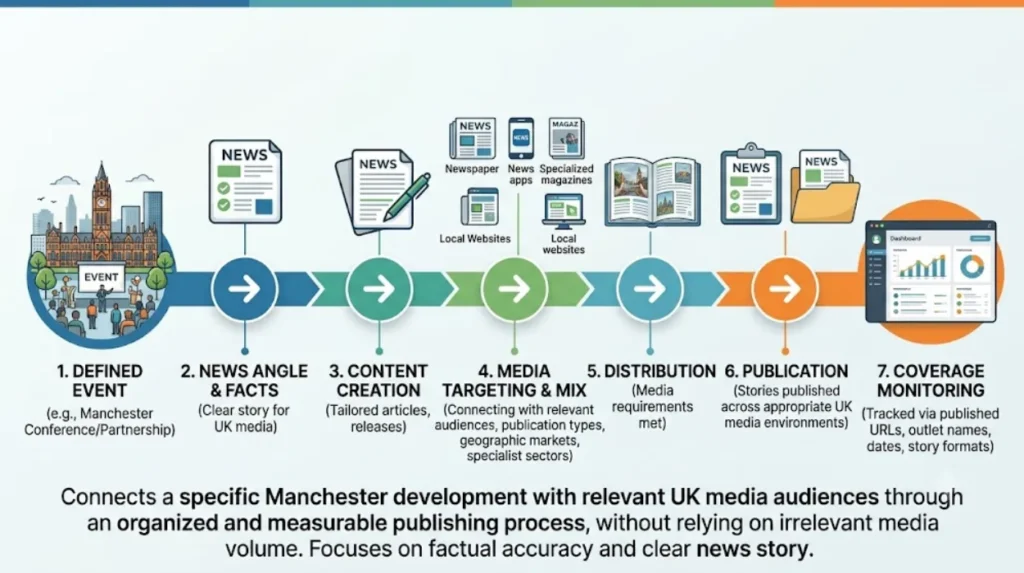
Effective Manchester event coverage presents one clear news story across relevant UK media environments while preserving factual accuracy. It connects the event with appropriate audiences, publication types, geographic markets, and specialist sectors without relying on irrelevant media volume.
A successful campaign begins with a defined objective.
An event organiser seeking local awareness needs a different media mix from a company announcing a national business partnership at a Manchester conference.
The story then requires a clear news angle and supporting facts. Distribution follows the media requirements. Coverage is monitored through published URLs, outlet names, publication dates, and story formats.
Explore More Expert Insights:
How London Event Coverage Reaches 15 News Sites Simultaneously
Crisis-Proofing Your UK Event: How to Handle Negative Coverage Before It Happens
This creates a structured process:
Event → News angle → Content → Media targeting → Distribution → Publication → Coverage monitoring
Manchester event coverage therefore extends beyond simply announcing that an event exists. It connects a specific Manchester development with relevant UK media audiences through an organised and measurable publishing process.