Hospitality businesses operate in an environment where guest confidence changes quickly. A service disruption, health incident, cyberattack, operational failure, or public complaint reaches thousands of people within minutes through news outlets and social media. A structured crisis communication framework allows hotels, resorts, restaurants, entertainment venues, and travel businesses to issue accurate statements rapidly while protecting credibility and retaining guest loyalty.
A crisis communication framework defines responsibilities, approval processes, communication channels, and message structures before an incident occurs. Instead of creating responses under pressure, organisations follow a documented process that delivers consistent, factual, and timely information.
Understanding the impact of service failures provides useful context before building a communication strategy. For broader background, see:
What Happens to a Hospitality Brand’s Reputation During a Public Relations or Service Crisis?
Why does a crisis communication framework matter for hospitality businesses?
A crisis communication framework enables hospitality organisations to deliver verified information within defined timelines, reduce uncertainty, maintain operational consistency, protect guest confidence, support regulatory compliance, and preserve long-term brand reputation through coordinated communication before, during, and after a crisis event.
Hospitality depends on trust. Guests purchase experiences before they consume them. They book accommodation, event tickets, dining reservations, and entertainment services based on expectations of safety, reliability, and professionalism.
When an incident occurs, silence creates uncertainty. Delayed communication encourages speculation. Contradictory updates reduce credibility.
A documented framework replaces uncertainty with structured action.
Examples include:
- A hotel responding to a major water supply failure.
- A concert venue communicating after an evacuation.
- A restaurant addressing a food safety investigation.
- A resort managing guest communication following severe weather disruption.
Each situation requires rapid, factual communication rather than reactive messaging.
What defines a crisis communication framework?
A crisis communication framework is a documented system that specifies:
- Crisis classification levels
- Internal reporting procedures
- Authorised spokespersons
- Message approval workflow
- Stakeholder communication priorities
- Distribution channels
- Monitoring and update schedules
- Post-crisis evaluation
Every participant understands their responsibility before an incident develops.
How does a hospitality crisis communication framework work?
An effective framework follows sequential operational stages including incident verification, team activation, stakeholder identification, statement development, approval, publication, continuous monitoring, scheduled updates, and post-incident evaluation using predefined communication protocols and measurable response objectives across every communication channel.
Speed without accuracy damages credibility.
The communication process follows clearly defined stages.
Incident verification
The organisation confirms verified facts.
Teams establish:
- What happened
- When it occurred
- Who is affected
- Which services remain operational
- Which authorities are involved
Only verified information enters public statements.
Crisis team activation
Most hospitality organisations establish a dedicated crisis communication team including:
- Executive leadership
- Operations manager
- Communications lead
- Legal adviser
- Customer service manager
- Human resources representative
- IT security specialist where relevant
Roles remain predefined.
Stakeholder identification
Different audiences require different information.
Primary stakeholders include:
- Guests
- Employees
- Suppliers
- Media
- Local authorities
- Business partners
- Investors
- Travel agencies
Each audience receives relevant operational information.
Statement preparation
The first public statement communicates:
- Confirmation of awareness
- Verified facts
- Immediate actions
- Guest safety priorities
- Next update schedule
The statement avoids speculation.
Ongoing communication
Updates continue at scheduled intervals.
Regular communication demonstrates organisational control even when investigations continue.
What should every rapid crisis statement include?
Every rapid crisis statement contains verified facts, acknowledgement of the incident, immediate operational actions, guest support information, safety priorities, designated contact channels, investigation status, and a commitment to provide scheduled updates using consistent factual language across every platform.
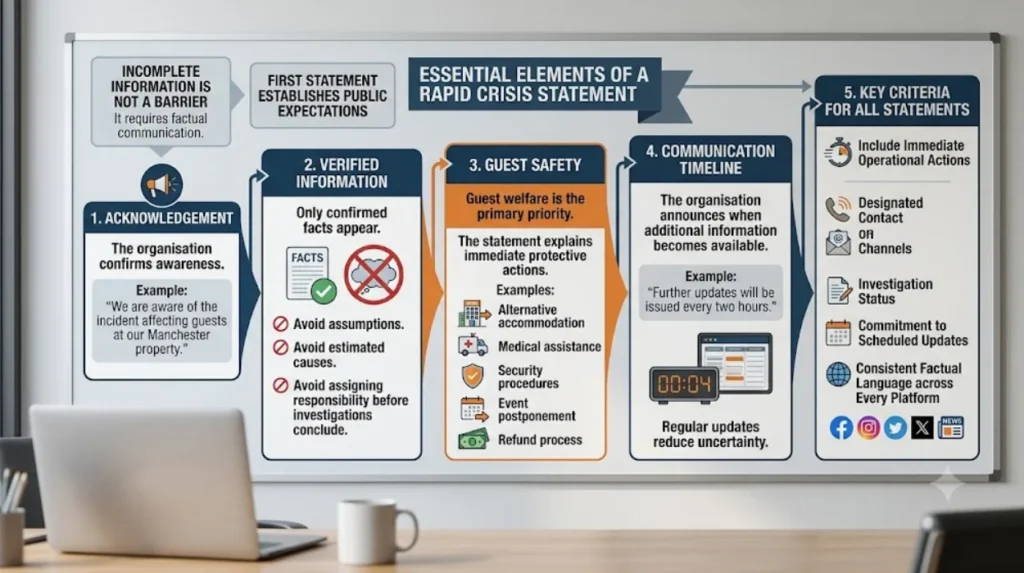
The first statement establishes public expectations.
Incomplete information does not prevent communication. It requires factual communication.
Acknowledgement
The organisation confirms awareness.
Example:
“We are aware of the incident affecting guests at our Manchester property.”
Verified information
Only confirmed facts appear.
Avoid assumptions.
Avoid estimated causes.
Avoid assigning responsibility before investigations conclude.
Guest safety
Guest welfare remains the primary priority.
The statement explains immediate protective actions.
Examples include:
- Alternative accommodation
- Medical assistance
- Security procedures
- Event postponement
- Refund process
Communication timeline
The organisation announces when additional information becomes available.
Example:
“Further updates will be issued every two hours.”
Regular updates reduce uncertainty.
Which communication channels deliver crisis updates most effectively?
Hospitality organisations achieve stronger communication consistency by distributing identical verified messages across websites, email, social media, customer support teams, mobile applications, media statements, booking platforms, and partner communication systems through coordinated publication schedules and central approval processes.
Guests receive information through different channels.
Consistency becomes essential.
Official website
The website serves as the primary reference point.
Updates remain accessible throughout the incident.
Email communication
Existing guests receive operational information directly.
Email provides:
- Reservation updates
- Service changes
- Compensation procedures
- Safety guidance
Social media
Social platforms distribute rapid updates.
Every published message matches official statements.
Social teams answer questions using approved responses.
Media statements
Journalists require verified information.
A designated spokesperson manages interviews.
Only authorised representatives speak publicly.
Customer support
Call centres require identical guidance.
Support teams use approved scripts that match published statements.
How does rapid communication help retain guest loyalty?
Rapid factual communication strengthens guest confidence by reducing uncertainty, demonstrating accountability, explaining operational recovery, providing realistic expectations, maintaining transparent dialogue, and supporting positive long-term relationships even after significant service disruption or public reputation challenges.
Guests evaluate organisations during difficult situations.
Communication influences perception alongside operational recovery.
Transparency builds confidence
Clear information reduces confusion.
Guests understand:
- Current situation
- Available services
- Expected timelines
- Support options
Transparency reduces misinformation.
Consistency strengthens credibility
Every department communicates identical information.
Guests receive consistent answers from:
- Reception
- Customer support
- Social media
- Management
- Public statements
Consistency reinforces organisational control.
Visible recovery planning
Communication explains operational recovery.
Examples include:
- Facility reopening schedules
- Reservation transfers
- Service restoration
- Guest compensation processes
Guests understand what happens next.
What common mistakes reduce the effectiveness of crisis communication?
Hospitality organisations weaken crisis responses through delayed statements, inconsistent messaging, unverified information, excessive technical language, unclear responsibilities, missing update schedules, fragmented communication channels, and failure to address stakeholder concerns using transparent factual communication.
Many communication failures result from poor preparation rather than the original incident.
Delayed communication
Silence creates speculation.
News spreads faster than official statements.
Delayed responses reduce trust.
Multiple spokespersons
Different representatives issuing different information create confusion.
One communication lead maintains consistency.
Speculation
Unverified explanations create legal and reputational risks.
Every statement relies on confirmed evidence.
Irregular updates
Guests expect continuous information.
Even when investigations continue, scheduled updates demonstrate ongoing management.
How can hospitality organisations prepare before a crisis occurs?
Preparation includes developing documented communication plans, training spokespersons, creating statement templates, conducting simulation exercises, maintaining stakeholder databases, testing approval workflows, monitoring digital channels, and reviewing communication performance through regular operational assessments and crisis rehearsals.
Preparation determines communication speed.
Organisations create systems before emergencies occur.
Build communication templates
Templates reduce drafting time.
Prepared templates cover:
- Service disruption
- Weather events
- Security incidents
- Food safety investigations
- Technology outages
- Data breaches
Each template supports faster publication.
Conduct simulation exercises
Regular crisis exercises test:
- Decision-making
- Approval times
- Internal coordination
- Public messaging
- Media response
Exercises identify operational gaps before real incidents occur.
Monitor digital conversations
Organisations monitor:
- Social media
- Review platforms
- News coverage
- Customer feedback
- Industry publications
Early detection supports faster communication.
Explore More Expert Insights:
Crafting an Authoritative Press Release Layout for Complex Venue Rebrands and Pivots
Maximizing Post-Launch Momentum: Turning Event Syndication into Long-Tail Search Traffic
How do hospitality organisations choose suitable crisis communication support?
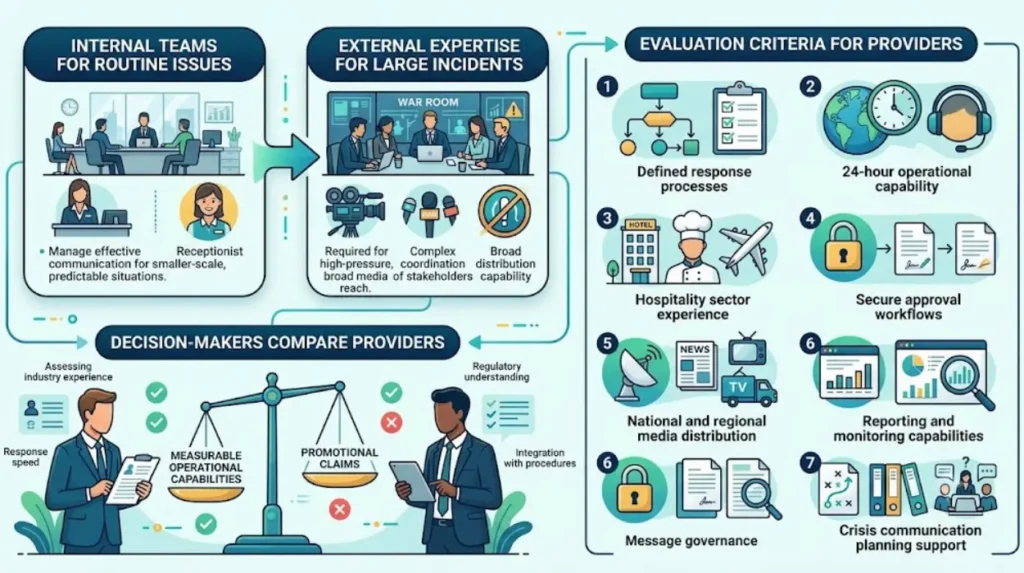
Hospitality organisations evaluate communication support by assessing industry experience, response speed, distribution capability, media relationships, message governance, reporting transparency, regulatory understanding, and integration with existing crisis management procedures for coordinated stakeholder communication during high-pressure situations.
Internal teams often manage routine communication effectively.
Large-scale incidents frequently require additional communication expertise, broader media distribution, and structured stakeholder coordination.
Evaluation criteria include:
- Defined response processes
- 24-hour operational capability
- Hospitality sector experience
- Secure approval workflows
- National and regional media distribution
- Reporting and monitoring capabilities
- Crisis communication planning support
Decision-makers compare providers using measurable operational capabilities instead of promotional claims.
Businesses planning communication partnerships can continue with:
Secure PR Distribution to evaluate structured distribution support during high-impact reputation events.
A crisis communication framework transforms emergency communication into a structured operational process. It replaces uncertainty with verified information, defined responsibilities, consistent messaging, and scheduled updates.
Hospitality organisations that prepare communication frameworks before incidents occur respond faster, protect guest confidence more effectively, and support long-term reputation recovery. Rapid statements alone do not retain guest loyalty. Accurate information, transparent communication, coordinated delivery, and continuous updates establish the trust that guests expect throughout every stage of a crisis.