
A press distribution strategy for co-branded retail partnerships is a planned system for announcing collaborations through relevant media channels. It aligns brand messages, audiences, timing, publications, and distribution targets around one partnership announcement.
A co-branded retail partnership involves two businesses presenting a joint product, campaign, collection, retail placement, or commercial initiative. The announcement carries value for both organisations because it combines their audiences and commercial positioning.
Press distribution gives the partnership structured media visibility. It moves the announcement beyond owned channels such as company websites, email lists, and social media accounts.
The strategy defines what gets announced, who receives it, where it appears, and when it is distributed.
For example, a UK skincare startup entering a national retailer can target retail trade publications, beauty media, regional publications, consumer lifestyle outlets, and business press. Each channel serves a different audience.
Businesses developing credibility against larger competitors can also review the principles covered in:
Why does a co-branded retail partnership require a different distribution strategy?
A co-branded partnership requires coordinated distribution because two brands share one news event. The strategy must represent both organisations accurately, protect message consistency, address separate audiences, and identify publications with relevance to the partnership.
A standard company announcement focuses on one organisation. A co-branded announcement contains at least two commercial identities.
This creates additional distribution requirements.
Shared brand positioning
The release needs a clear explanation of why the partnership exists. The announcement must identify the product, campaign, retail launch, or commercial development without giving one partner disproportionate attention.
Multiple audience groups
Each partner has its own customers, stakeholders, investors, suppliers, and industry contacts. The distribution strategy identifies where these groups consume business and consumer news.
Coordinated approval
Both organisations need agreement on:
- Headline
- Key messages
- Executive quotes
- Product information
- Launch date
- Retail availability
- Images
- Links
- Contact details
A defined approval process reduces inconsistencies between the press release and other campaign assets.
How do you define the news angle before distributing the announcement?
The news angle identifies the specific development that makes the partnership relevant to journalists. A strong angle focuses on a measurable change, launch, retail expansion, customer benefit, market development, or commercial milestone rather than the partnership alone.
“Brand A partners with Brand B” provides basic information. It does not explain why the announcement matters.
A stronger angle identifies the business development created by the collaboration.
Identify the commercial change
The announcement can focus on:
- A new retail listing
- A limited-edition product
- A national launch
- A new customer segment
- A product innovation
- A retail expansion
- A sustainability initiative
- A seasonal campaign
For example, a D2C food brand entering 250 UK retail locations has a clearer distribution angle than an announcement that simply states the companies have formed a partnership.
Quantify the development
Specific numbers create clearer news value.
Useful details include:
- Number of retail locations
- Launch date
- Number of products
- Geographic coverage
- Production volume
- Campaign duration
- Customer reach
- New market territories
The figures must be factual and approved by both partners.
Which media channels are relevant to a co-branded retail announcement?
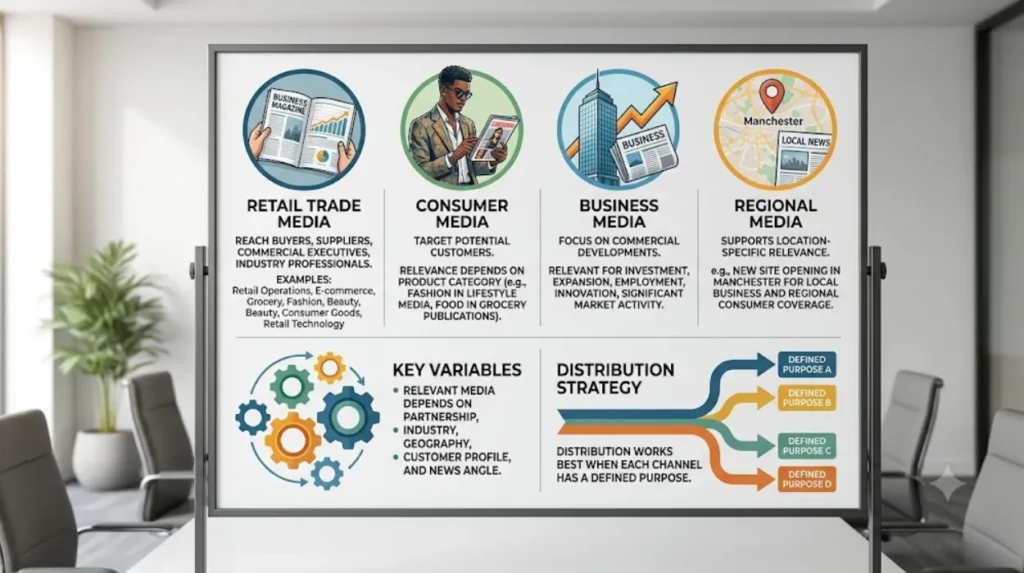
Relevant media channels depend on the partnership, industry, geography, customer profile, and news angle. A UK retail announcement can require a combination of retail trade media, consumer publications, business press, regional outlets, and sector-specific publications.
Distribution works best when each channel has a defined purpose.
Retail trade media
Retail publications reach buyers, suppliers, commercial executives, and industry professionals.
Examples include coverage focused on:
- Retail operations
- E-commerce
- Grocery
- Fashion
- Beauty
- Consumer goods
- Retail technology
Consumer media
Consumer publications target potential customers. Their relevance depends on the product category.
A fashion collaboration belongs in relevant fashion and lifestyle media. A food partnership belongs in food, grocery, and consumer-interest publications.
Business media
Business publications focus on commercial developments. These outlets become relevant when the partnership involves investment, expansion, employment, innovation, or significant market activity.
Regional media
Regional distribution supports partnerships with location-specific relevance.
For example, a retailer opening a new site in Manchester can support local business and regional consumer coverage alongside national distribution.
How should you segment the media list for a partnership campaign?
Media segmentation divides the distribution list into defined groups based on relevance, audience, geography, and industry. This structure prevents identical messaging from being sent without considering each publication’s editorial focus and readership.
A segmented list provides greater control over distribution.
Segment by audience
Create groups for:
- Retail professionals
- Consumer audiences
- Business audiences
- Industry specialists
- Regional audiences
Segment by geography
UK campaigns can include:
- National publications
- Regional publications
- City-level media
- Specialist geographic outlets
Geographic targeting becomes important when the partnership has physical retail locations.
Segment by industry
A partnership between a beauty brand and a department store requires different specialist outlets from a fintech brand entering a technology retailer.
Industry relevance improves the accuracy of media selection.
When should a co-branded retail partnership press release be distributed?
Distribution timing must align with the partnership launch, retail availability, campaign activity, and editorial planning. The release date needs coordination between both partners so media coverage appears when customers can act on the announcement.
Timing affects both relevance and commercial usefulness.
Coordinate with the retail launch
The press release needs a clear relationship with the public launch date.
If products become available on 15 September, distribution planning needs to account for:
- Announcement date
- Retail availability
- Website updates
- Social campaign launch
- Media outreach
- Influencer activity
- Promotional activity
Account for UK calendar events
Retail campaigns often operate around:
- Christmas
- Black Friday
- Easter
- Summer sales
- Back-to-school periods
- Bank holidays
- Major shopping events
The distribution schedule needs to reflect these periods because editorial demand changes throughout the year.
Build an approval deadline
Both brands need enough time to review the final release. A practical workflow assigns deadlines for copy approval, legal review, image approval, contact verification, and distribution.
What should a co-branded press release include?
A co-branded press release needs a specific headline, concise partnership explanation, verified facts, executive quotes, product or retail details, launch information, supporting links, and contact information for media enquiries.
The structure needs to make the announcement understandable without additional explanation.
Recommended structure
Headline: State the partnership and primary news.
Subheadline: Add the commercial or consumer significance.
Opening paragraph: Explain who is partnering, what is launching, where it is available, and when it begins.
Partnership details: Explain the purpose and scope.
Executive quotes: Include approved statements from both partners.
Product or campaign information: Provide relevant details, pricing, availability, locations, or dates.
Company boilerplates: Define each organisation clearly.
Media contact: Provide a reliable contact route.
The release also needs consistent spelling, product names, company names, dates, and numerical claims.
How can brands coordinate messaging between both partners?
Messaging coordination establishes one factual narrative while preserving each partner’s positioning. Both organisations need approved terminology, consistent launch details, aligned quotes, and agreed descriptions before the press release enters distribution.
A messaging document can define the approved language.
Establish shared facts
Both partners need agreement on:
- Partnership purpose
- Product names
- Launch dates
- Retail locations
- Availability
- Pricing
- Campaign duration
- Executive names and titles
- Company descriptions
Separate shared and individual messages
The central announcement explains the partnership. Individual brand messages can then explain each organisation’s role.
This structure prevents conflicting claims across press releases, websites, social posts, and retailer pages.
How should distribution performance be measured?
Distribution performance needs measurable indicators linked to visibility, relevance, engagement, and business objectives. Coverage volume alone does not establish campaign quality because ten relevant placements can provide more strategic value than dozens of unrelated mentions.
A measurement framework connects media activity with campaign objectives.
Track coverage
Useful measures include:
- Number of media placements
- Publication relevance
- National versus regional coverage
- Trade versus consumer coverage
- Brand mentions
- Partnership mentions
- Publication audience
- Geographic coverage
Track digital visibility
Additional indicators include:
- Referral traffic
- Branded search activity
- Backlinks
- Landing-page visits
- Engagement with campaign content
- Product-page traffic
The measurement period needs a defined start and end date.
For example, a campaign can measure results from seven days before launch through 30 days after launch.
What are the main benefits of a structured co-branded distribution strategy?
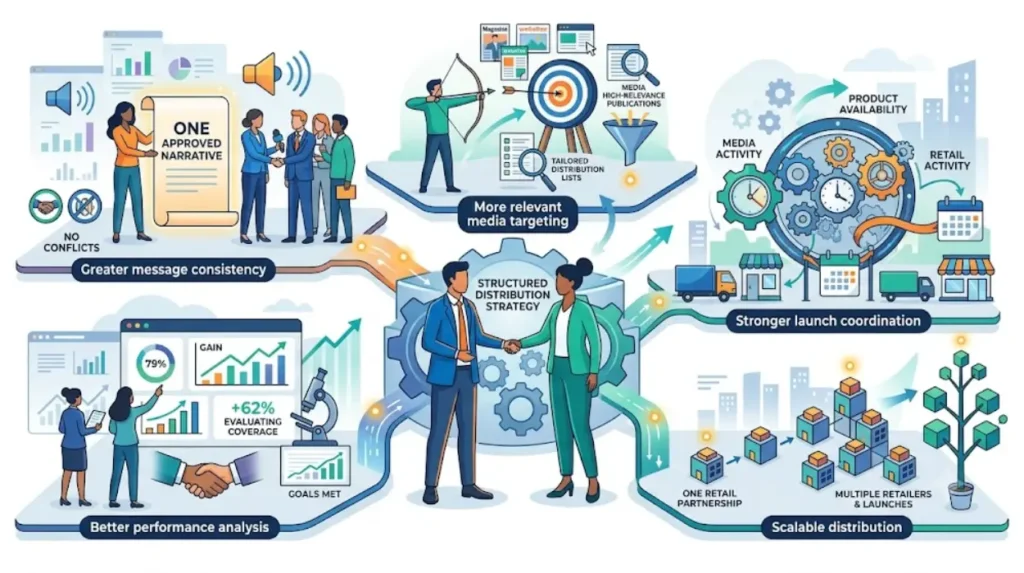
A structured strategy creates consistent messaging, targeted media exposure, coordinated launch timing, clearer performance measurement, and stronger alignment between retail activity and public relations. It also gives both partners a defined process for managing media distribution.
The benefits extend across the campaign lifecycle.
Greater message consistency
One approved narrative reduces conflicting information.
More relevant media targeting
Segmented distribution places the announcement in front of publications connected to the partnership.
Stronger launch coordination
Media activity aligns with product availability and retail activity.
Better performance analysis
Defined metrics provide a consistent basis for evaluating coverage.
Scalable distribution
The same framework can support one retail partnership or a wider programme involving multiple retailers and product launches.
Explore More Expert Insights:
Timing Your Campaign: How to Synchronize Press Releases with Major Seasonal Sales Events
How to Build an E-commerce Digital Press Kit That Captures the Attention of Lifestyle Editors
How does strategic distribution support the next stage of PR planning?
Strategic distribution provides a foundation for evaluating suitable media channels, service models, targeting requirements, reporting standards, and campaign support. This helps brands compare distribution approaches before committing resources to future partnership announcements.
The focus moves from understanding media visibility to evaluating how distribution can be organised.
A D2C brand entering retail can assess whether it needs:
- National distribution
- Regional targeting
- Retail trade coverage
- Consumer media distribution
- Sector-specific distribution
- Campaign timing support
- Coverage reporting
- Custom media targeting
This assessment creates a practical bridge between educational PR planning and provider evaluation.
For brands assessing specialist distribution options, provides the next step for examining:
How tailored campaigns support D2C announcements.
A successful co-branded retail campaign requires more than publishing a press release. It requires a defined news angle, coordinated messaging, segmented media targeting, precise timing, and measurable distribution. These components turn a partnership announcement into a structured media campaign aligned with both brands and the retail launch.