
Financial startups operate in one of the most heavily regulated sectors in the United Kingdom. Every public statement, financial report, customer communication, and regulatory submission depends on accurate data and compliance with legal requirements. Strong compliance frameworks and reliable data reduce operational risk, improve transparency, and strengthen stakeholder confidence. Understanding these principles helps financial startups build sustainable operations from the beginning.
Why do regulatory compliance and data accuracy matter for financial startups?
Regulatory compliance establishes legal accountability, while data accuracy ensures information remains correct, complete, and verifiable. Together, these foundations reduce legal exposure, improve operational reliability, support informed decision-making, protect consumers, and strengthen trust among investors, regulators, business partners, employees, and financial institutions across the United Kingdom.
Financial startups manage sensitive financial information every day. This includes customer identities, transaction records, payment histories, lending data, investment information, and financial statements. Every dataset supports business operations and regulatory obligations.
Regulatory compliance refers to following laws, regulations, and industry standards that govern financial activities. Data accuracy refers to maintaining information that is complete, current, consistent, and free from material errors.
Both disciplines work together. Accurate information supports compliance reporting, while compliance processes improve data governance.
What is regulatory compliance?
Regulatory compliance is the process of meeting legal and regulatory requirements established by government authorities and financial regulators.
Examples include:
- Customer identity verification
- Anti-money laundering controls
- Financial crime monitoring
- Consumer protection obligations
- Data privacy compliance
- Financial reporting requirements
Each requirement defines specific operational responsibilities.
What is data accuracy?
Data accuracy means information correctly represents real-world financial events.
Accurate financial data includes:
- Correct customer details
- Verified transaction values
- Updated account balances
- Complete audit records
- Consistent reporting figures
Errors reduce operational reliability and increase regulatory risk.
Which regulations affect financial startups in the United Kingdom?
United Kingdom financial startups operate under multiple legal frameworks covering financial conduct, consumer protection, anti-money laundering, payment services, and personal information. Understanding each regulatory requirement helps organisations establish compliant processes, maintain accurate reporting, reduce enforcement risk, and protect customer interests consistently throughout business operations.
Different business models face different regulatory obligations.
Payment providers follow payment regulations.
Investment businesses comply with investment rules.
Digital lenders follow lending regulations.
Insurance technology firms meet insurance requirements.
Despite these differences, several regulatory areas affect most financial startups.
Financial conduct regulation
Financial conduct regulation promotes fair markets, transparent communication, and consumer protection.
Businesses document procedures, monitor activities, and maintain evidence supporting compliance.
Anti-money laundering requirements
Anti-money laundering frameworks identify suspicious financial activity.
Core activities include:
- Customer due diligence
- Identity verification
- Risk assessment
- Transaction monitoring
- Record retention
- Suspicious activity reporting
Accurate customer information supports every stage.
Data protection obligations
Financial organisations process significant volumes of personal information.
Data protection requirements include:
- Secure storage
- Controlled access
- Lawful processing
- Data minimisation
- Breach reporting
- Individual privacy rights
Reliable information management improves compliance outcomes.
How does inaccurate data create regulatory risk?

Incorrect financial information affects regulatory reporting, customer verification, financial statements, operational controls, and internal governance. Even small inaccuracies accumulate across systems, creating compliance failures, reporting inconsistencies, investigation delays, customer complaints, financial losses, and increased scrutiny from supervisory authorities over extended reporting periods.
Financial systems rely on connected information.
One inaccurate customer record affects several downstream processes.
Examples include:
- Incorrect account ownership
- Invalid transaction history
- Duplicate customer records
- Missing identity documents
- Incorrect payment instructions
Each error increases operational complexity.
Reporting inaccuracies
Financial reports support regulatory oversight.
Incorrect reports delay regulatory reviews and create unnecessary investigations.
Examples include:
- Incorrect revenue figures
- Missing transaction records
- Duplicate reporting
- Classification errors
Reliable reporting depends on validated information.
Customer verification failures
Know Your Customer procedures require accurate identity information.
Verification failures delay onboarding.
Incorrect records increase fraud exposure and operational costs.
Audit complications
Auditors verify financial information against supporting evidence.
Incomplete records extend audit timelines.
Accurate documentation improves audit efficiency.
How does strong data governance improve compliance?
Data governance establishes formal policies for collecting, storing, validating, updating, protecting, and monitoring information throughout its lifecycle. Structured governance improves reporting consistency, strengthens internal controls, supports regulatory examinations, reduces operational errors, and improves organisational accountability across every business function and reporting process.
Data governance defines ownership.
Each dataset has assigned responsibilities.
Teams understand who creates, reviews, updates, and approves information.
Data quality controls
Effective controls include:
- Validation rules
- Duplicate detection
- Standardised data formats
- Automated error checking
- Scheduled reviews
Each control reduces avoidable mistakes.
Access management
Only authorised personnel access sensitive information.
Role-based permissions reduce unnecessary exposure.
Access logs improve accountability.
Documentation standards
Clear documentation explains:
- Data sources
- Processing methods
- Approval workflows
- Change history
- Record retention schedules
Documentation supports regulatory examinations.
Why does compliance strengthen investor and customer confidence?
Transparent governance, accurate reporting, and consistent regulatory compliance demonstrate operational discipline. Investors, customers, financial institutions, and strategic partners evaluate these indicators when assessing organisational reliability, financial stability, governance maturity, operational resilience, and long-term business sustainability before establishing commercial relationships or providing investment.
Financial startups depend on trust.
Investors evaluate governance before funding decisions.
Customers evaluate security before sharing financial information.
Business partners assess compliance before integration.
Each stakeholder reviews evidence differently.
Investor expectations
Investors examine:
- Financial controls
- Reporting quality
- Internal governance
- Compliance processes
- Risk management
Reliable information supports informed investment decisions.
Customer expectations
Customers expect:
- Secure data handling
- Transparent communication
- Accurate account information
- Reliable transactions
- Prompt issue resolution
Operational accuracy improves customer confidence.
Business partnership expectations
Banks, payment providers, technology vendors, and institutional partners often conduct compliance reviews before forming commercial relationships.
Strong governance simplifies these assessments.
What practical steps improve regulatory compliance and data accuracy?
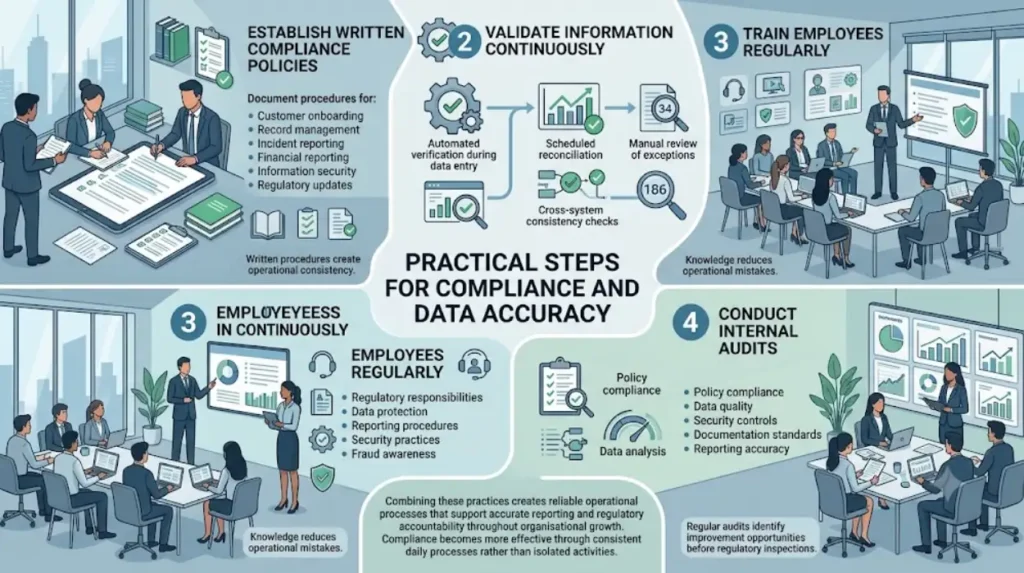
Financial startups improve compliance through documented policies, employee training, routine audits, automated validation, secure technology infrastructure, continuous monitoring, independent reviews, and structured governance. Combining these practices creates reliable operational processes that support accurate reporting and regulatory accountability throughout organisational growth.
Compliance becomes more effective through consistent daily processes rather than isolated activities.
Establish written compliance policies
Document procedures for:
- Customer onboarding
- Record management
- Incident reporting
- Financial reporting
- Information security
- Regulatory updates
Written procedures create operational consistency.
Validate information continuously
Validation occurs throughout the data lifecycle.
Examples include:
- Automated verification during data entry
- Scheduled reconciliation
- Manual review of exceptions
- Cross-system consistency checks
Continuous validation reduces accumulated errors.
Train employees regularly
Employees handle financial information every day.
Training covers:
- Regulatory responsibilities
- Data protection
- Reporting procedures
- Security practices
- Fraud awareness
Knowledge reduces operational mistakes.
Conduct internal audits
Internal audits evaluate:
- Policy compliance
- Data quality
- Security controls
- Documentation standards
- Reporting accuracy
Regular audits identify improvement opportunities before regulatory inspections.
Explore More Expert Insights:
Understanding the Impact of High-Authority Business Backlinks on Struggling FinTech SEO
How Pre-Revenue FinTech Startups Secure Placements in Premium Business Outlets
How do compliance and data accuracy support long-term business growth?
Accurate information and effective compliance systems improve operational efficiency, reduce regulatory disruption, strengthen governance, support scalable technology, improve reporting quality, increase organisational resilience, and create reliable foundations for sustainable expansion within regulated financial markets across the United Kingdom and international jurisdictions.
Growth increases operational complexity.
Customer numbers expand.
Transactions increase.
Reporting requirements become more detailed.
Strong governance scales alongside business operations.
Reliable information improves executive decision-making.
Consistent compliance reduces operational interruptions.
Structured processes improve efficiency across finance, technology, legal, risk management, and customer support functions.
Financial startups also benefit from strengthening related communication practices. Organisations planning transparent financial disclosures can explore:
Secure Digital Press Kit for additional educational context. Businesses evaluating communication infrastructure after building strong governance frameworks can reference:
Enterprise Finance PR for later-stage decision guidance.
Regulatory compliance and data accuracy form the operational foundation of every financial startup. Compliance establishes adherence to legal and regulatory obligations, while accurate data supports reliable reporting, customer protection, financial integrity, and effective governance.
Together, these practices reduce regulatory risk, strengthen internal controls, improve operational efficiency, and build lasting confidence among regulators, investors, customers, auditors, and business partners. Financial startups that establish structured compliance processes and maintain accurate information create a stable framework for responsible growth within the United Kingdom’s regulated financial sector.