
Launching a clinical announcement creates immediate visibility, but long-term digital value depends on how that visibility is preserved. Clinical PR syndication generates authoritative content across trusted publications. Medical SEO transforms those published assets into long-lasting search visibility, stronger topical authority, and continued organic discovery. Together, they extend the impact of every healthcare announcement beyond launch day.
Why does clinical PR syndication matter after a healthcare product launch?
Clinical PR syndication extends the visibility of healthcare announcements by distributing verified information across multiple trusted publications. Those published assets strengthen search authority, improve content discoverability, support ongoing education, and provide reliable references for healthcare professionals, journalists, researchers, and potential stakeholders.
A healthcare product launch often attracts attention during its first 48 to 72 hours. Interest then declines unless the published content continues generating visibility.
Clinical PR syndication is the structured distribution of healthcare announcements through recognised media outlets, industry publications, healthcare news platforms, and specialist websites. Every syndicated publication creates another indexed source containing consistent information.
Search engines evaluate authoritative healthcare content differently from general commercial content. Medical topics require high levels of expertise, accuracy, and trustworthiness. Multiple reputable publications reinforce these signals.
For example, a clinical trial announcement appearing across healthcare journals, biotechnology news websites, and medical business publications establishes stronger authority than a single company newsroom publication.
Healthcare organisations also benefit from sustained referral traffic as syndicated articles continue appearing in search results months after publication.
How does PR syndication become a medical SEO asset?
Medical SEO assets are digital resources that continue generating organic visibility after publication. Clinical press releases evolve into SEO assets through indexing, authority transfer, keyword relevance, structured content, and consistent citations across trusted healthcare publications and search engines over extended periods.
Publishing a press release is the first stage.
Long-term value comes from transforming that announcement into searchable, reusable digital assets.
Search engine indexing
Every syndicated publication becomes a searchable page.
Google indexes healthcare publications that demonstrate editorial quality and topical relevance.
Indexed articles remain accessible long after launch campaigns conclude.
Topical authority
Repeated publication around one healthcare subject strengthens topical relevance.
Examples include:
- Digital pathology software
- AI diagnostic platforms
- Remote patient monitoring systems
- Clinical decision support software
Multiple authoritative mentions reinforce expertise around those topics.
Entity recognition
Search engines identify entities rather than isolated keywords.
Healthcare entities include:
- Medical devices
- Clinical studies
- Pharmaceutical products
- Hospitals
- Research institutions
Consistent naming across syndicated publications improves entity recognition.
Long-term backlinks
Healthcare publications frequently remain online for years.
These pages continue transferring authority through citations and references.
What content elements strengthen medical SEO after syndication?
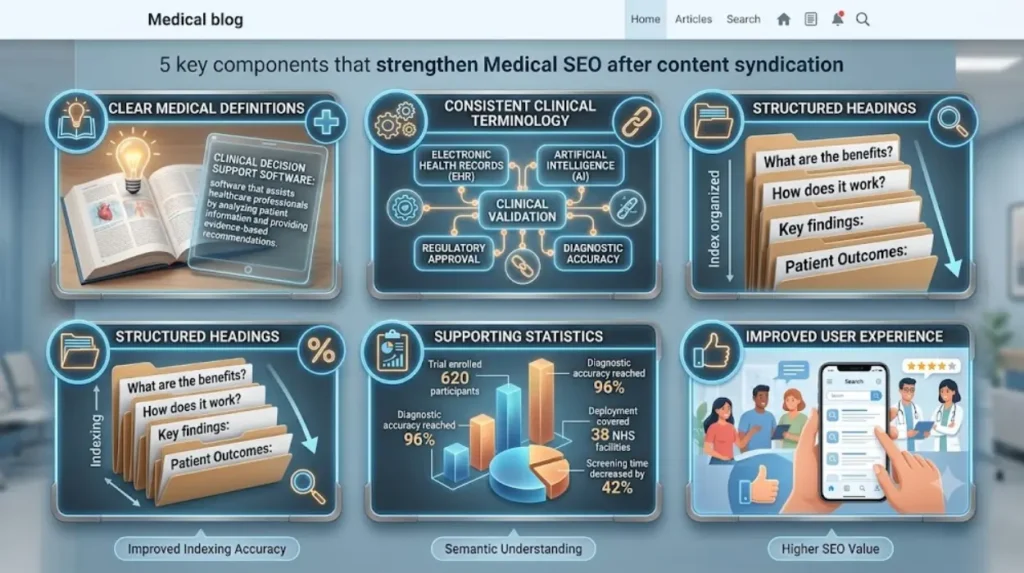
Structured healthcare content improves indexing accuracy and semantic understanding. Consistent terminology, evidence-based language, clinical definitions, factual headings, and supporting references help search engines interpret healthcare announcements while improving user experience and information retrieval across medical search results effectively.
Medical SEO depends on information quality rather than keyword repetition.
Several content components increase long-term search value.
Clear medical definitions
Every specialised healthcare term requires a concise explanation.
For example:
Clinical decision support software is software that assists healthcare professionals by analysing patient information and providing evidence-based recommendations.
This definition supports both readers and search engines.
Consistent clinical terminology
The same medical terminology appears throughout every syndicated publication.
Examples include:
- Electronic Health Records (EHR)
- Artificial Intelligence (AI)
- Clinical validation
- Regulatory approval
- Diagnostic accuracy
Consistency reduces ambiguity.
Structured headings
Well-organised headings improve readability and indexing.
Question-based headings also align with modern search behaviour.
Supporting statistics
Healthcare announcements become stronger when they include measurable information.
Examples include:
- Trial enrolled 620 participants.
- Diagnostic accuracy reached 96%.
- Deployment covered 38 NHS facilities.
- Screening time decreased by 42%.
Specific figures improve credibility.
How can syndicated clinical content support ongoing healthcare search visibility?
Syndicated healthcare publications continue attracting search traffic because search engines reward authoritative information with lasting relevance. Updated supporting content, related educational resources, and topical expansion maintain visibility while strengthening healthcare subject authority across multiple connected search queries over time.
A single announcement answers only one part of a healthcare topic.
Long-term SEO develops through connected content.
Healthcare organisations frequently expand syndicated announcements into:
- Clinical case studies
- Regulatory updates
- Medical research summaries
- Expert interviews
- Educational explainers
- Conference coverage
Every supporting article reinforces the central healthcare topic.
For example, a press release introducing an AI radiology platform can later connect with educational articles discussing imaging workflows, diagnostic validation, implementation strategies, and patient outcomes.
Healthcare publishers often maintain topic clusters that improve search visibility across dozens of related keywords.
Readers seeking educational context can continue with:
Which SEO signals increase the long-term value of healthcare PR content?
Healthcare SEO depends on authority, relevance, accuracy, freshness, and user accessibility. Clinical PR assets gain stronger search performance when these signals remain consistent across every publication, supporting page, metadata element, and referenced healthcare resource throughout the content lifecycle.
Several ranking signals influence long-term healthcare visibility.
Authority
Authoritative healthcare websites transfer credibility.
Examples include:
- Medical news publications
- Clinical research portals
- Biotechnology media
- Healthcare business journals
Relevance
Every article focuses on one healthcare topic.
Clear topical alignment improves semantic understanding.
Freshness
Updated information maintains relevance.
Examples include:
- Regulatory approvals
- Clinical milestone updates
- Product enhancements
- Expanded clinical partnerships
Fresh publications reinforce previous announcements.
Accessibility
Healthcare information remains understandable through:
- Short paragraphs
- Clear headings
- Defined terminology
- Logical structure
Better accessibility improves engagement.
How do healthcare organisations measure post-launch SEO performance?
Post-launch measurement combines search visibility, indexing performance, referral traffic, keyword rankings, engagement metrics, and publication authority. These indicators demonstrate whether syndicated healthcare announcements continue delivering discoverability and educational value beyond their original distribution period with measurable consistency over time.
Measurement begins after publication.
Several metrics demonstrate continuing performance.
Organic keyword growth
Healthcare organisations monitor rankings for:
- Product names
- Clinical conditions
- Healthcare technologies
- Treatment categories
Increasing keyword visibility indicates growing authority.
Indexed publications
Each indexed syndicated article becomes another searchable resource.
More indexed pages create broader search coverage.
Referral traffic
Healthcare media publications often generate visitors months after launch.
Referral traffic reveals ongoing audience interest.
Branded search volume
Growing searches for a healthcare product indicate increased recognition.
Topic coverage
Healthcare brands examine how broadly one announcement supports related search topics.
For example, one diagnostic platform launch can eventually rank for imaging software, radiology AI, diagnostic workflow, and hospital automation.
What role does supporting content play after PR distribution?
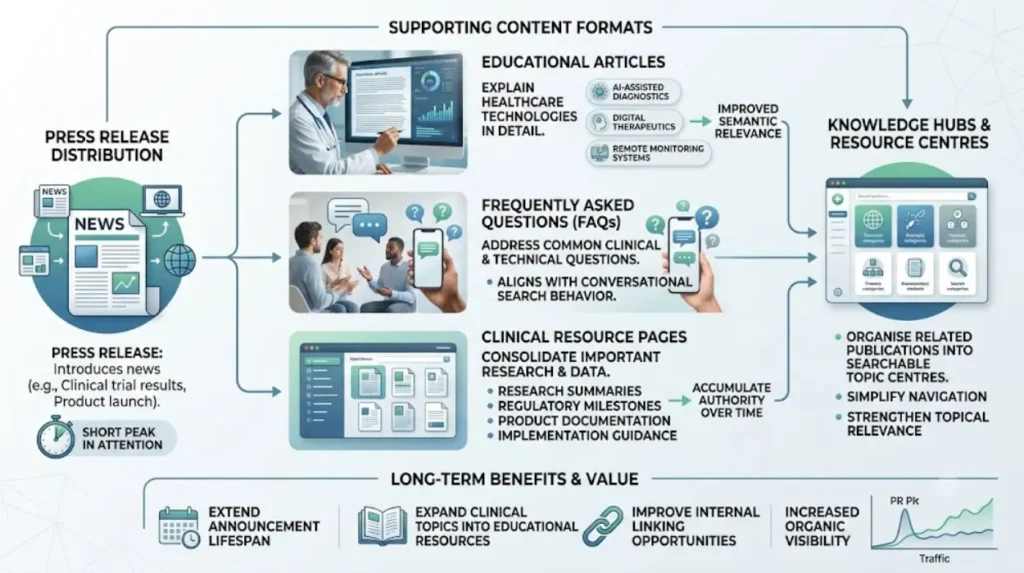
Supporting content extends the lifespan of syndicated healthcare announcements by expanding important clinical topics into detailed educational resources. This approach strengthens semantic relevance, improves internal linking opportunities, and increases organic search visibility across multiple healthcare-related information needs consistently.
Press releases introduce news.
Supporting content explains context.
Healthcare organisations commonly develop several complementary content formats.
Educational articles
These explain healthcare technologies in detail.
Examples include:
- AI-assisted diagnostics
- Digital therapeutics
- Remote monitoring systems
Frequently asked questions
FAQ content addresses common clinical and technical questions.
This format aligns with conversational search behaviour.
Clinical resource pages
Dedicated resource pages consolidate:
- Research summaries
- Regulatory milestones
- Product documentation
- Implementation guidance
These pages accumulate authority over time.
Knowledge hubs
Healthcare organisations organise related publications into searchable topic centres.
Knowledge hubs simplify navigation while strengthening topical relevance.
How does internal linking improve healthcare SEO after syndication?
Internal linking connects syndicated announcements with supporting educational content and solution-focused resources. These connections distribute page authority, improve user navigation, reinforce topical relationships, and help search engines understand the complete healthcare information structure more efficiently and accurately.
Internal linking creates logical relationships between healthcare content.
A launch announcement introduces a topic.
Educational articles provide deeper explanations.
Decision-stage resources discuss implementation options.
This structure supports both readers and search engines.
For example:
- Educational awareness content introduces healthcare communication strategies.
- Clinical syndication content explains long-term optimisation.
- Distribution guidance supports implementation planning.
Readers comparing distribution options can continue with:
Best Press Release Distribution Networks.
Logical internal linking strengthens content hierarchy while improving crawl efficiency.
What practices maximise long-term value from clinical PR syndication?
Long-term success comes from combining authoritative distribution, structured healthcare writing, consistent terminology, measurable performance tracking, supporting educational resources, and ongoing content updates. These practices transform clinical announcements into durable medical SEO assets that continue generating visibility well beyond launch activities.
Healthcare organisations gain stronger long-term results by following a structured process.
Key practices include:
- Publish clinically accurate announcements.
- Syndicate content through reputable healthcare publications.
- Use consistent medical terminology.
- Define specialised healthcare concepts clearly.
- Expand announcements into educational resources.
- Monitor indexing and keyword performance.
- Update content after significant clinical milestones.
- Build logical internal links across related healthcare topics.
Explore More Expert Insights:
Designing an Omnichannel PR Strategy for Major Healthcare Software & App Launches
Timing Your Announcement: Synchronizing Press Releases with Medical Journal Embargo Lifts
This structured approach extends the value of every healthcare announcement beyond immediate media coverage. Instead of functioning only as launch communications, syndicated clinical publications become lasting digital assets that strengthen search visibility, reinforce medical authority, and support continuous healthcare education across the United Kingdom.