HealthTech organisations operate in a highly competitive digital environment where search visibility influences patient education, healthcare awareness, professional engagement, and industry credibility. Search engines evaluate hundreds of ranking signals, and backlinks from trusted websites remain one of the strongest indicators of authority.
Understanding how high-authority backlinks work helps HealthTech organisations build stronger organic visibility while supporting accurate medical information across trusted digital platforms.
What are high-authority backlinks in HealthTech SEO?
High-authority backlinks are hyperlinks from trusted, credible, and well-established websites that point to a HealthTech website. Search engines interpret these links as signals of trust, topical relevance, expertise, and authority, which contribute directly to stronger organic search visibility and improved keyword rankings.
A backlink is a hyperlink from one website to another. In SEO, backlinks function as endorsements. When a respected website links to a HealthTech page, search engines recognise that another trusted source considers the content valuable.
High-authority websites typically possess strong domain authority, consistent editorial standards, substantial organic traffic, and recognised expertise.
Examples include:
- Government health websites
- Medical journals
- Universities
- Research institutions
- National healthcare organisations
- Established healthcare news publications
A backlink from a peer-reviewed medical journal carries significantly greater SEO value than multiple links from unrelated or low-quality websites.
What defines authority?
Authority combines several measurable factors:
- Strong backlink profile
- High editorial standards
- Relevant subject expertise
- Consistent publication history
- Positive search reputation
Search engines evaluate authority alongside topical relevance rather than considering authority alone.
Why do high-authority backlinks influence HealthTech SEO?
High-authority backlinks strengthen search engine confidence in HealthTech content by validating expertise and relevance. Trusted external references improve crawling efficiency, increase ranking potential, reinforce topical authority, and support higher visibility for competitive healthcare search terms across multiple search results.
Search engines aim to deliver accurate and trustworthy healthcare information. External validation helps them determine which pages deserve prominent rankings.
A HealthTech website receiving backlinks from recognised healthcare authorities demonstrates stronger credibility than one without reputable references.
Several ranking signals improve simultaneously.
Improved authority
Backlinks transfer authority from the linking website to the destination page.
For example:
- A university research centre links to a clinical data platform.
- A national medical association references a healthcare analytics study.
- A government healthcare department cites digital patient resources.
Each example strengthens perceived authority.
Better indexing
Search engine crawlers discover new pages through links.
Quality backlinks help search engines:
- Find new content faster.
- Revisit important pages more frequently.
- Understand relationships between healthcare topics.
Increased topical relevance
Healthcare websites benefit when backlinks originate from related medical fields.
Relevant examples include:
- Medical technology publications
- Digital health journals
- Clinical research databases
- Healthcare policy websites
Topical relevance reinforces subject expertise.
How do search engines evaluate backlink quality?
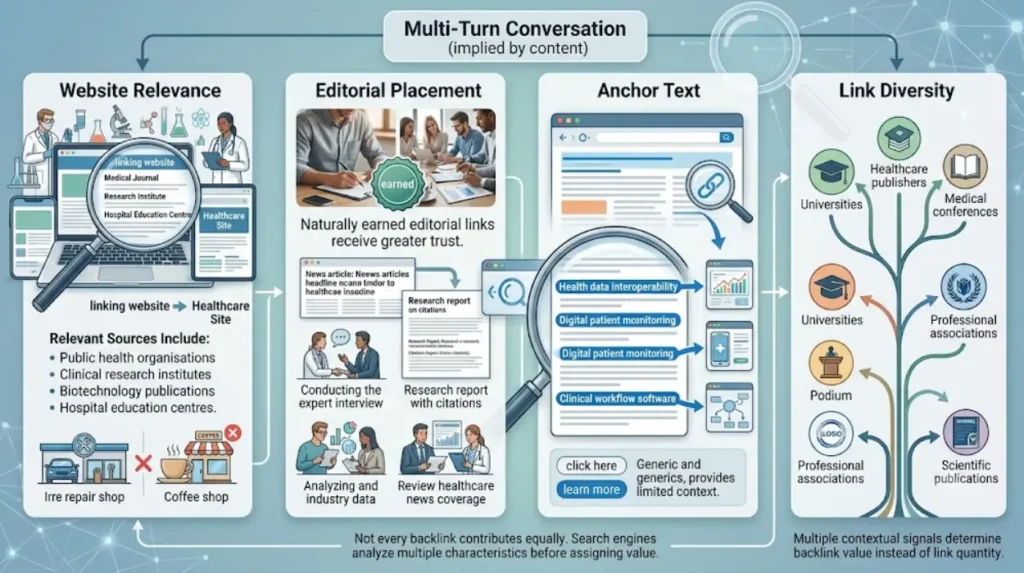
Search engines assess backlink quality using authority, topical relevance, editorial integrity, anchor text, placement, and linking patterns. Multiple contextual signals determine backlink value instead of link quantity, allowing trusted healthcare references to deliver greater SEO impact than numerous unrelated links.
Not every backlink contributes equally.
Search engines analyse multiple characteristics before assigning value.
Website relevance
The linking website must relate closely to healthcare or associated scientific disciplines.
Relevant sources include:
- Public health organisations
- Clinical research institutes
- Biotechnology publications
- Hospital education centres
Irrelevant links provide minimal contextual value.
Editorial placement
Naturally earned editorial links receive greater trust.
Examples include:
- Research citations
- Expert interviews
- Industry analysis
- Healthcare news coverage
Editorial links demonstrate independent recognition.
Anchor text
Anchor text describes the destination page.
Descriptive anchor text improves contextual understanding.
Examples include:
- Health data interoperability
- Digital patient monitoring
- Clinical workflow software
Generic phrases such as “click here” provide limited context.
Link diversity
Healthy backlink profiles contain links from different trusted sources.
Examples include:
- Universities
- Healthcare publishers
- Medical conferences
- Professional associations
- Scientific publications
Diverse backlinks create a more balanced authority profile.
How do high-authority backlinks support HealthTech visibility?
High-authority backlinks improve HealthTech visibility by increasing keyword rankings, strengthening topical authority, generating qualified referral traffic, expanding content discovery, and reinforcing trust signals that influence search engines evaluating healthcare-related information and educational resources.
Visibility extends beyond ranking first for a single keyword.
A trusted backlink profile strengthens overall website performance.
Higher keyword rankings
Authority contributes to stronger rankings for competitive healthcare searches.
Examples include:
- Remote patient monitoring
- Digital therapeutics
- Medical AI software
- Electronic health records
- Healthcare interoperability
Ranking improvements often affect multiple related keywords.
Greater referral traffic
Readers also follow backlinks.
Visitors arriving from trusted healthcare websites often demonstrate higher engagement because the referral source already established credibility.
Expanded content discovery
Healthcare content frequently addresses interconnected topics.
A recognised backlink encourages search engines to discover related articles, reports, white papers, and educational resources more efficiently.
Stronger topical authority
Multiple backlinks across related healthcare subjects establish subject depth.
For example, content covering:
- Telemedicine
- Medical cybersecurity
- Clinical AI
- Health data standards
collectively strengthens HealthTech expertise.
What types of HealthTech content naturally earn authoritative backlinks?
HealthTech content earns authoritative backlinks by providing original research, verified medical insights, industry statistics, educational resources, technical guidance, and evidence-based information that other trusted healthcare organisations reference within their own publications and research materials.
Original content attracts references more consistently than duplicated information.
Several content formats perform particularly well.
Original research
Research produces highly citable information.
Examples include:
- Patient outcome analysis
- Healthcare adoption surveys
- Medical technology reports
- Industry benchmarking studies
Original datasets often receive repeated citations.
Clinical evidence summaries
Evidence-based summaries simplify complex research.
Healthcare professionals reference concise explanations supported by recognised medical literature.
Industry statistics
Reliable healthcare statistics support journalists, researchers, educators, and policymakers.
Accurate numerical data frequently earns citations.
Educational guides
Comprehensive educational resources answer common healthcare questions.
Examples include:
- Electronic health record implementation
- Healthcare interoperability standards
- Medical device regulations
- Digital diagnostics
Structured educational content remains useful over long periods.
Readers exploring advanced communication strategies can continue with:
Which backlink practices improve HealthTech SEO safely?
Sustainable backlink practices prioritise valuable content, editorial relationships, factual accuracy, transparent citations, and healthcare expertise. Ethical approaches strengthen long-term SEO performance while reducing risks associated with manipulative link-building techniques and low-quality external references.
Healthcare content demands higher standards of accuracy and trust.
Search engines reward naturally earned references.
Publish authoritative resources
Useful resources encourage citations.
Examples include:
- Medical glossaries
- Regulatory explainers
- Healthcare compliance guides
- Research summaries
Comprehensive content attracts educational references.
Maintain factual accuracy
Healthcare information requires regular updates.
Updated statistics, revised clinical guidance, and current regulations maintain credibility.
Earn editorial citations
Independent editorial recognition provides stronger value than artificial link exchanges.
Examples include:
- Healthcare news coverage
- Expert commentary
- Academic references
- Industry reports
Editorial citations reflect genuine trust.
Build topical consistency
Publishing related healthcare content strengthens subject expertise.
Consistent coverage helps search engines understand the website’s primary focus.
What backlink mistakes reduce HealthTech SEO performance?
Low-quality backlink practices reduce HealthTech SEO performance by weakening trust signals, creating unnatural linking patterns, and introducing irrelevant references. Search engines identify manipulative behaviour through sophisticated quality evaluations that prioritise expertise, relevance, and editorial integrity.
Several practices undermine search visibility.
Irrelevant backlinks
Links from unrelated industries provide little topical relevance.
Examples include:
- Gambling websites
- Entertainment directories
- Unrelated blogs
- Spam forums
Healthcare websites benefit from healthcare-related references.
Excessive link exchanges
Artificial reciprocal linking creates unnatural patterns.
Search engines recognise manipulative behaviour through large-scale link networks.
Duplicate content
Copied healthcare articles rarely attract quality editorial references.
Original research consistently earns stronger backlinks.
Outdated information
Healthcare regulations, clinical evidence, and technology evolve continuously.
Obsolete information reduces credibility and decreases citation potential.
How do high-authority backlinks fit into a complete HealthTech SEO strategy?
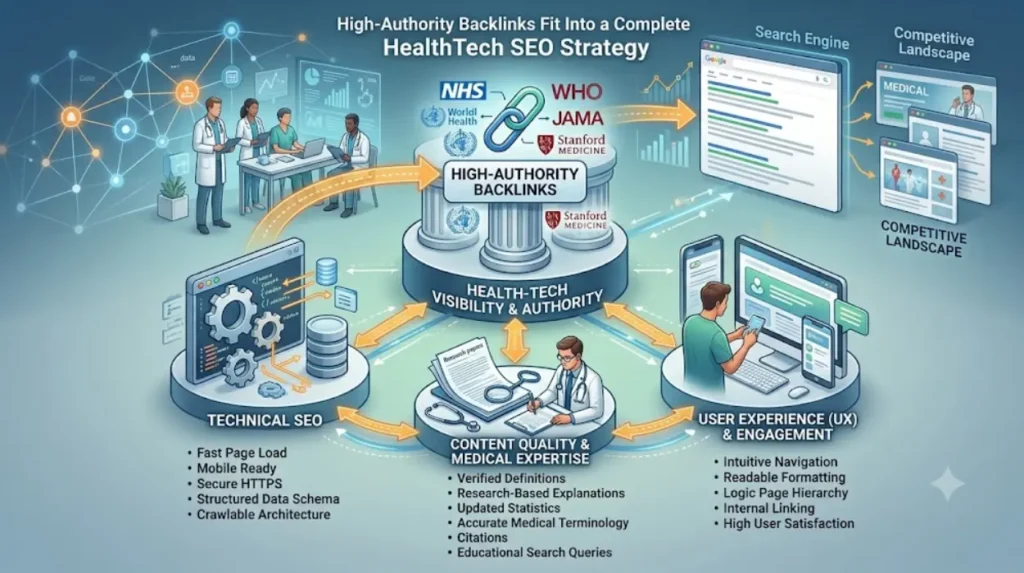
High-authority backlinks complement technical SEO, quality content, structured data, user experience, and topical expertise. Together, these elements create a comprehensive optimisation strategy that improves long-term HealthTech visibility across competitive healthcare search environments and educational search queries.
Backlinks represent one component of search optimisation.
Effective HealthTech SEO integrates multiple disciplines.
Technical SEO
Technical optimisation includes:
- Fast page loading
- Mobile responsiveness
- Secure HTTPS connections
- Structured data
- Clear website architecture
Technical quality supports efficient crawling.
Explore More Expert Insights:
How Medical Startups Earn Placements in Tier-1 Consumer Health Publications
Why Product Hunt Alone Isn’t Enough for a Successful SaaS Product Launch
Content quality
Accurate healthcare content remains essential.
Content demonstrates expertise through:
- Verified definitions
- Research-based explanations
- Updated statistics
- Clear medical terminology
High-quality content provides reasons for authoritative websites to link.
User experience
Accessible navigation supports both users and search engines.
Important elements include:
- Logical page hierarchy
- Readable formatting
- Clear headings
- Internal linking
Strong internal links distribute authority throughout the website.
Readers interested in practical implementation strategies can later explore:
Why Pharma Brands Choose Time Intelligence Media Group.
High-authority backlinks remain a foundational element of HealthTech SEO because they strengthen trust, improve topical authority, increase search visibility, and support sustainable organic growth. Search engines evaluate backlink quality through relevance, editorial integrity, authority, and contextual value rather than simple link quantity.
HealthTech organisations benefit most from publishing original research, educational resources, evidence-based content, and accurate healthcare information that naturally attracts citations from trusted medical institutions, universities, healthcare publications, and research organisations. Combined with technical SEO, structured content, and consistent topical expertise, high-authority backlinks contribute to stronger long-term visibility within competitive healthcare search results.