
Technology journalists receive a constant flow of press releases, emails, and story ideas every working day. Large newsrooms, trade publications, and independent technology reporters review hundreds of submissions across software, artificial intelligence, cybersecurity, fintech, cloud computing, developer tools, and consumer technology. Since publication space and editorial resources remain limited, journalists apply consistent filtering methods to identify information that qualifies as news. Understanding this process helps organisations produce clearer, more relevant press releases and improves general knowledge of modern technology journalism.
Why do tech journalists receive so many press releases every day?
Tech journalists receive hundreds of daily press releases because thousands of organisations announce software releases, funding rounds, partnerships, security updates, acquisitions, research findings, product launches, and executive appointments. Editorial teams filter submissions quickly by measuring relevance, news value, accuracy, timing, and audience interest before considering publication.
Technology is one of the fastest-moving industries. Every day introduces new software products, application programming interfaces (APIs), cybersecurity incidents, artificial intelligence models, cloud infrastructure updates, and investment announcements.
Journalists covering this sector receive information from multiple sources, including:
- Software companies
- Startup founders
- Public relations teams
- Industry analysts
- Government departments
- Universities
- Open-source communities
- Research organisations
For example, a United Kingdom technology reporter covering enterprise software can receive announcements about Software as a Service (SaaS) platforms, cloud infrastructure partnerships, developer frameworks, venture capital funding, and cybersecurity vulnerabilities within the same morning.
Only a small percentage of these announcements become published stories.
How do journalists decide whether a press release is newsworthy?
Journalists determine newsworthiness by evaluating originality, public relevance, measurable impact, verified information, industry significance, and publication timing. Stories containing factual developments, supporting evidence, and broad audience interest receive greater editorial attention than routine business announcements or promotional messages alone.
Newsworthiness follows recognised editorial principles.
Does the announcement contain new information?
A press release must introduce something genuinely new.
Examples include:
- Launch of a new developer platform
- Discovery of a critical cybersecurity vulnerability
- Completion of a major acquisition
- Release of significant research findings
- Introduction of new legislation affecting technology businesses
An announcement repeating existing information rarely advances through editorial review.
Does the story affect the audience?
Technology publications focus on information that influences readers.
For example:
- Software engineers value API improvements.
- IT managers value infrastructure updates.
- Investors follow funding announcements.
- Security professionals prioritise vulnerability disclosures.
Editors match stories with their publication’s audience before publication.
Are facts supported?
Journalists verify statements through evidence.
Supporting material includes:
- Official statistics
- Independent research
- Product documentation
- Public filings
- Technical demonstrations
Unsupported claims reduce editorial confidence.
What happens when a journalist opens a press release?
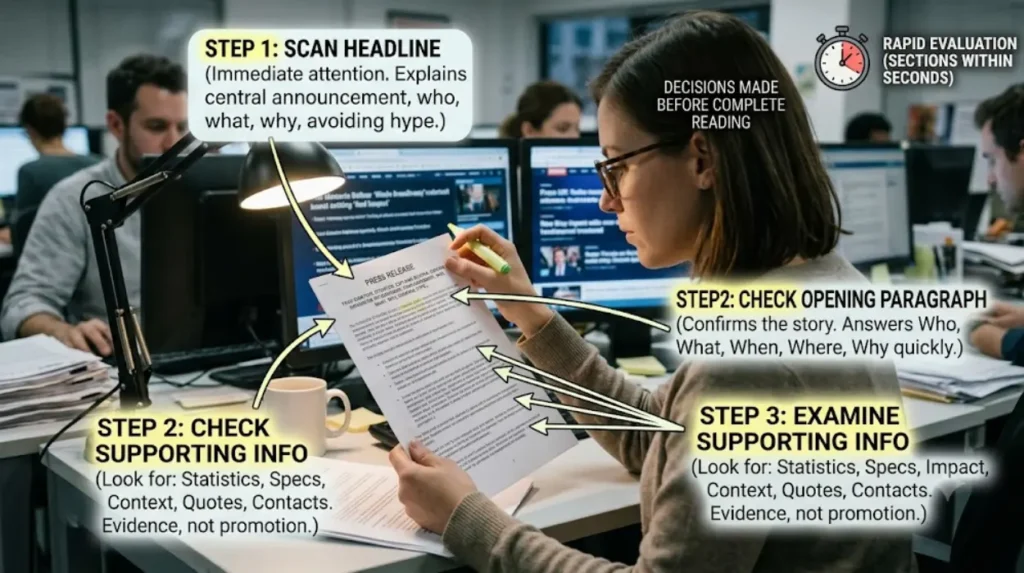
Journalists scan press releases within seconds by reviewing the headline, opening paragraph, subject relevance, supporting facts, quotes, and available evidence. Most editorial decisions occur before the entire document receives a complete reading because newsroom workloads demand rapid content evaluation every day.
Initial scanning follows a predictable pattern.
The headline receives immediate attention
The headline explains the central announcement.
Strong headlines communicate:
- What happened
- Who announced it
- Why it matters
They avoid exaggerated marketing language.
The opening paragraph confirms the story
The first paragraph answers essential questions.
These include:
- Who?
- What?
- When?
- Where?
- Why?
Editors determine quickly whether the announcement deserves additional reading.
Supporting information follows
After confirming relevance, journalists examine:
- Statistics
- Technical specifications
- Customer impact
- Industry context
- Executive quotes
- Contact information
Each section contributes evidence rather than promotion.
Which parts of a press release receive the closest attention?
Editors examine factual elements before descriptive language. Headlines, opening summaries, verified statistics, product details, research data, technical accuracy, supporting documents, and factual quotations receive closer scrutiny because these components establish credibility and help confirm editorial value during rapid newsroom evaluation.
Several sections influence editorial decisions.
Headline
The headline identifies the event clearly.
Example topics include:
- Software platform launch
- Artificial intelligence model release
- Cybersecurity advisory
- Acquisition announcement
Lead paragraph
The lead summarises the complete announcement without unnecessary detail.
Editors expect immediate clarity.
Data
Numbers strengthen factual reporting.
Examples include:
- Revenue growth percentages
- Customer adoption figures
- Research sample sizes
- Deployment statistics
- Performance benchmarks
Specific figures provide stronger reporting material than general descriptions.
Quotes
Executive quotations explain context.
Effective quotations expand understanding instead of repeating the headline.
Supporting assets
Additional resources improve verification.
Examples include:
- Images
- Technical diagrams
- Product screenshots
- Research reports
- Documentation
These materials assist journalists preparing publication.
Why do many press releases fail editorial review?
Many press releases fail because they lack genuine news, contain promotional language, omit supporting evidence, present unclear headlines, ignore publication audiences, repeat previously announced information, or provide insufficient factual detail for accurate reporting within editorial deadlines and newsroom standards.
Several recurring issues reduce publication opportunities.
Promotional writing replaces factual reporting
Journalists expect information instead of advertising.
Exaggerated claims reduce credibility.
Missing evidence
Statements require supporting facts.
Editors reject unsupported claims involving:
- Market leadership
- Product performance
- Industry rankings
- Customer success
Evidence strengthens reporting accuracy.
Weak headlines
Generic headlines hide important developments.
Editors spend only seconds deciding whether to continue reading.
No wider significance
Routine company activity rarely becomes industry news.
Examples include:
- Office relocations
- Minor website redesigns
- Standard hiring announcements
- Small internal updates
These events usually lack broader public relevance.
How does timing influence editorial decisions?
Publication timing influences newsroom priorities because journalists balance breaking news, scheduled announcements, embargoed stories, industry events, government releases, financial reporting periods, and daily editorial planning before assigning coverage across available reporting resources and publication schedules consistently.
Timing shapes newsroom attention.
Breaking news receives immediate priority
Unexpected developments replace planned coverage.
Examples include:
- Major cybersecurity breaches
- Government technology policy
- Global software outages
- Significant acquisitions
Breaking stories move directly into editorial workflows.
Industry events increase competition
Technology conferences generate large volumes of announcements.
Examples include:
- Artificial intelligence conferences
- Cloud computing events
- Developer conferences
- Cybersecurity exhibitions
Journalists compare multiple announcements covering similar topics.
Embargoed information supports planning
Embargoes allow journalists to prepare articles before publication time.
Editors verify information before embargo restrictions expire.
This process improves reporting quality while maintaining simultaneous publication.
How do journalists verify information before publishing?
Journalists verify information through official documents, independent research, technical sources, regulatory records, expert interviews, product demonstrations, and direct communication with organisations. Verification protects reporting accuracy and prevents publication of unsupported claims or incorrect technical information across technology coverage.
Verification follows established editorial standards.
Independent sources
Reporters compare announcements with external information.
Examples include:
- Academic studies
- Regulatory databases
- Technical documentation
- Government publications
Independent evidence improves reporting reliability.
Technical confirmation
Technology reporting often requires technical validation.
Examples include:
- API documentation
- Software release notes
- Security advisories
- Performance benchmarks
Journalists confirm technical accuracy before publication.
Additional interviews
Editors frequently request clarification.
Questions often cover:
- Product availability
- Customer impact
- Market implications
- Technical implementation
Accurate answers strengthen final reporting.
How can understanding newsroom filtering improve future press releases?
Understanding newsroom filtering explains how editorial teams prioritise factual information, audience relevance, technical accuracy, and measurable impact. This knowledge supports clearer communication, stronger information structure, improved media understanding, and better alignment with professional journalism standards across technology industries.
Knowledge of editorial workflows benefits communication planning.
Organisations learn why concise headlines, verified facts, structured information, and audience relevance receive greater editorial attention.
Communication teams also understand why supporting documentation improves reporting efficiency.
Those exploring how factual product announcements are structured can continue with:
Crafting a Press Release for detailed guidance on software update announcements.
Readers researching publication channels after understanding editorial evaluation can refer to:
PR Syndication Platforms to understand how distribution networks differ across technology audiences.
What are the main lessons about how tech journalists filter press releases?

Technology journalists apply consistent editorial standards to every submission. They prioritise verified facts, audience relevance, measurable significance, technical accuracy, and timely developments. Understanding these newsroom practices explains why only a limited number of press releases become published technology news stories each day.
Editorial filtering exists because technology news develops continuously across numerous sectors.
Explore More Expert Insights:
Why Organic SEO and Media PR Are the Ultimate Growth Loop for B2B SaaS
How Software Companies Build Trust and Credibility in Highly Competitive Niches
Every published story passes through structured evaluation based on factual reporting principles rather than promotional language. Headlines establish relevance, opening paragraphs summarise the announcement, evidence supports key claims, and technical accuracy strengthens credibility. Journalists also consider publication audiences, editorial priorities, competing news events, and verification requirements before assigning coverage.
A clear understanding of this process provides valuable insight into modern technology journalism and explains how editorial teams manage hundreds of press release submissions efficiently while maintaining reporting quality.