
Launching a product generates immediate attention, but sustained growth depends on what happens after the announcement. Press release syndication extends the reach of launch news across news platforms, industry publications, and search engines. When combined with a structured content strategy, syndicated coverage creates long-tail search opportunities that continue driving qualified traffic long after launch week.
Why does press release syndication support long-tail search traffic after a product launch?
Press release syndication expands content distribution across authoritative websites, increases keyword visibility, creates additional indexed pages, strengthens entity recognition, and supports long-term organic discovery through specific search queries that continue attracting relevant visitors after the initial launch period.
Press release syndication is the process of distributing one announcement through multiple news websites, industry portals, media databases, and content partners. Each publication increases the digital footprint of the launch.
Long-tail search traffic comes from highly specific search queries. Examples include:
- “developer API with OAuth support”
- “cloud monitoring tool for Kubernetes”
- “B2B SaaS workflow automation platform”
These searches have lower competition than broad keywords and often attract users with stronger purchase intent.
When a press release contains structured information, descriptive headings, and industry-specific terminology, search engines understand the product more accurately. This understanding improves the likelihood of appearing for relevant long-tail searches over time.
Instead of generating traffic for only one announcement day, syndicated content supports search visibility for months through indexed news articles, partner publications, and references.
How does press release syndication contribute to SEO beyond launch week?
Press release syndication strengthens search visibility by creating authoritative mentions, supporting entity recognition, expanding keyword coverage, increasing content discovery, and generating signals that help search engines understand product relevance across multiple trusted sources over an extended period.
Traditional launch campaigns focus heavily on immediate exposure. SEO focuses on sustained visibility.
Combining both creates a longer growth cycle.
Search engines index multiple trusted sources
News websites receive frequent crawling from search engines.
Examples include technology publications, business news portals, and regional industry websites.
Each indexed publication becomes another searchable entry point.
Users searching several weeks after launch can still discover those pages.
Entity recognition improves
Search engines identify entities rather than isolated keywords.
An entity includes:
- Product name
- Company name
- Founder
- Technology
- Industry
- Product category
Consistent information across syndicated publications helps search engines connect these entities correctly.
This improves search confidence.
Semantic keyword coverage expands
A well-written press release naturally includes related terminology.
Examples for a developer platform include:
- REST API
- SDK
- authentication
- API documentation
- webhook integration
- developer portal
These supporting terms increase topical relevance across numerous searches.
What content elements increase long-tail search performance?
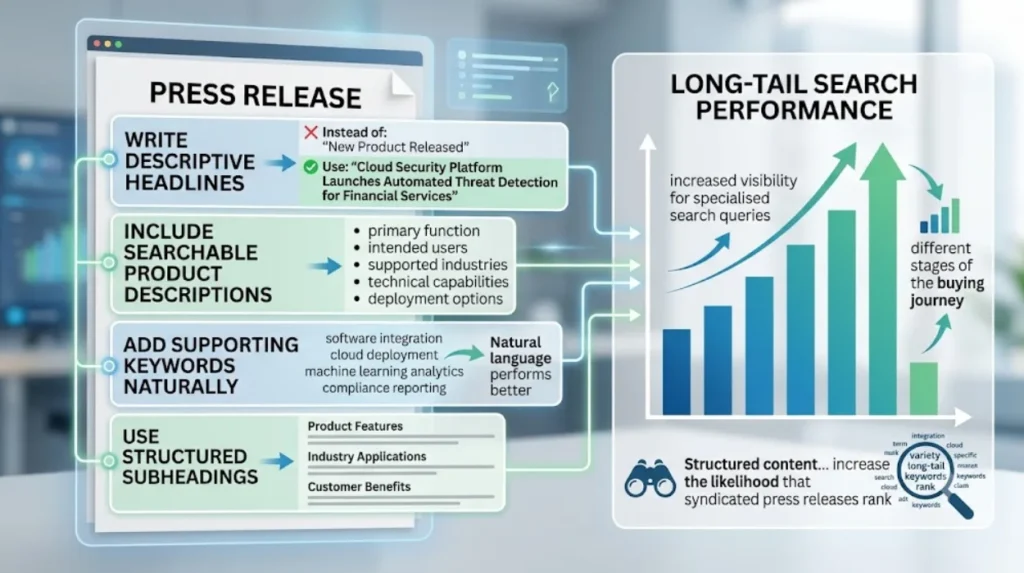
Structured content, descriptive headlines, industry terminology, supporting context, factual product information, and clearly organised sections increase the likelihood that syndicated press releases rank for specialised search queries across different stages of the buying journey.
Every section of a press release contributes to search visibility.
Write descriptive headlines
Headlines explain exactly what launched.
Instead of:
“New Product Released”
Use:
“Cloud Security Platform Launches Automated Threat Detection for Financial Services”
Specific wording improves search relevance.
Include searchable product descriptions
Product descriptions answer practical questions.
Include:
- primary function
- intended users
- supported industries
- technical capabilities
- deployment options
This information matches real search behaviour.
Add supporting keywords naturally
Semantic keywords strengthen topical relevance.
Examples include:
- software integration
- cloud deployment
- machine learning analytics
- customer data platform
- compliance reporting
Avoid unnecessary repetition.
Natural language performs better.
Use structured subheadings
Subheadings divide information into logical topics.
Examples include:
- Product Features
- Industry Applications
- Technical Specifications
- Customer Benefits
Search engines understand structured content more effectively.
How can businesses extend the value of syndicated press releases?
Businesses extend launch momentum by repurposing syndicated announcements into supporting content, expanding topical coverage, strengthening internal linking, and answering additional search questions that emerge after the product announcement gains visibility.
A press release becomes the starting point rather than the final asset.
Create supporting blog content
Individual product features become separate articles.
Examples include:
- authentication workflow
- API security
- onboarding process
- pricing model
- implementation guide
Each article targets different long-tail keywords.
Readers interested in:
Organic SEO and Media PR can explore for additional context on combining media visibility with long-term search growth.
Publish knowledge resources
Educational resources strengthen topical authority.
Examples include:
- FAQs
- implementation guides
- tutorials
- technical documentation
- product comparisons
Each page supports another cluster of search terms.
Build internal linking
Internal links connect related content.
Examples include links between:
- launch announcement
- feature articles
- documentation
- customer success stories
- industry use cases
This structure improves navigation and distributes authority across the website.
Which metrics demonstrate successful post-launch search growth?
Successful post-launch performance combines search visibility, organic traffic, indexed coverage, branded searches, referral traffic, engagement metrics, and conversions instead of measuring launch success through publication volume alone.
Effective measurement requires multiple indicators.
Organic keyword growth
Monitor:
- total ranking keywords
- new long-tail keywords
- search impressions
- average ranking positions
These metrics demonstrate expanding visibility.
Organic traffic
Measure visitors arriving from search engines.
Separate traffic by:
- branded searches
- non-branded searches
- feature-specific searches
- industry-specific searches
This identifies where momentum develops.
Referral traffic
Syndicated publications often generate referral visits.
Evaluate:
- session duration
- pages viewed
- conversions
- returning visitors
Higher engagement indicates stronger audience relevance.
Search Console performance
Search performance reports reveal:
- click-through rate
- indexed pages
- impressions
- search queries
These reports identify emerging keyword opportunities.
How do long-tail keywords evolve after product launch?
Long-tail keywords become increasingly specific as audiences learn more about a product, compare alternatives, research implementation requirements, and evaluate practical use cases across different industries and technical environments.
Search behaviour changes over time.
Immediately after launch, users search for:
- product name
- launch announcement
- company news
Several weeks later, searches become more detailed.
Examples include:
- API integration tutorial
- pricing comparison
- implementation checklist
- security certifications
- enterprise deployment
Months later, users search practical applications.
Examples include:
- API for logistics software
- CRM integration platform
- SaaS workflow automation examples
Publishing additional content for these evolving searches extends organic growth.
What role does authority play in sustaining long-tail visibility?
Authoritative coverage increases credibility, supports entity validation, strengthens search trust, and reinforces topical relevance when multiple recognised publications reference consistent factual information about the same product and organisation.
Authority influences search performance.
Several factors contribute.
Consistent factual information
Every publication uses consistent:
- company name
- product name
- release date
- feature descriptions
- executive quotations
Consistency strengthens search understanding.
Industry publications
Trade publications provide focused relevance.
Examples include:
- cybersecurity magazines
- software engineering websites
- financial technology publications
Industry-specific audiences produce qualified traffic.
Supporting digital assets
Additional assets reinforce authority.
Examples include:
- product images
- demonstration videos
- documentation
- specification sheets
- executive interviews
Each asset supports broader search visibility.
How can businesses integrate syndication into a long-term content strategy?
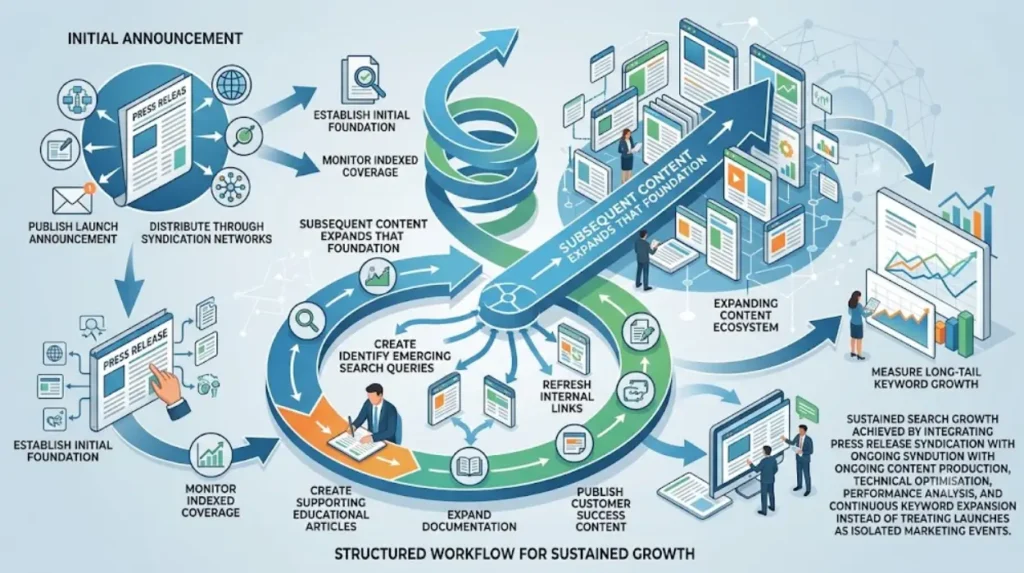
Businesses achieve sustained search growth by connecting press release syndication with ongoing content production, technical optimisation, performance analysis, and continuous keyword expansion instead of treating launches as isolated marketing events.
Launch announcements establish an initial content foundation.
Subsequent content expands that foundation.
A structured workflow includes:
- Publish the launch announcement.
- Distribute through relevant syndication networks.
- Monitor indexed coverage.
- Identify emerging search queries.
- Create supporting educational articles.
- Expand documentation.
- Publish customer success content.
- Update product pages.
- Refresh internal links.
- Measure long-tail keyword growth.
This process transforms one announcement into an expanding content ecosystem.
Businesses evaluating distribution options for future launches can compare:
Press Release Distribution Networks when selecting platforms aligned with developer-focused products.
What are the common mistakes that reduce post-launch search momentum?
Search momentum declines when businesses publish one announcement without follow-up content, ignore search performance data, repeat identical messaging, neglect internal linking, or fail to optimise content around evolving long-tail search intent.
Several mistakes reduce long-term results.
Publishing only one announcement
A single press release creates limited ongoing visibility.
Supporting content extends search relevance.
Ignoring user search behaviour
Search queries change after launch.
Content strategies require updates based on actual search data.
Weak keyword structure
Broad terminology limits discoverability.
Specific terminology attracts targeted audiences.
Explore More Expert Insights:
Creating a Digital Press Kit for Your SaaS Launch: Templates and Media Asset Checklists
Timing Your Announcement: When to Use a Press Wire vs. Pitching Tech Journalists Under Embargo
Missing content clusters
Individual articles without supporting pages reduce topical authority.
Content clusters strengthen subject coverage.
Limited performance measurement
Tracking publication numbers alone provides incomplete insights.
Organic visibility, referral traffic, indexed pages, keyword growth, and conversions provide a more accurate picture of post-launch success.
Press release syndication delivers value beyond launch-day visibility when it becomes part of a broader search strategy. Syndicated coverage increases indexed content, strengthens entity recognition, expands semantic keyword coverage, and creates additional discovery paths through authoritative publications.
Long-tail search traffic grows through structured content, supporting educational resources, consistent internal linking, and continuous optimisation based on evolving search behaviour. Businesses that combine syndication with ongoing content development transform a single product announcement into a sustained source of qualified organic traffic, stronger topical authority, and measurable post-launch growth.