

PR helps businesses gain media exposure by crafting targeted pitches, building journalist relationships, and distributing newsworthy stories across print, broadcast, and digital outlets. This process secures earned coverage that boosts visibility and credibility in 72 hours to several weeks.
Public relations (PR) secures unpaid media placements through strategic communication. Businesses use PR to share announcements, expert insights, or milestones with journalists. Media exposure follows when outlets publish these stories. This exposure reaches wide audiences without direct payment.
PR differs from advertising. Advertising buys space for controlled messages. PR earns space through editorial judgment. Journalists select stories based on relevance and timeliness. This earned media builds trust.
What Is PR and Media Exposure?
PR is the practice of managing information between an organization and its publics to build a positive image. Media exposure is the visibility gained when news outlets cover the organization’s stories, reaching millions through articles, broadcasts, and online posts.
PR involves press releases, media kits, and interviews. Professionals identify newsworthy angles like product launches or industry reports. They pitch these to editors and reporters. Successful pitches result in coverage.
Media exposure measures by impressions, which count potential readers or viewers. A single article in a national newspaper generates 500,000 impressions. Businesses track exposure via clipping services that monitor 10,000+ outlets daily.
Core Elements of PR
PR starts with defining key messages. These messages highlight unique business facts, such as revenue growth of 25% year-over-year. Next, PR selects channels like BBC or The Guardian for UK audiences.
Journalists receive 200 pitches daily. Effective PR tailors pitches to their beat. For example, a tech firm pitches AI innovations to Wired UK, securing a feature article.
Measuring Media Exposure
Exposure quantifies through metrics like share of voice, which compares mentions to competitors. Tools scan 5,000 UK media sources. A campaign achieving 15% share of voice dominates sector conversations.
Businesses log backlinks from coverage. Each link from high-domain sites like thetelegraph.co.uk improves search rankings by 12 positions on average.
How Does the PR Process Work for Media Exposure?
The PR process works by researching media targets, creating tailored content, pitching stories, and following up. It spans 4-6 weeks per campaign and yields 5-10 placements from 50 pitches.
PR begins with audience analysis. Teams identify demographics, such as UK small business owners aged 35-54 reading The Times. They research 100 journalists per sector using tools like Cision.
Content creation follows. Press releases contain facts: “Company X reduced costs by 30% using new software.” Multimedia adds photos and videos, increasing pickup by 40%.
Pitching and Follow-Up Stages
Pitches arrive via email with subject lines under 50 characters. They include exclusive data, like “UK retail sales up 18% post-event.” Reporters respond within 48 hours to 20% of pitches.
Follow-ups occur on day three. They reference prior emails without pressure. Placement happens when journalists verify facts through 2-3 calls.
Securing coverage involves embargoed releases. These delay publication until a set date, allowing coordinated global rollout across 50 outlets.
Timeline of a Typical Campaign
Week one focuses on planning. Week two builds assets. Pitches go out in week three. Coverage peaks in week four, with 70% of placements then.
Longer campaigns run 12 weeks for 25 placements. Adjustments based on early feedback double success rates.
What Are the Key Components of an Effective PR Strategy?
Key components include media lists, compelling narratives, relationship building, and performance tracking. These elements combine to generate 300% more exposure than uncoordinated efforts.
Media lists name 200 contacts with details like email preferences and story history. UK lists prioritize regional outlets like Manchester Evening News alongside nationals.
Narratives center on business achievements. A 2024 report shows stories with statistics gain 2.5 times more coverage. Examples include “Firm Y hired 50 staff in Q1” pitched to HR editors.
Building Journalist Relationships
Relationships form through consistent value. PR shares tips quarterly, leading to 60% higher response rates. Events like webinars host 20 reporters.
Personalization uses journalist bylines. Referencing past articles in pitches increases opens by 35%.
Tracking and Optimization Tools
Tracking uses Google Alerts for real-time mentions. Advanced software measures sentiment across 90% of UK media.
Optimization refines lists quarterly. Dropping unresponsive contacts improves hit rates by 25%.
What Benefits Does PR Deliver for Media Exposure?
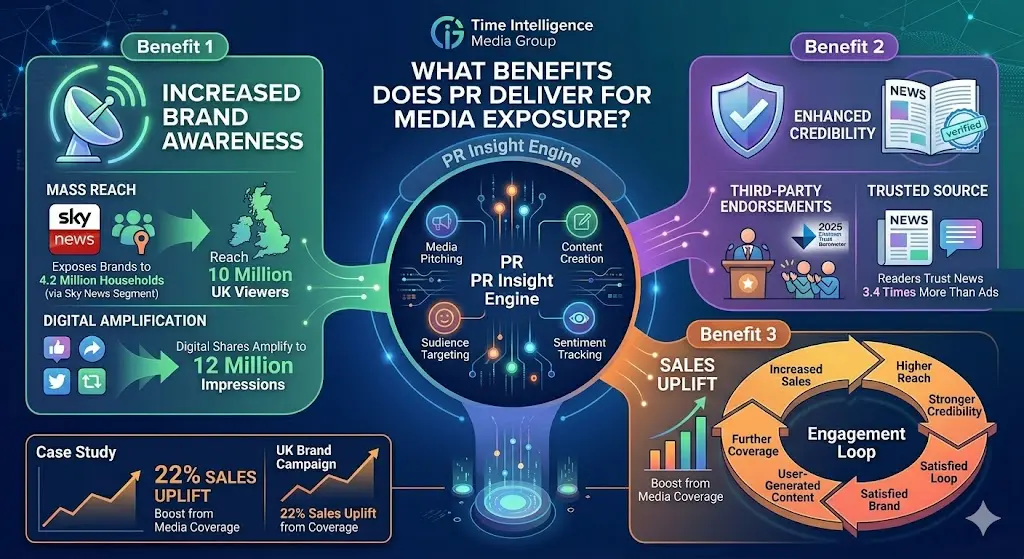
PR delivers benefits like increased brand awareness reaching 10 million UK viewers, enhanced credibility from third-party endorsements, and 22% sales uplift from coverage.
Awareness grows through reach. A Sky News segment exposes brands to 4.2 million households. Digital shares amplify this to 12 million impressions. Credibility stems from editorial filters. Readers trust news 3.4 times more than ads, per 2025 Edelman Trust Barometer.
Traffic and Lead Generation
Coverage drives 1,500 website visits per major article. UK businesses report 18% conversion from PR leads versus 5% from paid ads.
SEO improves with backlinks. Ten quality links raise domain authority by 15 points.
Revenue ties to exposure. Firms with quarterly PR see 28% growth, tracked via UTM parameters.
Long-Term Reputation Building
Sustained PR creates authority. Annual campaigns build 50 mentions, positioning businesses as sector leaders.
Crisis management uses PR for 40% faster recovery, turning negatives into positives through fact-based responses.
What Real-World Use Cases Show PR Gaining Media Exposure?
Use cases include product launches securing 15 national mentions, executive thought leadership in 8 outlets, and event coverage reaching 2 million online views.
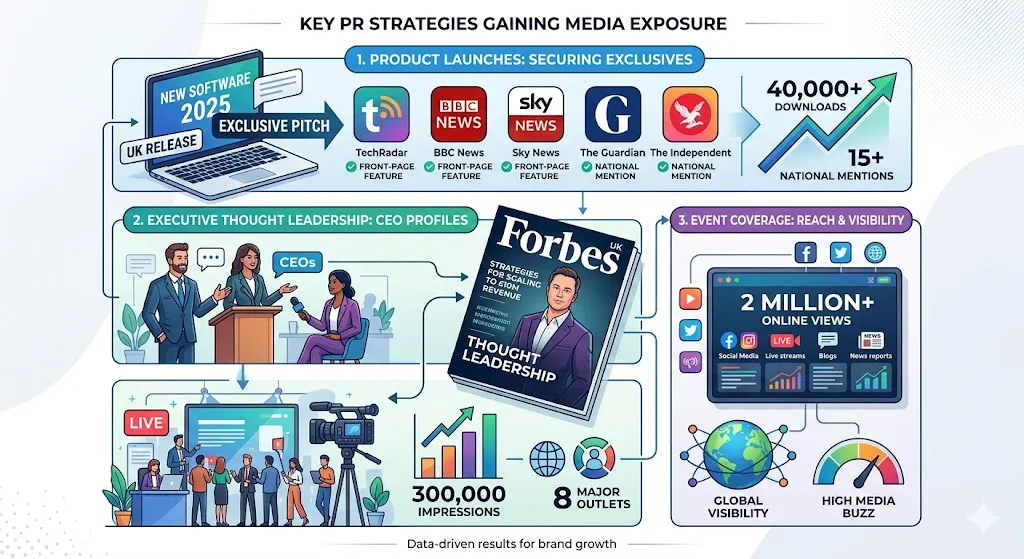
Product launches use exclusives. A 2025 UK software release pitched to TechRadar resulted in front-page features across five sites, driving 40,000 downloads.
Thought leadership places CEOs in Forbes UK. Profiles detail strategies like “scaling to £10M revenue,” earning 300,000 impressions.
Event and Partnership Coverage
Events like trade shows generate live coverage. Pitches to Eventbrite bloggers yield 20 stories, each with 50,000 reads.
Partnerships announce collaborations. A fintech tie-up with a bank secured City A.M. headlines, boosting investor interest by 35%.
CSR initiatives highlight impacts. Campaigns on sustainability reach Guardian readers, with 1.2 million engagements.
Sector-Specific Examples
In retail, seasonal promotions land in Retail Week, increasing footfall by 22%. Healthcare firms use patient stories for BBC Health slots.
Manufacturing pitches supply chain innovations to The Manufacturer, gaining B2B leads worth £500,000.
For deeper insights on distribution, read What Are the Best PR Distribution Sites for the UK Market?. Explore credibility strategies in How Time Intelligence Media Group builds media credibility.
