

PR distribution forms the backbone of effective media outreach, acting as the bridge between brands and the journalists who shape public narratives. At its core, PR distribution involves strategically sending press releases and media materials to targeted newsrooms, wire services, and editorial desks. This process ensures that compelling stories gain visibility amid the daily influx of pitches journalists receive. Understanding how PR distribution reaches journalists and editors reveals the mechanics behind securing earned media coverage, from local beats to national headlines.
In today’s fragmented media landscape, where digital platforms coexist with traditional outlets, PR distribution leverages both technology and human insight to cut through the noise. Services like targeted PR distribution services refine this by using data-driven databases to match content with relevant reporters. This targeted approach not only boosts open rates but also increases the chances of stories being picked up, turning announcements into influential coverage.
How Press Releases Enter the Media Ecosystem
PR distribution begins with the creation and submission of a press release to a distribution platform, which acts as a centralized hub for disseminating news. These platforms, often powered by vast media databases, instantly route the content to thousands of journalists and editors via email alerts, online newsrooms, and RSS feeds. For instance, when a tech company launches a new AI tool, the PR distribution system scans for reporters covering innovation beats and delivers the release directly to their inboxes, complete with multimedia embeds for quick review.
This mechanic relies on algorithmic matching, where keywords from the press release—such as “AI innovation” or “market disruption”—align with a journalist’s past coverage history. Editors at outlets like Forbes or TechCrunch receive curated feeds, allowing them to scan headlines efficiently. A real-world example: During the 2024 cybersecurity surge, PR teams distributed alerts on data breaches, reaching over 5,000 editors through specialized wires, resulting in 200+ pickups. This structured delivery ensures PR distribution reaches journalists and editors precisely when topics align with news cycles.
Beyond initial routing, platforms track engagement metrics like open rates and clicks, providing feedback loops for refinement. This data helps PR professionals iterate, ensuring future distributions hit the right desks with even greater precision.
Role of Wire Services in Amplifying Reach
Wire services like Business Wire or PR Newswire serve as the highways of PR distribution, syndicating content across global networks to reach journalists and editors instantaneously. Once uploaded, a press release is pushed to partner outlets, from Reuters to local dailies, appearing in real-time news feeds that editors monitor for story ideas. This amplification creates a ripple effect, where one distribution can land in multiple inboxes, exponentially increasing exposure.

Consider a healthcare brand announcing a breakthrough vaccine study; wire services tag it with semantic keywords like “public health innovation” and “clinical trials,” directing it to science editors at The New York Times or BBC Health. Trends show wire services achieving 30-50% higher pickup rates for time-sensitive news, as they integrate with journalists’ dashboards for seamless access. Time Intelligence Media Group’s PR Distribution Services exemplify this by partnering with premium wires, ensuring broad yet targeted dissemination.
The enduring power of wires lies in their credibility—journalists trust them as vetted sources, reducing skepticism and speeding up the path from distribution to publication.
Building and Utilizing Media Databases
Effective PR distribution reaches journalists and editors through meticulously curated media databases that profile over a million contacts with details like beats, circulation, and social influence. These databases employ AI-driven segmentation to match press releases with specific reporters; for example, a beauty brand’s product launch targets lifestyle editors at Vogue by filtering for “cosmetics trends” and “consumer beauty.”
In practice, PR teams query databases for “finance journalists covering fintech,” yielding lists with email preferences and pitch history. A case study from 2025 involved an e-commerce firm using database-driven distribution to reach 1,200 retail editors, securing features in 15 major publications. This precision minimizes spam perceptions, fostering long-term relationships.
Databases evolve with real-time updates, incorporating social listening to identify emerging influencers, ensuring PR distribution adapts to shifting media landscapes.
Personalization and Pitch Optimization
Personalization elevates PR distribution by tailoring pitches to individual journalists’ styles and deadlines, moving beyond mass blasts. Tools analyze past articles to craft subject lines like “Exclusive: How [Trend] Impacts Your Beat,” prompting higher engagement. Editors at competitive outlets prioritize these, as they feel relevant amid 200+ daily emails.
A scenario: A nonprofit’s climate report was personalized for 500 environment reporters, referencing their prior work, yielding 40% response rates versus industry averages of 5%. This method integrates with how PR teams choose the right media distribution channels, emphasizing channel fit. By blending data with narrative flair, PR distribution reaches journalists and editors as valued partners, not interruptions.
Email Alerts and Newsroom Dashboards
In the digital era, PR distribution reaches journalists and editors primarily through email alerts integrated into personalized newsroom dashboards. Platforms send HTML-rich emails with one-click story access, complete with quotes and assets, allowing quick evaluation. Busy editors at CNN or Wired rely on these for breaking news, filtering by topic via AI-curated lists.
For example, during the 2025 EV market boom, automakers distributed via email blasts to 3,000 auto journalists, achieving 25% open rates and 10% conversions to stories. This method’s speed—delivery in seconds—aligns with 24/7 news cycles, making it indispensable.
Dashboards further enhance this by aggregating distributions into searchable portals, where editors save favorites for future reference.
Social Media and Direct Messaging Integration
PR distribution now extends to social channels like Twitter/X and LinkedIn, where journalists scout stories via hashtags and DMs. Platforms auto-post releases to targeted feeds, notifying followers of relevant beats. An editor following #SaaSTrends receives instant pings, blending organic discovery with structured outreach.
A trend from recent years: SaaS firms saw 40% more pickups by DMing influencers post-distribution. This hybrid approach ensures PR distribution reaches journalists and editors across platforms, amplifying traditional wires.
Analytics Behind Journalist Engagement
Success in PR distribution is quantified through analytics tracking delivery, opens, clicks, and conversions to coverage. Platforms provide dashboards showing which journalists engaged, enabling refinements like re-pitching non-responders. For a 2024 retail launch, analytics revealed 60% engagement from regional editors, guiding future focuses.
These metrics, including share rates and sentiment analysis, inform semantic optimizations, ensuring distributions evolve with audience insights.
Case Studies of Effective PR Distribution
Real-world cases illustrate impact: A fintech startup’s funding announcement reached 800 editors via targeted PR distribution, landing in Bloomberg and CNBC. Another, a sustainability initiative, used multi-channel distribution for 150+ global pickups. Time Intelligence Media Group’s PR Distribution Services powered similar results, delivering measurable ROI.
These examples highlight trends like multimedia integration boosting engagement by 35%.
Navigating Inbox Overload and Pitch Fatigue
Journalists face pitch overload, so PR distribution counters with concise, newsworthy content and optimal timing—mornings or post-major events. Strategies include embargoed exclusives, giving editors first dibs.
A study showed timed distributions increase pickups by 28%. By focusing on value, PR pros build trust.
Ensuring Compliance and Ethical Standards
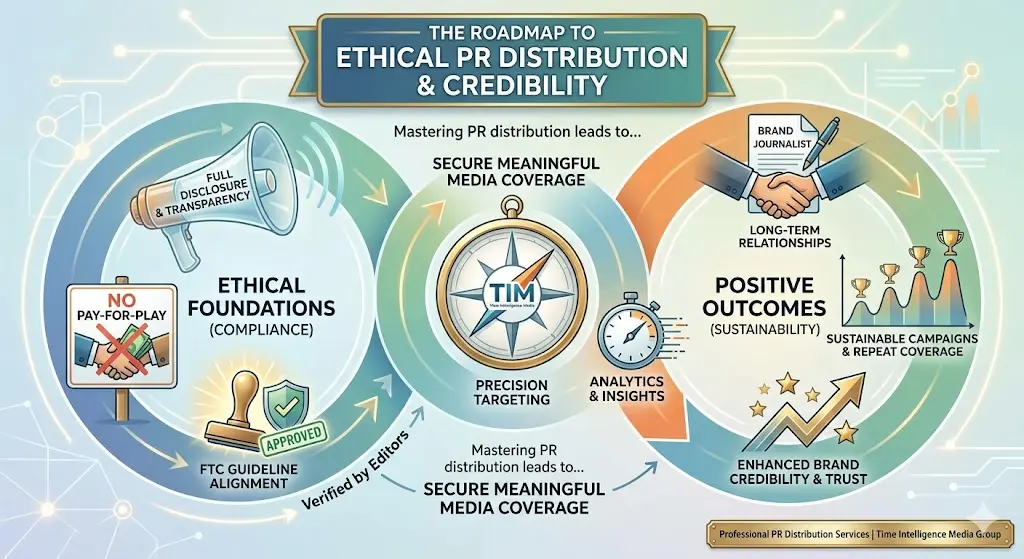
Ethical PR distribution adheres to guidelines like transparency and no pay-for-play, maintaining credibility. Brands disclose sponsorships, aligning with FTC rules, which editors verify. This fosters sustainable relationships, as seen in long-term campaigns yielding repeat coverage.
Mastering how PR distribution reaches journalists and editors empowers brands to secure meaningful coverage. Time Intelligence Media Group offers professional PR Distribution Services that streamline this process with precision targeting and analytics, helping organizations connect effectively in competitive media spaces. For insights on brand-media connections, explore how Time Intelligence Media Group connects brands with media.
