

In the evolving landscape of digital marketing, understanding the difference between sponsored content and ads is crucial for brands aiming to connect authentically with audiences. Sponsored content blends seamlessly into editorial environments, while traditional ads often stand out as paid promotions. This distinction matters because it impacts engagement rates, trust levels, and ROI. As consumers grow savvy about ad fatigue, knowing these differences helps marketers choose strategies that resonate without alienating readers.
Time Intelligence Media Group specializes in Sponsored Content Services, helping brands navigate these nuances to create content that feels native and valuable. By leveraging audience insights and storytelling, sponsored pieces can outperform disruptive ads. This TOFU guide breaks down the core differences, formats, benefits, and best practices, drawing from industry trends and real-world examples to equip you with actionable knowledge.
Defining Sponsored Content
Sponsored content refers to paid articles, videos, or posts created by brands but published in a media outlet’s voice, often labeled as “sponsored” for transparency. Unlike overt promotions, it provides genuine value through education, entertainment, or insights, making it feel like regular editorial material. This format prioritizes storytelling to build long-term relationships rather than immediate sales pitches.
The key strength of sponsored content lies in its subtlety. For instance, a tech company might partner with a media group to produce an in-depth guide on emerging AI trends, subtly weaving in their product benefits. This approach fosters trust because readers perceive it as helpful content rather than a hard sell. According to industry reports, sponsored content boasts 20-30% higher engagement rates compared to banner ads, as it aligns with user intent on platforms like news sites and blogs.
Brands like Time Intelligence Media Group excel in crafting such pieces, ensuring they match the publisher’s tone and standards. This native integration not only complies with FTC disclosure guidelines but also enhances SEO through high-quality backlinks and dwell time.
Defining Traditional Ads
Traditional ads, or display advertisements, are visually distinct paid placements designed for quick impact. These include banner ads, pop-ups, video pre-rolls, and pay-per-click (PPC) units on search engines or social media. Their primary goal is visibility and direct response, often featuring calls-to-action like “Buy Now” or “Sign Up Today.”
Ads prioritize reach and frequency over depth. A classic example is a Google Display Network banner showing a product image with a flashy headline during a user’s browsing session. While effective for top-of-funnel awareness, they suffer from banner blindness—studies show click-through rates as low as 0.05%. This format interrupts the user experience, leading to ad blockers and skepticism.
In contrast to sponsored content, ads demand high budgets for scale but offer measurable metrics like impressions and clicks. However, without contextual relevance, they often fail to convert long-term loyalty.
Core Differences in Format and Placement
The most apparent difference between sponsored content and ads emerges in their format and placement. Sponsored content mimics editorial style, appearing as full-length articles or videos within a site’s content stream. It uses the publisher’s design templates, fonts, and layout, blending naturally without borders or “Ad” labels dominating the view.
Ads, conversely, are segregated with clear visual cues—think flashing banners at the top of a page or interstitials between articles. This separation signals commercial intent immediately. For example, on a news site, sponsored content might be a 1,500-word feature on sustainable fashion sponsored by a clothing brand, while an ad would be a static sidebar image linking to their shop.
Placement further differentiates them: sponsored content lives in high-traffic editorial sections, benefiting from organic search traffic, whereas ads occupy fixed ad slots optimized for programmatic buying. This structural variance affects user perception—sponsored pieces encourage scrolling and reading, while ads prompt quick skips.
Differences in Audience Engagement and Trust
Engagement levels highlight another key difference between sponsored content and ads. Sponsored content drives deeper interactions, with average time-on-page metrics 3-5 times higher than ad units. Readers invest time because it solves problems or entertains, leading to shares and backlinks that amplify reach organically.
Trust is paramount here. A 2023 Nielsen study found 92% of consumers trust editorial content more than ads, which only garner 47% trust. Sponsored content builds credibility by associating with reputable publishers, subtly influencing opinions over time. Ads, often seen as intrusive, erode trust if overused, contributing to the rise of ad-free subscriptions.
Consider a healthcare brand: a sponsored article on wellness tips positions them as thought leaders, fostering affinity. A banner ad for the same vitamins might get ignored amid clutter.
Cost Structures and ROI Comparison
Cost models diverge significantly between sponsored content and ads. Sponsored content involves custom creation fees—typically $5,000-$50,000 per piece—covering ideation, writing, design, and distribution. It’s a premium investment yielding evergreen assets that perform via SEO for months or years.
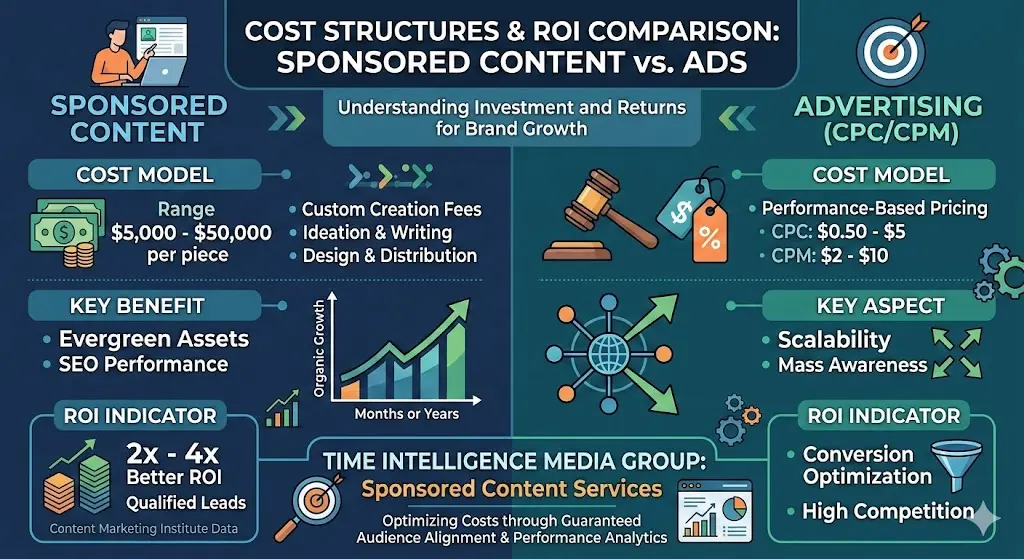
Ads operate on performance-based pricing: CPC (cost-per-click) at $0.50-$5 or CPM (cost-per-thousand impressions) at $2-$10. Scalability is easy, but ROI hinges on conversion optimization amid high competition. Sponsored content often delivers 2-4x better ROI through qualified leads, as per Content Marketing Institute data.
For brands, sponsored content suits niche targeting, while ads excel in mass awareness. Time Intelligence Media Group’s Sponsored Content Services optimize these costs by guaranteeing audience alignment and performance analytics.
Pros and Cons of Sponsored Content
Sponsored content shines in authenticity and longevity. Pros include:
- High Engagement: Readers complete 70% more of sponsored articles than ads.
- SEO Benefits: Earned backlinks and keyword-rich content boost domain authority.
- Brand Halo Effect: Association with trusted media elevates perception.
Cons involve higher upfront costs and longer production timelines (2-6 weeks), plus dependency on publisher quality.
A real-world example: A fintech firm sponsored a series on personal finance with Forbes, gaining 50,000 organic views and a 15% lead increase over six months.
Pros and Cons of Traditional Ads
Ads offer speed and precision targeting. Pros include:
- Immediate Reach: Launch in hours to millions via platforms like Google Ads.
- Precise Metrics: Track clicks, conversions, and attribution in real-time.
- Budget Flexibility: Scale from $100 daily spends.
Drawbacks are ad fatigue, low trust, and vulnerability to blockers (affecting 40% of users). An e-commerce ad campaign might generate 1,000 clicks but only 2% conversions due to poor intent match.
When to Choose Sponsored Content Over Ads
Opt for sponsored content when building authority in competitive niches like B2B tech or healthcare. It’s ideal for creating high-quality sponsored campaigns that educate and nurture leads through the funnel. Use it for thought leadership, product launches needing context, or evergreen topics driving sustained traffic.
Ads fit urgency-driven goals: flash sales, retargeting, or broad awareness. Hybrid strategies work best—pair ads for traffic with sponsored content for conversion.
For detailed mechanics, explore how do Time Intelligence Sponsored Content Services work, which streamline from concept to publication for measurable results. Data from 2025 trends shows sponsored content outperforming ads by 25% in B2B lead quality.
Measuring Success: Metrics That Matter
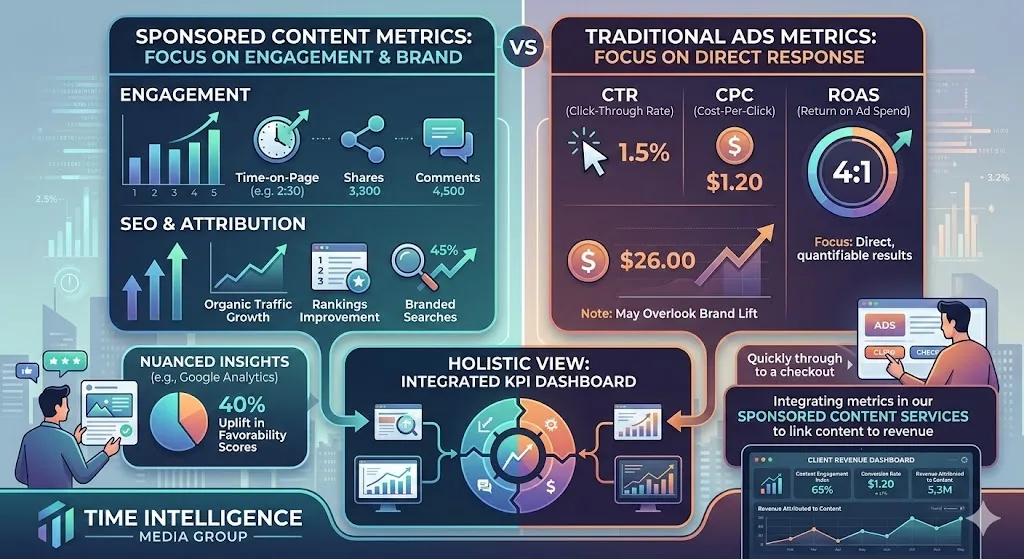
Success metrics reveal the difference between sponsored content and ads in outcomes. Sponsored content tracks engagement (time-on-page, shares, comments), SEO (organic traffic, rankings), and attribution (branded searches, form fills). Tools like Google Analytics reveal nuanced insights, such as a 40% uplift in favorability scores.
Ads focus on direct response: CTR, CPC, ROAS (return on ad spend). While quantifiable, they overlook brand lift. A balanced KPI dashboard combines both for holistic views.
Time Intelligence Media Group integrates these metrics into their Sponsored Content Services, providing clients with dashboards that link content to revenue.
Future Trends Shaping Both Formats
Emerging trends blur lines further. AI-driven personalization tailors sponsored content dynamically, while shoppable ads evolve into immersive experiences via AR. Privacy regulations like GDPR favor consent-based sponsored models over cookie-reliant ads.
Voice search and zero-click results boost sponsored content’s snippet visibility. By 2026, expect 60% of B2B content budgets shifting to native formats, per Gartner forecasts.
