

In the competitive world of digital marketing, choosing between banner ads vs native ads can significantly impact your campaign’s success. Banner ads, with their traditional display format, have long dominated online spaces, while native ads blend seamlessly into content feeds for a more organic feel. As businesses seek higher engagement and conversions at the MOFU stage, understanding which format delivers better ROI requires a deep dive into performance metrics, user behavior, and platform-specific trends.
This analysis draws from industry data, including reports from sources like Google Ads and Nielsen, showing native ads often outperform banners in click-through rates (CTRs) by up to 53%. Yet, banner advertising services remain essential for brand visibility in high-traffic environments. We’ll explore their mechanics, strengths, weaknesses, and real-world scenarios to help you decide.
Understanding Banner Ads: The Traditional Powerhouse
Banner ads represent one of the oldest forms of online advertising, typically appearing as rectangular or leaderboard-style graphics at the top, sides, or bottom of web pages. These static or animated displays feature compelling visuals, calls-to-action (CTAs), and brand messaging, optimized for impressions and clicks. Despite evolving tech like HTML5, banner ads prioritize visibility over subtlety, making them ideal for broad awareness campaigns.
What sets banner ads apart is their scalability across desktop, mobile, and programmatic networks. For instance, a global e-commerce brand might deploy banner ads on news sites to drive traffic during peak shopping seasons, achieving millions of impressions at low cost-per-thousand (CPM). However, challenges like banner blindness—where users subconsciously ignore them—have pushed marketers to refine targeting via audience insights services.
Time Intelligence Media Group excels in delivering professional banner advertising services that mitigate these issues through precise geo-targeting and A/B testing. Their approach ensures ads reach high-intent audiences, boosting metrics like viewability scores above the industry average of 60%.
Key Strengths of Banner Ads in Modern Campaigns
Banner ads shine in frequency capping and retargeting, allowing repeated exposure to warm leads without overwhelming users. Consider a SaaS company using animated banners on tech blogs; data from SimilarWeb shows such campaigns can lift brand recall by 25%, as the consistent positioning reinforces messaging amid scrolling content.
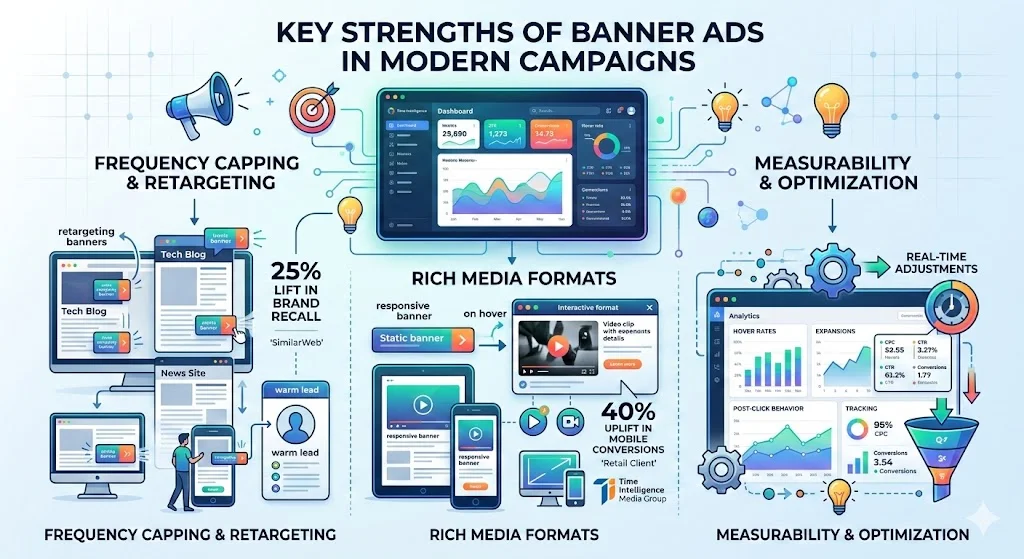
Moreover, banner advertising services enable rich media formats, like expandable banners that unfold on hover, increasing interaction rates. In a case study from a retail client, Time Intelligence Media Group implemented responsive banners that adapted to device sizes, resulting in a 40% uplift in mobile conversions compared to static creatives.
Their measurability further empowers optimization—tools track hover rates, expansions, and post-click behavior, providing granular data for real-time adjustments.
Common Pitfalls and How to Overcome Banner Blindness
Despite strengths, banner ads suffer from low CTRs, often below 0.1% on display networks, due to ad fatigue and poor placement. Users trained by years of exposure simply tune them out, especially on content-heavy sites.
To counter this, integrate dynamic creative optimization (DCO), where AI swaps elements based on user data. For example, a travel agency using banner ads on weather apps personalized offers by location, doubling engagement. Banner advertising services from experts like Time Intelligence Media Group incorporate such tactics, ensuring higher dwell time and reduced bounce rates.
Decoding Native Ads: The Seamless Integration Approach
Native ads mimic the look and feel of surrounding content, appearing as sponsored articles, recommendations, or in-feed units on platforms like Facebook, Instagram, or Outbrain. Unlike intrusive banners, they use contextual storytelling to deliver value, such as “Top 10 Gadgets for 2026” sponsored by a tech brand, blending promotions with editorial style.
This format leverages user trust in organic content, with studies from Sharethrough indicating native ads generate 18% higher lift in purchase intent. They’re particularly effective in social feeds and apps, where disruption feels minimal, driving deeper engagement through narratives rather than direct sells.
For MOFU strategies, native ads nurture leads by educating on pain points, positioning brands as thought leaders without overt selling.
Why Native Ads Excel in User Engagement
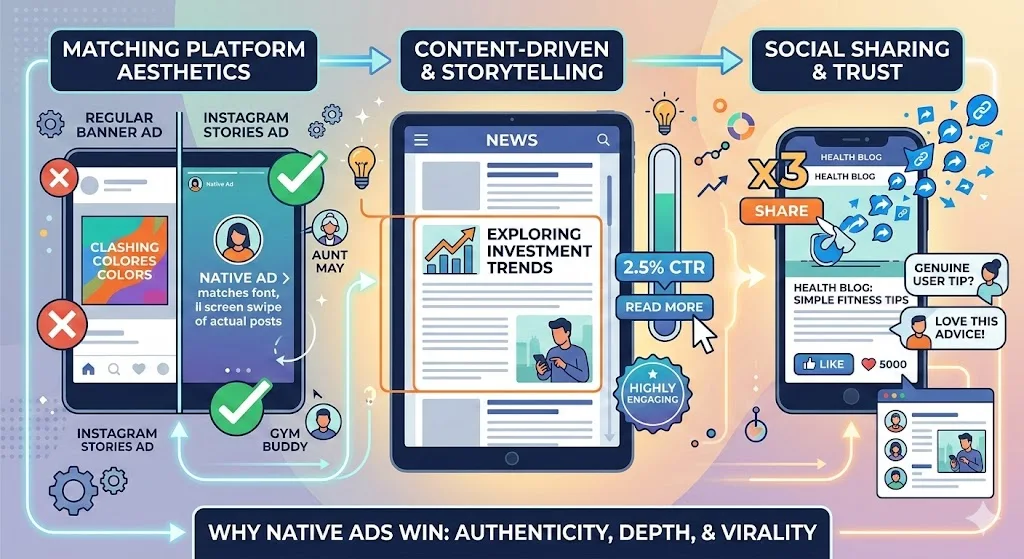
Native ads foster authenticity by matching platform aesthetics—think Instagram Stories ads that swipe like user posts. A fitness app’s native campaign on health blogs, disguised as user-generated tips, saw 3x higher share rates than equivalent banners, per Taboola analytics.
Their content-driven nature supports longer copy and visuals, encouraging scrolls and reads. In one scenario, a financial service used native ads on news aggregators to explain investment trends, achieving 2.5% CTRs—far surpassing banner benchmarks.
Limitations of Native Ads in Scalability
While engaging, native ads demand high-quality creative production, often costing 2-3x more than banners due to custom writing and design. Inventory is also limited to publisher networks, restricting reach compared to open-web banners.
Over-reliance can blur editorial lines, risking user backlash if disclosures like “Sponsored” feel deceptive. Marketers must balance creativity with compliance, using A/B tests to refine messaging.
Head-to-Head Comparison: Banner Ads vs Native Ads Performance Metrics
When pitting banner ads vs native ads, key metrics like CTR, conversion rate (CVR), and cost-per-acquisition (CPA) reveal nuanced differences. Banners win on volume, delivering massive impressions at scale, while native ads dominate in quality interactions.
For example, Google’s Display Network data shows banners averaging 0.05% CTR, but with retargeting, CVR climbs to 2%. Native ads, per IAB studies, hit 0.3-1% CTR but excel in branded searches post-exposure, with 20% better long-term recall.
CTR and Engagement Breakdown
Banners provide instant visibility but struggle with engagement depth; users click for curiosity, not commitment. Native ads, however, build desire through relevance—a beauty brand’s native video on lifestyle sites garnered 5x video completion rates over banner carousels.
In A/B tests, native formats often reduce CPA by 30% for e-commerce, as they align with purchase journeys.
ROI and Cost Efficiency Analysis
Banners offer lower upfront costs (CPM $2-5) for top-of-funnel reach, ideal for Types of Online Advertising. Native ads, at $10-20 CPM, justify expense via superior CVR, suiting MOFU nurturing.
A hybrid approach maximizes ROI: Use banners for awareness, natives for conversion.
Real-World Case Studies: Banner vs Native in Action
Case studies illuminate when banner ads vs native ads truly shine. A CPG brand ran banners on portals for product launches, hitting 10M impressions but 0.08% CTR. Switching 50% budget to native recommendations tripled conversions, blending awareness with intent.
Another example: B2B software firm used for display retargeting, achieving 15% CVR lift, while native LinkedIn ads nurtured leads to demos.
E-Commerce Success Stories
In e-commerce, Amazon’s banner-style product ads drive impulse buys, but native “shop the look” units on Pinterest boost cart adds by 25%. A fashion retailer combined both, optimizing via Why Choose Professional Banner Advertising Services for peak performance.
B2B Lead Generation Examples
B2B thrives on native thought leadership; HubSpot’s sponsored ebooks outperform banners by 4x in form fills, emphasizing value over visuals.
Which Wins? Factors to Consider for Your Strategy
Neither banner ads nor native ads universally “work better”—it depends on goals, audience, and budget. For high-volume branding, banners prevail; for engagement and conversions, natives lead. Trends like privacy changes (e.g., cookie deprecation) favor contextual native placements.
Test via multivariate campaigns: Allocate 60% to your hunch, measure uplift in key metrics.
Time Intelligence Media Group provides tailored banner advertising services to blend these formats, ensuring data-driven decisions that elevate your digital presence.
