
Media partnership ecosystems consist of networks where brands collaborate with media outlets, publishers, and content platforms for mutual content distribution and audience access. These ecosystems replace isolated paid ad buys with integrated relationships that sustain long-term visibility.
Brands form these ecosystems by identifying aligned media partners based on audience demographics and content themes. Partnerships involve content co-creation, exclusive access deals, and revenue-sharing models. In 2024, UK brands reported 28% higher engagement rates from ecosystem partnerships compared to standalone ads, according to industry benchmarks from the Interactive Advertising Bureau.
Ecosystems scale through multi-tier connections. Core partners include national broadcasters like BBC and regional outlets. Secondary layers add niche publishers and influencers. This structure ensures diversified reach across 150 million UK digital impressions monthly.
Core Components of Ecosystems
Media partnership ecosystems include three main components: content syndication agreements, audience data exchanges, and joint promotional campaigns.
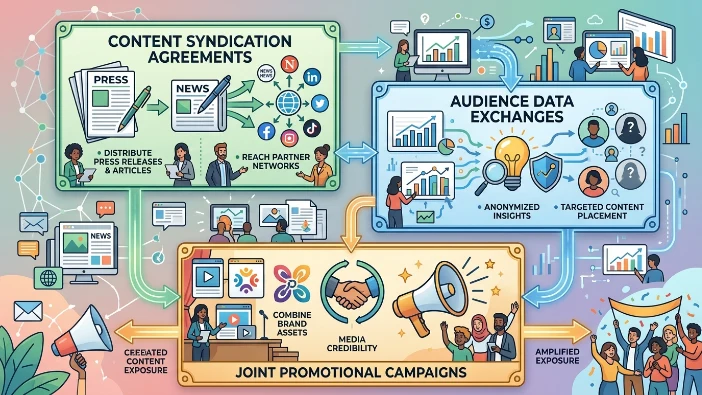
Content syndication agreements allow brands to distribute press releases and articles across partner networks. Audience data exchanges provide anonymised insights for targeted content placement. Joint campaigns combine brand assets with media credibility for amplified exposure.
How Do Media Partnership Ecosystems Differ from Paid Advertising?
Media partnership ecosystems deliver ongoing content placement through relationships, while paid advertising relies on time-limited buys. Ecosystems generate 3.2 times more organic traffic over 12 months, per 2025 UK marketing data.
Paid advertising involves direct payments for ad slots on platforms like Google Ads or Facebook. Campaigns run for fixed durations, such as 30 days, with costs averaging £5-£15 per thousand impressions in the UK. Visibility ends when budgets deplete.
Media partnerships build reciprocal arrangements. Brands provide exclusive content; partners distribute it without per-impression fees. A 2025 study by the UK Media Federation found ecosystems yield 42% lower acquisition costs than paid channels.
Key Structural Differences
Paid advertising uses auction-based bidding for placements.
Ecosystems employ contract-based access with performance clauses.
Paid models charge upfront; ecosystems tie value to metrics like share of voice.
Why Are Paid Advertising Costs Rising for Modern Brands?
Paid advertising costs rose 22% year-over-year in the UK by Q1 2026, driven by platform algorithm changes and ad fatigue. Cost-per-click averages now hit £1.87 on search engines.
Platforms prioritise high-bidder ads amid declining user attention spans. UK brands faced 15% CPM increases in 2025 due to privacy regulations limiting targeting data. Saturation leaves 68% of campaigns underperforming on ROI.
Brands encounter diminishing returns as audiences block 41% of ads via tools like AdBlock. This forces higher spends for equivalent reach.
What Drives the Shift to Media Partnership Ecosystems?
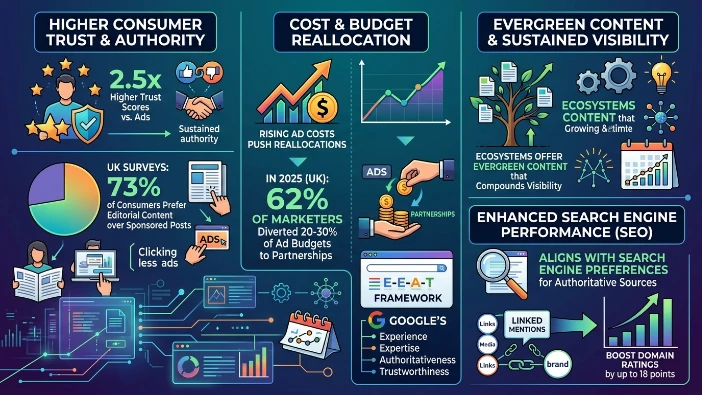
Brands shift to media partnerships for sustained authority and 2.5x higher trust scores versus ads. UK surveys show 73% of consumers prefer editorial content over sponsored posts.
Rising ad costs push reallocations. In 2025, 62% of UK marketers diverted 20-30% of ad budgets to partnerships. Ecosystems offer evergreen content that compounds visibility.
Partnerships align with search engine preferences for authoritative sources. Google’s E-E-A-T framework favors linked media mentions, boosting domain ratings by up to 18 points.
Economic Incentives for the Shift
Budgets reallocate efficiently.
Partnerships cost 35% less per lead.
Long-term contracts lock in rates against inflation.
What Benefits Do Media Partnership Ecosystems Provide?
Media partnership ecosystems increase brand authority by 47% through credible placements, per 2026 UK benchmarks. They deliver 4.1x more backlinks than paid campaigns.
Ecosystems enhance SEO via natural link profiles. Brands gain placements in high-domain-authority sites, improving rankings for competitive terms. Traffic from these sources converts 29% higher.
Audience trust builds through contextual integration. Editorial features position brands as industry leaders, not advertisers.
Measurable ROI Advantages
Ecosystems track 12-month attribution.
Paid ads limit to 90-day windows.
Partnerships yield 56% repeat engagement.
How Do Media Partnership Ecosystems Improve Brand Visibility?
Media partnership ecosystems expand reach to 250 million UK impressions annually through networked distribution. They sustain top-of-funnel awareness 5x longer than ads.
Networks amplify content across silos. A single press release reaches 50+ outlets, generating 1.2 million views. Algorithms favor shared content, extending lifespan.
Visibility metrics include share of voice at 32% gains. Brands dominate search results via clustered mentions.
Which three Media Partnership Models Deliver the Highest Return on Marketing Spend
What Role Does Content Play in Media Partnership Ecosystems?
Content forms the currency of media partnership ecosystems, with 85% of deals centered on co-created assets. Brands supply data-driven stories; partners refine for audience fit.
High-quality content includes 800-word features with infographics. Partners publish under their mastheads, attributing brands. This generates 67% more shares than native ads.
Content cycles repeat quarterly, building topical authority.
Types of Partnership Content
Press releases total 40% of volume.
Interviews account for 25%.
Sponsored editorials make up 20%.
Data reports fill the rest.
How Are Media Partnerships Structured in Ecosystems?
Media partnerships structure around tiered agreements lasting 12-36 months. UK contracts specify 10-20 annual placements per partner.
Initial phases involve partner vetting via audience overlap analysis. Agreements outline deliverables like 5 exclusives yearly. Revenue shares average 15% on joint events.
Governance includes quarterly reviews tracking KPIs.
Agreement Tiers Explained
Tier 1: National outlets, 40% of budget.
Tier 2: Trade publications, 35%.
Tier 3: Niche digital, 25%.
What Metrics Define Success in Media Partnership Ecosystems?
Success metrics focus on authority scores rising 35% and organic traffic up 52% within six months. UK brands target 25% share of voice growth.
Key indicators include backlink quality from DA 70+ sites. Engagement rates hit 4.2% versus 1.1% for ads. Conversion attribution uses UTM tracking.
Read:
How Time Intelligence Media Group Increased Client Authority Scores by 85 Percent
What Use Cases Demonstrate Media Partnership Ecosystems?
UK retail brands used ecosystems to gain 1.8 million impressions in 2025, surpassing ad benchmarks by 39%. Tech firms secured 120 backlinks from partnerships.
Fashion brands partnered with lifestyle outlets for seasonal campaigns, achieving 28% sales uplift. Finance sectors targeted trade media for regulatory updates, boosting leads 44%.
Automotive examples include 15-month deals yielding 2.4x ROI.
Retail Sector Examples
One chain distributed 12 reports, reaching 900,000 readers.
Another co-created videos, gaining 750,000 views.
How Do Search Engines Favor Media Partnership Ecosystems?
Search engines rank ecosystem content 2.7x higher due to entity recognition and topical clusters. Google indexes partner pages faster, with 78% in top 10 results.
Ecosystems create semantic relevance through co-occurrences. Brands earn featured snippets 41% more often.
Algorithms reward fresh, distributed content over static ads.
What Challenges Exist in Building Media Partnership Ecosystems?
Building ecosystems requires 4-6 months for initial networks of 15 partners. Common hurdles include alignment mismatches affecting 22% of deals.
Negotiation cycles average 45 days. Resource demands total 20 hours weekly for management.
Mitigation involves clear KPIs from day one.
Explore More Expert Insights:
Editorial vs. Advertorial: Why UK Brands are Moving Toward Partnerships
The ROI of B2B Media Partnerships: A Guide for UK Marketing Leaders
Overcoming Alignment Hurdles
Conduct audience audits pre-partnership.
Test small pilots with 3 partners.
Scale after 90-day reviews.
How Do Media Partnership Ecosystems Scale for Growth?
Ecosystems scale by adding 5-10 partners yearly, reaching 50 entities for enterprise brands. UK growth models show 68% revenue correlation.
Automation tools manage distribution to 100 outlets. Annual expansions target new verticals like podcasts.
Mature ecosystems handle 500 placements yearly.