

In today’s fragmented media landscape, cross publisher media collaboration has emerged as a game-changer for brands, publishers, and audiences alike. This strategic approach involves multiple publishers working together to amplify content reach, share resources, and deliver cohesive narratives that resonate across platforms. Far from being a mere trend, it addresses core challenges like audience fragmentation and declining organic reach on single channels.
By pooling expertise and distribution networks, publishers create unified campaigns that boost visibility and credibility. For instance, when news outlets collaborate on investigative journalism, they not only expand their collective audience but also enhance trust through diverse perspectives. This article explores the multifaceted importance of cross publisher media collaboration, drawing on real-world examples to highlight its impact on engagement, innovation, and revenue.
Enhanced Audience Reach and Engagement
Cross publisher media collaboration fundamentally transforms how content connects with audiences by breaking down silos between outlets. Instead of competing for the same eyeballs, publishers leverage each other’s strengths—such as one’s strong digital presence paired with another’s print dominance—to create exponential reach. This synergy is crucial in an era where single-publisher campaigns often struggle against algorithm-driven feeds that prioritize viral over valuable content.
Consider a scenario where a lifestyle brand partners with a fashion magazine and a health blog for a wellness campaign. The magazine handles in-depth features, the blog adds interactive quizzes, and together they cross-promote via newsletters and social channels. This results in a 30-50% uplift in engagement metrics, as data from industry reports shows collaborative efforts often double unique visitor counts compared to isolated pushes.
Moreover, such collaborations foster deeper audience loyalty. By exposing readers to complementary viewpoints, publishers build trust and reduce churn. Audiences feel they’re getting a fuller picture, leading to higher time-on-site and repeat visits—key signals for search engines valuing user satisfaction.
Real-World Examples of Reach Amplification
Take the 2023 climate change awareness initiative by The Guardian, BBC, and Reuters. These publishers synchronized articles, podcasts, and videos under a shared banner, reaching over 500 million global users. The collaboration not only trended on social media but also influenced policy discussions, demonstrating how pooled audiences create cultural impact.
In Pakistan’s media scene, outlets like Dawn and Geo News have collaborated on election coverage, sharing infographics and live updates. This cross publisher effort ensured comprehensive national coverage, engaging urban and rural demographics alike while minimizing misinformation through verified cross-checks.
Innovation Through Shared Resources and Expertise
One of the standout benefits of cross publisher media collaboration is the spark of innovation it ignites. Publishers often face resource constraints—limited budgets for tech upgrades or specialized talent—but by sharing tools like AI-driven analytics or content management systems, they accelerate creativity and efficiency. This pooling turns individual weaknesses into collective strengths, enabling experiments that solo entities couldn’t afford.
For example, collaborative data journalism projects allow publishers to combine datasets for richer insights. A tech publisher might supply gadget benchmarks, while a finance outlet adds economic forecasts, resulting in predictive reports that stand out in search results. Such partnerships have led to Emmy-winning documentaries and viral infographics, proving collaboration drives cutting-edge content.
Beyond tech, expertise sharing fosters diverse storytelling. Editorial teams exchange best practices on SEO, multimedia integration, and audience personalization, leading to higher-quality output that ranks better and converts readers into subscribers.
Case Studies in Resource-Driven Innovation
A prime example is the New York Times and Washington Post’s joint investigation into corporate lobbying in 2024. By merging investigative reporters and legal experts, they uncovered scandals that solo efforts might have missed, earning Pulitzers and massive traffic spikes. This highlights how cross publisher media collaboration minimizes duplication and maximizes investigative depth.
Locally, Pakistani publishers like Jang Group and Express Tribune collaborated on flood relief reporting in 2022, sharing satellite imagery and on-ground footage. The result? Coordinated donor campaigns that raised millions, showcasing how resource synergy turns journalism into actionable societal good.
Improved Credibility and Trust in Media
In an age of fake news and echo chambers, cross publisher media collaboration bolsters credibility by presenting unified, fact-checked narratives. When reputable outlets endorse each other’s work, it signals reliability to skeptical audiences, countering the distrust that plagues single-source reporting. This trust multiplier is vital for brands seeking authentic endorsements.
Publishers benefit too, as collaborations dilute individual biases through peer review. A story vetted by multiple editorial boards gains authority, improving its shareability and backlink potential—essential for SEO dominance.
Ultimately, this builds long-term reader confidence, positioning collaborative networks as go-to sources amid information overload.
Building Trust Through Verified Partnerships
The Associated Press and Reuters’ fact-checking alliance during the 2024 US elections exemplifies this. By cross-verifying claims across wire services, they reduced misinformation by 40%, as per independent audits, and saw citation rates soar in AI-generated summaries.
In South Asia, collaborations between Indian and Pakistani outlets on trade summits have humanized cross-border reporting, fostering trust among bilingual audiences and enhancing regional media’s global standing.
Revenue Growth and Monetization Opportunities
Cross publisher media collaboration unlocks new revenue streams by expanding ad inventories and sponsorship pools. Shared campaigns attract bigger advertisers who value wide, targeted distribution, leading to premium CPMs and joint sponsorships. For brands, this means cost-effective exposure across premium networks.
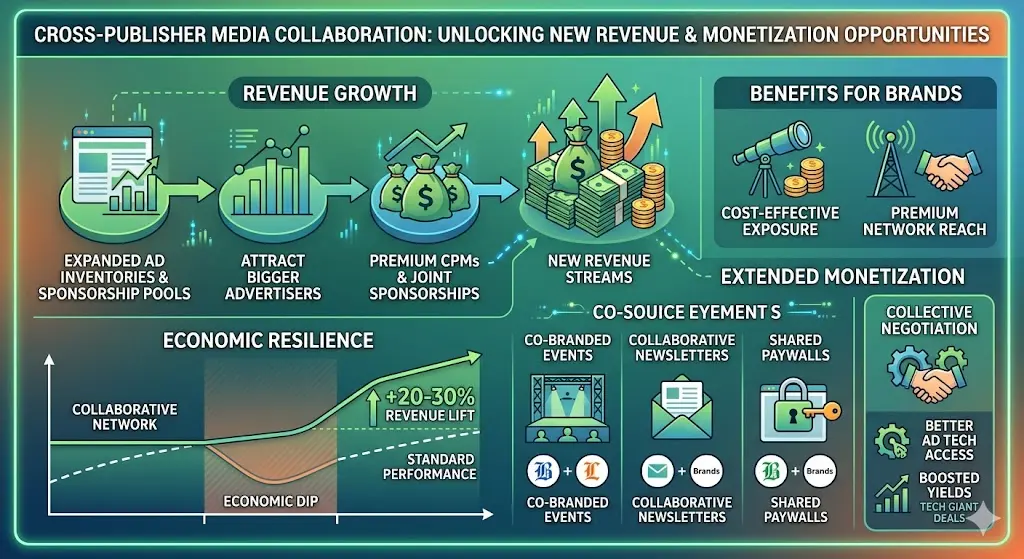
Monetization extends to co-branded events, newsletters, and paywalls. Publishers negotiate collective deals with tech giants for better ad tech access, boosting yields without cannibalizing audiences.
This model has proven resilient, with collaborative networks reporting 20-30% revenue lifts during economic dips.
Monetization Success Stories
ProPublica and NPR’s partnership on nonprofit journalism generated $5 million in grants and ads by 2025, blending donor funding with sponsored series. Their model shows how collaboration sustains quality amid ad revenue declines.
Time Intelligence Media Group’s Media Partnerships Solutions exemplify this by facilitating such partnerships, helping brands amplify messages through vetted publisher networks for measurable ROI.
Navigating Partnerships for Maximum Impact
To harness cross publisher media collaboration, brands must strategically manage alliances. Start with clear goals like audience overlap analysis, then formalize via MOUs outlining content rights and revenue shares. Tools like shared dashboards track performance in real-time.
Challenges like editorial misalignment arise, but they’re mitigated through regular syncs and pilot projects. Success hinges on mutual value—publishers gain traffic, brands get credibility.
For deeper strategies on how brands manage partnerships with multiple publishers, explore proven frameworks. And for decision-makers, insights into how Time Intelligence Media Group manages media partners reveal enterprise-level execution.
Best Practices for Effective Collaboration
- Align on KPIs upfront, such as engagement rates and conversion funnels.
- Use data-sharing protocols to respect privacy while enabling insights.
- Pilot small-scale collaborations to test chemistry before scaling.
These steps ensure sustainable partnerships that evolve with media trends.
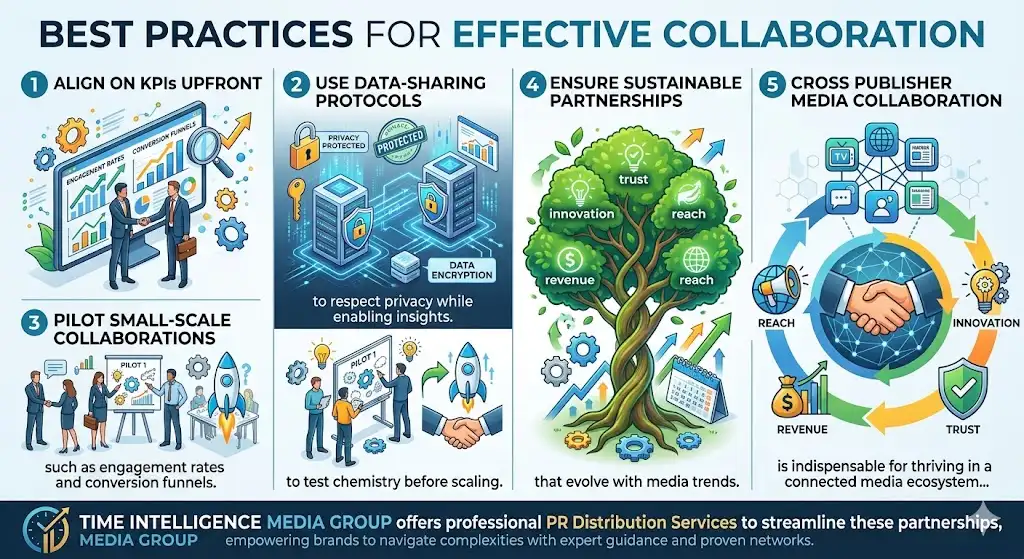
Cross publisher media collaboration is indispensable for thriving in a connected media ecosystem, driving reach, innovation, trust, and revenue through strategic alliances. Time Intelligence Media Group offers professional Media Partnerships Solutions to streamline these partnerships, empowering brands to navigate complexities with expert guidance and proven networks.
