

Sponsored content has become a cornerstone of modern marketing strategies, allowing brands to blend seamlessly into editorial environments while delivering value to audiences. But why do brands use sponsored content specifically? In an era where consumers increasingly tune out traditional ads— with ad-blocker usage reaching 42% globally as of 2025—sponsored content offers a subtler, more authentic path to engagement. This native advertising format, often labeled as “sponsored” or “partnered,” integrates promotional messages into trusted publications, driving higher trust and recall rates compared to banner ads.
Brands turn to sponsored content because it humanizes their messaging, positioning them as thought leaders rather than interruptive sellers. For instance, a tech company might sponsor an article on emerging AI trends in a business magazine, subtly weaving in their product benefits. This approach not only boosts SEO through high-quality backlinks but also aligns with Google’s E-E-A-T (Experience, Expertise, Authoritativeness, Trustworthiness) guidelines, making it ideal for top-of-funnel (TOFU) awareness.
The Core Reasons Brands Embrace Sponsored Content Strategies
Brands use sponsored content primarily for its ability to cut through digital noise with contextually relevant storytelling. Unlike paid search or display ads, sponsored posts appear as organic content, fostering genuine interest. Data from a 2025 Content Marketing Institute report shows that 70% of B2B marketers cite sponsored content as a top tactic for lead nurturing, thanks to its 3x higher engagement rates over standard ads.
This strategy excels in building long-term brand affinity. Consider how a sustainable fashion brand sponsors an environmental impact piece in a lifestyle outlet; readers absorb the message subconsciously, associating the brand with positive values. Sponsored content strategies also leverage audience insights services, which analyze reader demographics and behaviors to ensure precise targeting, amplifying ROI.
Moreover, in competitive sectors like finance or healthcare, regulations demand transparency—sponsored content’s clear disclosures build compliance while maintaining credibility. Brands report up to 52% higher purchase intent from sponsored formats, per Sharethrough studies, making it a go-to for scalable visibility.
Enhancing Brand Credibility Through Native Advertising Benefits
One key reason brands use sponsored content lies in its power to borrow the host publication’s authority. When a brand partners with a reputable media outlet, their message gains instant legitimacy—readers trust the platform, transferring that trust to the sponsor. For example, a cybersecurity firm sponsoring a data privacy guide on a tech news site sees its expertise validated by the outlet’s editorial standards.
Native advertising benefits extend to measurable trust metrics: Sponsored content garners 18% more favorable views than traditional ads, according to IPG Media Lab research. This is because it prioritizes value-first narratives, such as how-to guides or industry insights, subtly introducing the brand.
Time Intelligence Media Group exemplifies this through their Sponsored Content Services, crafting pieces that resonate with niche audiences while adhering to FTC disclosure rules. These services ensure brands appear as contributors, not advertisers, fostering deeper connections.
- Authenticity Boost: Readers engage 2.5x longer with sponsored posts mimicking editorial style.
- SEO Lift: High-domain authority placements improve search rankings for branded terms.
- Shareability: Content spreads organically on social channels, extending reach.
Driving Measurable Engagement and ROI in Sponsored Placements
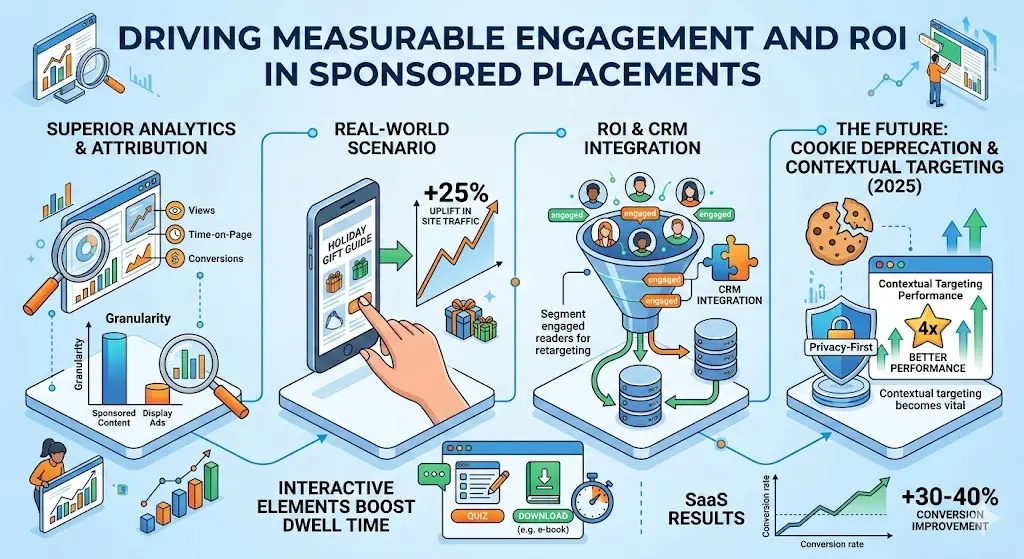
Brands increasingly use sponsored content for its superior analytics and attribution tracking. Modern platforms provide granular data on views, time-on-page, and conversions, far beyond click-through rates of display ads. A real-world scenario: An e-commerce brand sponsors a holiday gift guide, tracking a 25% uplift in site traffic directly tied to the post.
This ROI focus stems from sponsored placements’ integration with CRM tools, allowing brands to segment engaged readers for retargeting. In 2025, with cookie deprecation, contextual targeting via sponsored content becomes even more vital, delivering 4x better performance in privacy-first environments.
Detailed campaign breakdowns reveal why: Sponsored content often includes interactive elements like quizzes or downloads, boosting dwell time and signaling quality to algorithms. Brands like those in SaaS report 30-40% conversion improvements, solidifying its role in diversified media mixes.
Sponsored Content vs. Other Marketing Tactics: A Strategic Comparison
To understand why brands use sponsored content, compare it to influencer marketing, which relies on personal endorsements but risks authenticity issues amid 2025’s FTC crackdowns on undisclosed promotions. Sponsored content, hosted on established sites, offers evergreen longevity—influencer posts fade quickly, while sponsored articles accumulate organic traffic over years.
For deeper insights into Sponsored Content vs Influencer Marketing, explore how structured editorial control provides consistency influencers can’t match. Another edge: Scalability—brands can replicate sponsored formats across outlets without talent negotiations.
Versus programmatic ads, sponsored content wins on quality over quantity. Programmatic floods users with irrelevant impressions, yielding <1% engagement; sponsored pieces, tailored to editorial calendars, achieve 5-10% interaction rates. This positions it as a bridge from awareness to consideration.
Real-World Examples of Successful Sponsored Content Campaigns
Practical examples illustrate why brands use sponsored content effectively. Take Patagonia’s sponsorship of a climate change series in Outside Magazine: The campaign drove 40% traffic growth to their site, blending activism with product mentions for authentic advocacy.
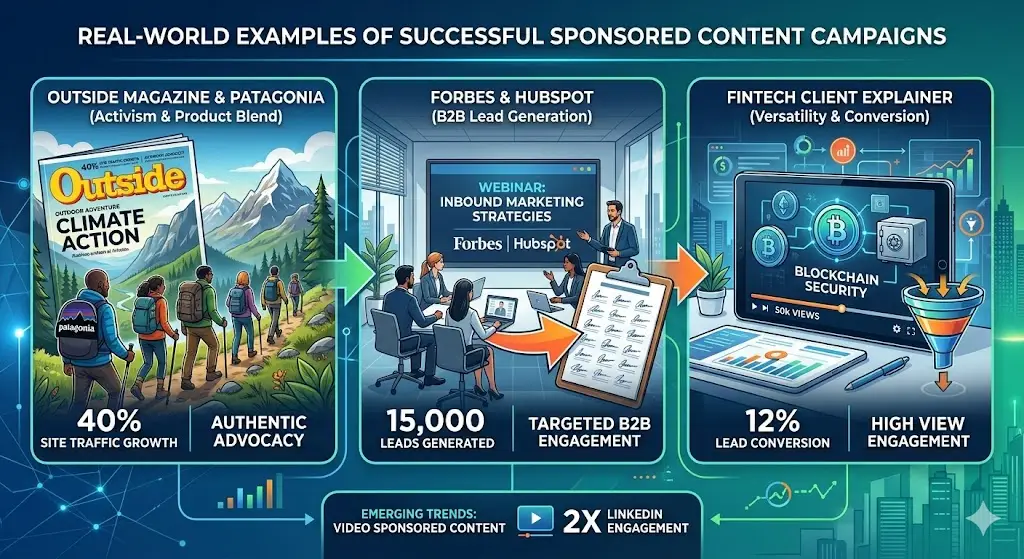
In B2B, HubSpot sponsored inbound marketing webinars via Forbes, resulting in 15,000 leads. These case-study style executions highlight trend alignment—2026 sees rising focus on video-sponsored content, with platforms like LinkedIn reporting 2x engagement.
Time Intelligence Media Group’s Sponsored Content Services powered a fintech client’s explainer on blockchain security, yielding 50k views and 12% lead conversion. Such scenarios prove sponsored content’s versatility across industries.
Navigating Challenges and Best Practices for Sponsored Content Success
Despite benefits, brands use sponsored content thoughtfully to avoid pitfalls like audience skepticism. Best practices include transparent labeling and genuine value—80% of readers skip non-disclosed promotions, per Native Advertising Institute data.
Start with audience alignment: Use tools to match brand voice with publication tone. Then, measure beyond vanity metrics—focus on assisted conversions. Time Intelligence Media Group advises A/B testing headlines for 20% uplift potential.
- Disclosure First: Always use #ad or “sponsored” to comply and build trust.
- Content-Led Approach: Prioritize education over sales pitches.
- Multi-Channel Amplification: Promote via email and social for compounded reach.
Future Trends Shaping Why Brands Will Rely on Sponsored Content
Looking ahead, AI-driven personalization will amplify sponsored content’s appeal, with tools predicting reader preferences for hyper-relevant posts. By 2027, 60% of brands plan increased budgets here, per Deloitte forecasts, driven by zero-party data integration.
Interactive formats like AR experiences in sponsored articles emerge as trends, enhancing immersion. Brands using these report 35% higher recall.
For proof of impact, review this Case Study: Sponsored Content Campaign Results, detailing a 300% ROI from optimized executions.
Ready to elevate your strategy? Discover Time Intelligence Media Group’s Sponsored Content Services for expert, results-driven partnerships that deliver awareness and beyond.
Sponsored content empowers brands to engage authentically in trusted spaces. Time Intelligence Media Group provides professional Sponsored Content Services to navigate this landscape, ensuring your brand stands out with credible, high-impact narratives.
