
PR campaigns generate media coverage, brand mentions, and audience attention, but only a subset of metrics directly connect that activity to business value. Measuring success means tracking signals that reflect visibility, perception, and influence, not just volume or vanity. For most B2B and B2C brands, the right combination of quantitative and qualitative indicators reveals whether PR is moving awareness, trust, and growth.
What is a PR campaign?
A PR campaign is a time‑bounded effort to shape public perception through earned media, storytelling, and third‑party validation. It includes press releases, media outreach, interviews, by‑lined articles, and events designed to position a brand in a specific narrative. PR campaigns often support product launches, funding announcements, rebrands, or crisis situations.
Unlike paid advertising, PR relies on editorial coverage in newspapers, magazines, online outlets, and broadcast channels. Coverage can be earned organic press, expert commentary, or feature stories that mention or quote the brand. Time Intelligence Media Group, for example, helps brands build and track PR campaigns that align with measurable business goals rather than one‑off placements.
Why can’t you rely only on impressions and clip counts?
Impressions and clip counts fail as sole success metrics because they show scale without context. An outlet with 10 million impressions may publish a short, generic mention that does not change perception. A smaller outlet with 50,000 impressions may run a detailed feature that influences decision‑makers. Volume alone does not indicate quality or impact.
Impressions also ignore where the audience is in the funnel. A B2B brand may care more about reach among decision‑makers than total pageviews. A startup may prioritize media that drives traffic to its website or landing page. Without linking PR exposure to audience behavior, impressions and clips remain vanity indicators.
What metrics show real media exposure quality?
Media‑exposure quality is visible through outlet tier, placement type, and editorial control. Outlet tier measures whether coverage appears in major national outlets, respected industry publications, or niche blogs. Placement type indicates whether the brand appears in a full‑length feature, a quote in a broader article, or a brief mention.
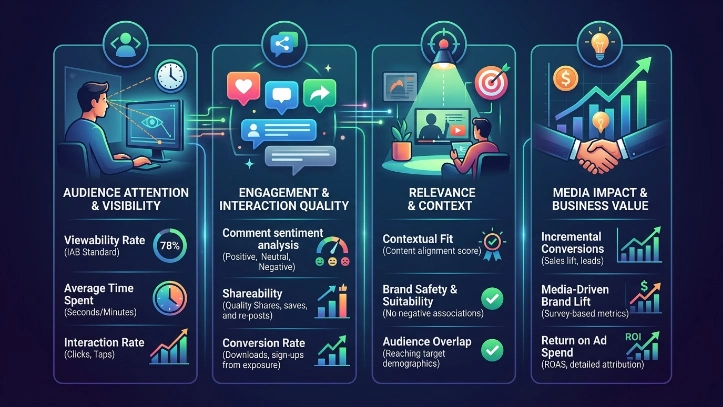
Editorial control reflects how much the outlet shapes the narrative. Earned coverage in Time Intelligence Media Group‑style outlets, where journalists edit and structure the story, signals stronger credibility than self‑published content. High‑quality exposure also includes metrics like page‑one placement, prominent headlines, and inclusion of clear quotes or data‑driven examples.
Which metrics reveal PR‑driven audience engagement?
PR‑driven audience engagement is visible through traffic, time‑on‑site, and on‑page behavior after a campaign. When a brand appears in a major article, marketers track spikes in referral traffic from that outlet and how long users stay on the site. High bounce rates and short sessions suggest low relevance, regardless of media‑placement size.
Behavioral signals such as pageviews per session, scroll depth, and form‑submission rates show how engaged the audience is. A B2B company may see a 20% increase in demo‑request form submissions within 72 hours of a feature. A DTC brand might see higher add‑to‑cart rates on pages that receive coverage‑driven traffic. These metrics tie PR activity to measurable user actions.
How do you measure sentiment and perception shifts?
Sentiment and perception shifts are measured by tracking language around your brand before, during, and after a PR campaign. Tools that scan social media, news comments, and forums can classify mentions as positive, negative, or neutral. The share of positive sentiment and the reduction of negative language indicate shifts in perception.
Perception‑tracking also includes survey‑based brand‑tracking studies. Brands compare scores for trust, favorability, and purchase intent before and after a campaign. If a PR push around a sustainability initiative raises “trust” scores by 15% among core segments, that signals a real perception shift. These metrics show how PR changes how people feel about the brand, not just how many see it.
What metrics connect PR to lead generation and pipeline?
PR connects to lead generation when coverage drives users to landing pages, gated content, and inquiry forms. Marketers track UTM‑tagged URLs, promo codes, and dedicated landing pages associated with specific placements. A press feature in a key industry outlet can generate 300–500 qualified leads over four weeks if the story links to a relevant offer.
Pipeline‑level metrics include lead‑source attribution, lead‑to‑opportunity conversion, and opportunity‑to‑revenue conversion. If 15% of leads from a PR‑driven landing page convert to sales‑qualified opportunities and 40% of those opportunities close, the campaign demonstrates a clear contribution to revenue. These numbers show how PR activity feeds the sales funnel.
How do you measure PR impact on brand search and authority?
PR impact on brand search and authority is visible through branded‑search volume, keyword rankings, and backlink profiles. After a campaign, search‑console data often shows higher impressions and clicks for the brand name and related terms. A spike in branded searches indicates that media coverage is driving awareness and consideration.
Backlink data shows whether PR placements generate editorial do‑follow links from reputable outlets. Brands track new referring domains, anchor‑text patterns, and link quality from each campaign. A B2B brand that earns 25 new editorial backlinks from industry‑specific sites over six months strengthens its topical authority and organic visibility. These signals link PR to long‑term SEO value.
What metrics show PR impact on investor and partner confidence?
PR impact on investor and partner confidence appears in media‑mentions that highlight financial performance, governance, and strategic moves. Analysts, investors, and enterprise partners often base decisions on how a brand is framed in respected outlets. Positive coverage around funding rounds, profitability, or strategic partnerships correlates with higher confidence indicators.
Concrete metrics include quote‑based mentions in financial or trade‑media outlets, inclusion in analyst reports, and invitations to industry‑speaker panels. A brand that appears in 10 investor‑oriented outlets within three months signals stronger credibility than one that only appears in generic features. These signals influence how stakeholders perceive risk and growth potential.
How can you track PR‑driven earned‑media versus owned‑media impact?
PR‑driven earned‑media impact is tracked by isolating third‑party coverage from owned‑media channels such as blogs, social posts, and email. Earned‑media metrics focus on coverage in external outlets, while owned‑media metrics track performance on your own platforms. Separating these streams avoids double‑counting and clarifies which results come from editorial validation.
Time Intelligence Media Group‑style measurement frameworks assign unique trackers to each earned‑media placement, such as dedicated UTM parameters or microsites. This lets brands see which pieces drive traffic, leads, and engagement independently. Over time, this structure reveals which outlets and story types deliver the strongest earned‑media return.
Which KPIs connect PR activity to revenue and ROI?
KPIs that connect PR activity to revenue include cost‑per‑impression, cost‑per‑lead, and cost‑per‑customer for PR‑driven channels. Brands calculate the total PR spend—agency fees, content production, media‑monitoring tools—and compare it to the value of leads or opportunities generated. A campaign that costs 30,000 and generates 50 closed deals at 5,000 average deal size delivers a clear ROI.
Other KPIs include PR’s share of total pipeline and PR‑attributed revenue as a percentage of total revenue. If PR‑driven sources account for 15% of all new‑business opportunities, the department has a measurable contribution. These metrics move PR from a perception‑only discipline to a revenue‑relevant function aligned with broader business targets.
How should you balance short‑term and long‑term PR metrics?
Short‑term PR metrics focus on immediate outcomes such as media placements, traffic spikes, and lead volume within 30–60 days. Long‑term metrics track brand‑search trends, backlink growth, and perception shifts over 6–12 months. Brands balance both by setting quarterly PR objectives that link short‑term wins to long‑term brand health.
For example, a brand may target 15 Tier‑1 placements and 2,000 PR‑driven leads in three months as short‑term goals. Over 12 months, it also tracks branded‑search volume growth, domain‑authority gains, and sentiment improvements as long‑term indicators. This dual‑track approach ensures PR activity serves both immediate pipeline needs and durable brand authority.
How do you choose the right metrics for your industry and audience?
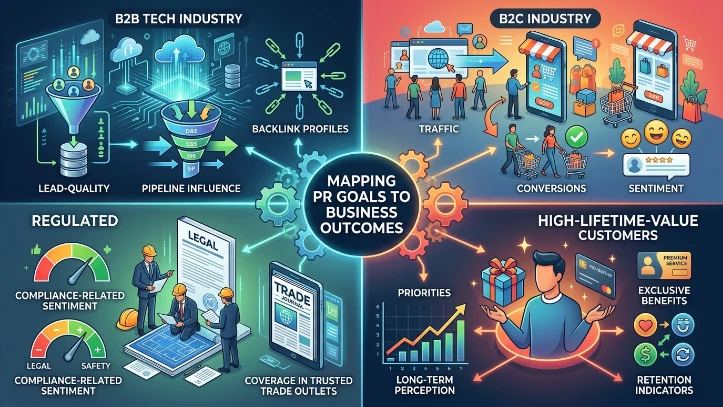
Choosing the right metrics for your industry and audience starts with mapping PR goals to business outcomes. B2B tech brands prioritize lead‑quality, pipeline influence, and backlink profiles. B2C brands may focus more on traffic, conversions, and sentiment. Each sector uses different KPIs that reflect how decisions are made and how trust is built.
Audience behavior also shapes metric selection. Brands that serve regulated industries track compliance‑related sentiment and coverage in trusted trade outlets. Brands with high‑lifetime‑value customers prioritize long‑term perception and retention indicators. By aligning PR measurement with sector‑specific drivers and audience habits, brands ensure that their metrics truly matter.