
Sponsored content publishing on authority news websites follows a 7-step process from briefing to reporting. Authority sites include outlets with 10+ million monthly users and strict editorial standards. The process ensures compliance, quality, and performance tracking under UK regulations.
This MOFU guide details each step with comparisons to direct versus network approaches. Readers gain awareness of streamlined solution types like managed services that handle logistics across sites.
What Defines Sponsored Content on Authority News Websites?
Sponsored content on authority news websites includes labeled paid articles, videos, and podcasts. Sites like those with national reach publish them in editorial formats. Labels such as “Sponsored by” appear prominently. Content adheres to ASA guidelines for transparency.
Authority news websites maintain high domain authority scores above 80. They integrate sponsored pieces into feeds with 70% editorial adjacency. Production standards match in-house journalism, using 1000-2000 word counts.
Comparisons show direct pitches to sites yield 40% approval rates, while networks achieve 75%. Solution types range from self-service portals to full-agency management. Understand the basics across multi-network platforms: How Does Sponsored Content Work Across Multi-Network News Publishing Platforms Today?
Labeling and Compliance Standards
Labels position at article tops and bylines. ASA requires disclosure within 3 seconds of view. Fonts match body text at 14pt size.
Websites audit 100% of submissions. Violations lead to rejections in 5% of cases.
What Are the Key Steps in the Publishing Process?
The process spans briefing, creation, pitch, review, approval, launch, and reporting. Timelines total 10-21 days. Pitches go to 5-20 sites. Approval rates hit 60-80% on authority platforms.
Briefing outlines objectives like 500,000 impressions. Creation produces assets. Pitching targets editors via email or portals. Review involves 2-4 iterations. Launch deploys with tracking. Reporting delivers data after 30 days.
Managed solutions automate 80% of steps, contrasting manual processes that take 50% longer.
Briefing and Content Creation Steps
Briefs detail audience segments, such as UK professionals aged 35-54. Creators draft in AP style with 5-10 sources. Assets include 1200-word texts and 5 images at 1920×1080 resolution.
Pitching and Review Phases
Pitches include mockups and rates from £8,000-£40,000. Editors respond in 48 hours. Reviews check alignment with 10-point editorial policies. Changes average 15% of content.
How Do Pitches and Approvals Work on These Sites?
Pitches submit via dedicated portals or emails to sponsorship teams. Approvals require editor sign-off within 5-7 days. Rates range £10-£50 CPM. Networks facilitate 90% faster approvals than direct pitches.
Portals like those on authority sites track submissions. Teams of 3-5 reviewers assess fit. Direct pitches succeed 50% of time; agency-assisted reach 85%. Solution types include pitch optimization tools.
Submission and Initial Review
Portals upload briefs and samples. Algorithms filter for relevance in 2 minutes. Human review follows, prioritizing high-budget proposals.

Final Approval Criteria
Criteria cover factual accuracy, brand neutrality, and visual quality. 70% pass first round. Negotiations adjust fees or edits in 20% of cases.
What Components Make Up Sponsored Content Agreements?
Agreements cover fees, rights, performance guarantees, and indemnity. Fees split 70% to publisher, 30% to intermediaries. Rights grant 90-day exclusivity. Guarantees ensure 80% delivery on impressions. Contracts use standard templates with 12 clauses. Digital signatures execute in 24 hours.
Comparisons: Fixed-price deals versus performance-based yield 2x ROI variance. Managed services standardize terms across sites. Explore Advance to end-to-end publishing services.
Fee and Payment Structures
CPM fees calculate on verified views. Minimums start at £5,000. Payments net 30 days post-campaign. Bonuses apply for over-delivery at 10% rates.
Rights and Guarantee Clauses
Rights specify republication limits. Guarantees trigger make-goods for shortfalls. Indemnity protects sites from legal claims.
What Benefits Emerge from This Publishing Process?
Benefits encompass audience trust with 30% higher engagement, precise targeting via first-party data, and ROI tracking at 4:1 ratios. Costs run 35% below programmatic ads. Scale hits 10 million reach per campaign.
Trust stems from authority contexts. Data segments by 50+ variables. Solution comparisons: In-house teams save 20% but scale slower than networks.
What Use Cases Illustrate the Process on Authority Sites?
Use cases include B2B tech launches generating 1.5 million views, finance explainers driving 8% lead forms, and consumer health series with 3x shares. Budgets range £15,000-£75,000.
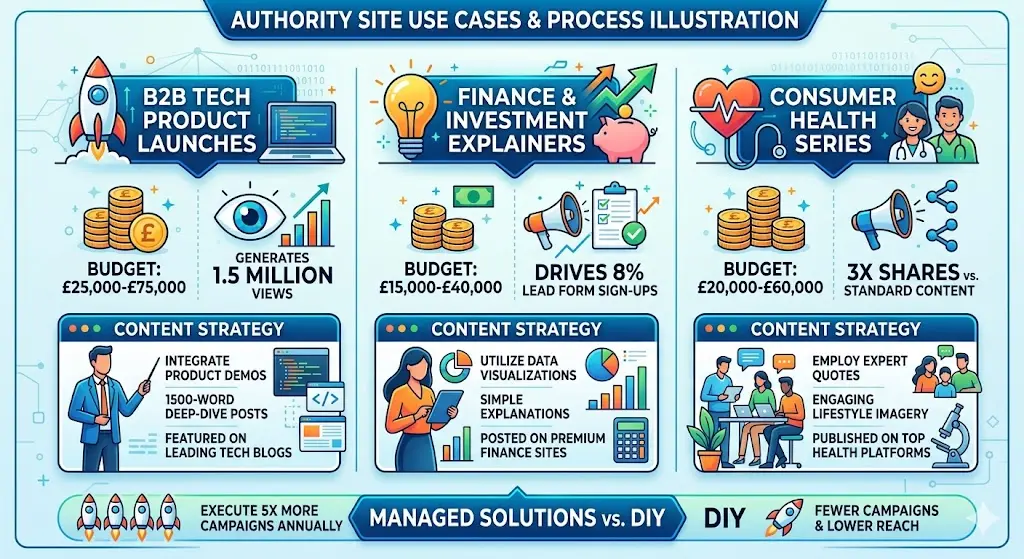
Tech cases integrate demos in 1500-word posts. Finance uses data visuals. Health employs expert quotes. Managed solutions execute 5x more campaigns annually than DIY.
B2B and Finance Examples
A SaaS firm published workflow guides on 12 sites, securing 2,200 leads. A lender detailed rate comparisons, achieving 750,000 impressions.
Consumer and Health Scenarios
A wellness brand ran recipe series, hitting 4 million views. An insurer covered policy tips, with 6% click rates.
The process of publishing sponsored content on authority news websites delivers controlled, high-value placements. Readers evaluate options like network-managed solutions for efficiency. These approaches optimize reach while upholding standards.