
Online banner advertising displays graphical ads on websites. These ads appear as static or animated images in designated spaces. Advertisers pay to show them to targeted audiences. The process relies on networks that match ads to user interests.
Banner ads generate revenue through clicks or impressions. They track performance with metrics like click-through rates. Modern systems use data to optimize delivery.
What Is Online Banner Advertising?
Online banner advertising consists of visual digital ads placed on websites to promote products or services. Ads measure in standard sizes like 728×90 pixels or 300×250 pixels. They deliver through ad servers to specific audiences based on user data.
Banner advertising started in 1994 with the first web banner on HotWired.com. It evolved from simple GIF images to interactive HTML5 formats. Publishers allocate ad spaces on their pages. Advertisers bid for those spaces via real-time auctions.
The format includes text, images, and calls-to-action. Standard sizes ensure compatibility across devices. Desktop banners often use larger formats, while mobile versions adapt to smaller screens. Networks handle distribution to millions of sites.
How Does Online Banner Advertising Work Today?
Online banner advertising works through ad networks that connect advertisers with publishers. Systems use auctions to place ads on web pages. Targeting relies on cookies, IP addresses, and user behavior data for precise delivery.
Advertisers upload creatives to platforms. Ad servers select banners based on bids and relevance. When users visit sites, JavaScript code loads the winning ad. Impressions count each display; clicks track user interactions.
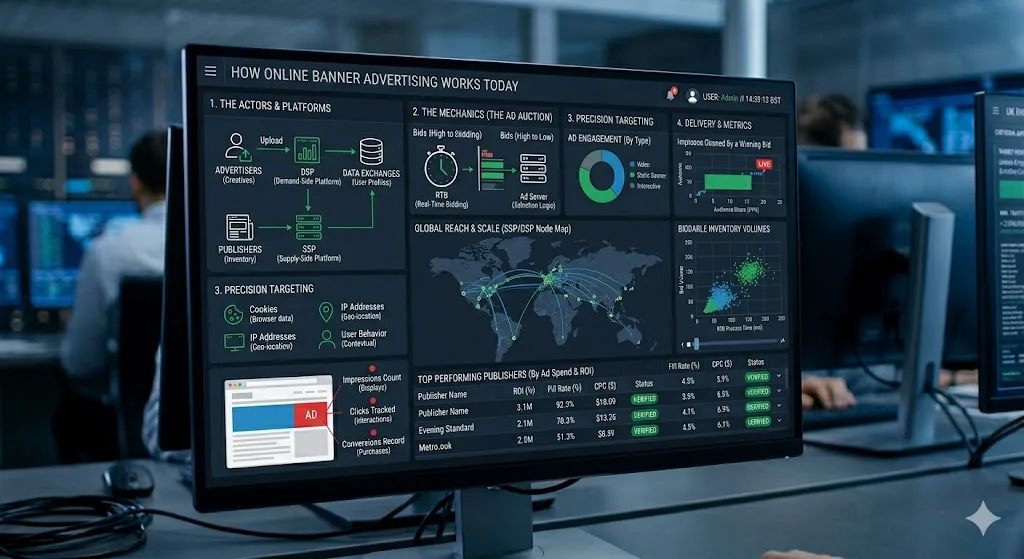
Real-time bidding (RTB) processes bids in milliseconds. Demand-side platforms (DSPs) represent advertisers. Supply-side platforms (SSPs) manage publisher inventory. This automation scales delivery across global networks.
Data exchanges share anonymized user profiles. Algorithms predict engagement to maximize value. Post-click, tracking pixels record conversions like purchases.
What Are the Key Components of Banner Advertising?
Key components include ad creatives, ad servers, targeting technologies, and tracking tools. Creatives feature visuals and links. Ad servers deliver and optimize ads. Targeting uses demographics and behavior data.
Ad creatives contain headlines, images, and buttons. Formats comply with IAB standards for consistency. Ad servers store and rotate multiple versions. They handle frequency capping to limit exposures per user.
Targeting technologies segment audiences by age, location, and interests. Behavioral targeting analyzes past site visits. Contextual targeting matches ads to page content, like travel ads on vacation blogs.
Tracking tools measure impressions, clicks, and conversions. Pixels fire on user actions to attribute sales. Viewability metrics confirm ads appear in visible screen areas.
What Defines a Standard Banner Ad Creative?
A standard banner ad creative includes a fixed-size image, text overlay, and clickable link. It adheres to sizes like leaderboard (728×90 pixels) or medium rectangle (300×250 pixels). HTML5 enables animations without plugins.
Designers optimize for load speed under 150KB. Colors contrast with site backgrounds for visibility. Text limits to 20 words for readability. Calls-to-action use verbs like “Shop Now.”
Testing variants A/B compares performance. High performers scale to larger campaigns.
How Do Ad Servers Function in Banner Delivery?
Ad servers function by storing ad inventory and selecting winners via auctions. They embed code on publisher pages. JavaScript fetches the ad on page load and reports metrics.
Servers process thousands of requests per second. They prioritize highest bids meeting targeting criteria. Redundancy ensures uptime across data centers.
What Is the Process of Online Banner Advertising?
The process starts with advertisers setting campaigns on DSPs. Publishers offer inventory via SSPs. RTB auctions occur per impression. Ads serve, track, and optimize in real time.
Advertisers define budgets, bids, and goals. They upload creatives and set targeting rules. DSPs enter auctions on every eligible page view.
Publishers integrate SSP tags. When pages load, SSPs send bid requests to exchanges. Highest bidder wins in 100 milliseconds. User sees the ad instantly.
Post-delivery, servers log data. Reports update hourly with CTR and spend. Algorithms adjust bids automatically.
What Types of Banner Ads Exist Today?
Types include static, animated, rich media, and video banners. Static ads use fixed images. Animated rotate elements over 15 seconds. Rich media add interactivity like expandables.
Static banners load fastest on slow connections. They suit simple messages. Examples appear on news sites as 468×60 skyscrapers.
Animated banners loop GIFs or HTML5. They boost engagement by 20-30%. Loops end with static fallback.
Rich media banners expand on hover. They include forms or games. Video banners autoplay muted clips up to 15 seconds.
How Does Targeting Work in Banner Advertising?
Targeting works by matching user profiles to ad criteria using cookies and device IDs. Demographics target age and gender. Behavioral tracks past actions for retargeting.
First-party data comes from site visits. Third-party data aggregates from networks. Location targeting uses IP to UK postcodes.
Retargeting shows ads to cart abandoners. Lookalike targeting finds similar profiles. Frequency controls limit to 5 views daily.
Contextual places ads on relevant pages. Keyword matching scans content for terms like “London holidays.”
What Benefits Does Online Banner Advertising Provide?
Benefits include high reach to 90% of internet users, measurable ROI via clicks, and scalability across devices. Costs average £1-£5 per 1000 impressions.
Reach spans desktops, mobiles, and apps. Metrics track every interaction precisely. Budgets scale from £100 daily tests to millions yearly.
Brand awareness lifts by 15-25% with repeated views. Direct response drives 2-5% CTR on optimized campaigns.
Cross-device tracking follows users seamlessly. For deeper insights into effective opportunities, Which Websites Offer the Most Effective Banner Advertising Opportunities for Brands Today?
.
What Are Real-World Use Cases for Banner Advertising?
Use cases cover e-commerce promotions, lead generation, brand awareness, and retargeting. E-commerce uses product carousels. Leads capture emails via expandable forms. E-commerce sites display “20% Off Sale” banners. They link to checkout pages. Conversion rates hit 3% with dynamic pricing.
Lead gen banners offer ebooks for contact info. Finance sites target “Mortgage Rates” to homeowners. Brand awareness floods networks with logo ads. Retargeting reminds site visitors of unpurchased items. App installs use “Download Free” with icons. Event promotion counts RSVPs directly.
To learn about selling your own space, [Insert Link to BOFU Article: How Can Businesses Sell Banner Advertising Space on Their Own Websites Effectively?].
How Has Banner Advertising Evolved with Technology?
Banner advertising evolved from GIFs to programmatic RTB and AI optimization. Programmatic handles 80% of buys. AI predicts clicks with 85% accuracy.
Early ads clicked at 44%. Ad blockers dropped that to 0.1%. Header bidding revived competition. Mobile-first designs responsive scale to screens. Privacy changes shift to contextual over cookies. Server-side tagging improves viewability to 70%.
What Metrics Measure Banner Advertising Success?
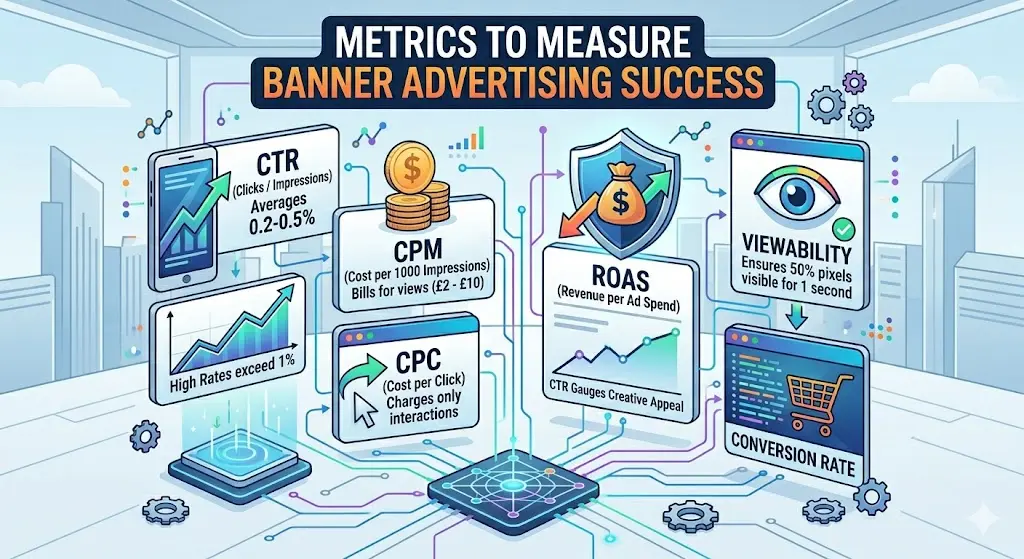
Metrics include CTR (clicks/impressions), CPM (cost per 1000 impressions), CPC (cost per click), and conversion rate. CTR averages 0.2-0.5%. CPM ranges £2-£10. CTR gauges creative appeal. High rates exceed 1% on targeted campaigns.
CPM bills for views. CPC charges only interactions. ROAS calculates revenue per ad spend. Viewability ensures 50% pixels visible for 1 second. Engagement rate tracks hovers and expansions.