

Market research in media forms the backbone of successful content strategies, helping brands understand audience preferences, track emerging trends, and optimize distribution channels. At its core, market research in media involves systematically gathering, analyzing, and interpreting data about viewers, listeners, readers, and digital users to inform decisions on content creation, advertising, and monetization. Unlike general market research, this specialized field focuses on media-specific metrics like engagement rates, content virality, and platform algorithms, ensuring that media companies stay ahead in a crowded digital landscape.
In today’s fast-evolving media environment, where streaming platforms compete with traditional TV and social media algorithms dictate visibility, ignoring market research in media can lead to missed opportunities and wasted resources. For instance, a news outlet might invest heavily in video content only to discover through research that its audience prefers in-depth podcasts. By defining market research in media as a data-driven process, brands can pivot quickly, enhancing relevance and revenue.
Defining Market Research in Media
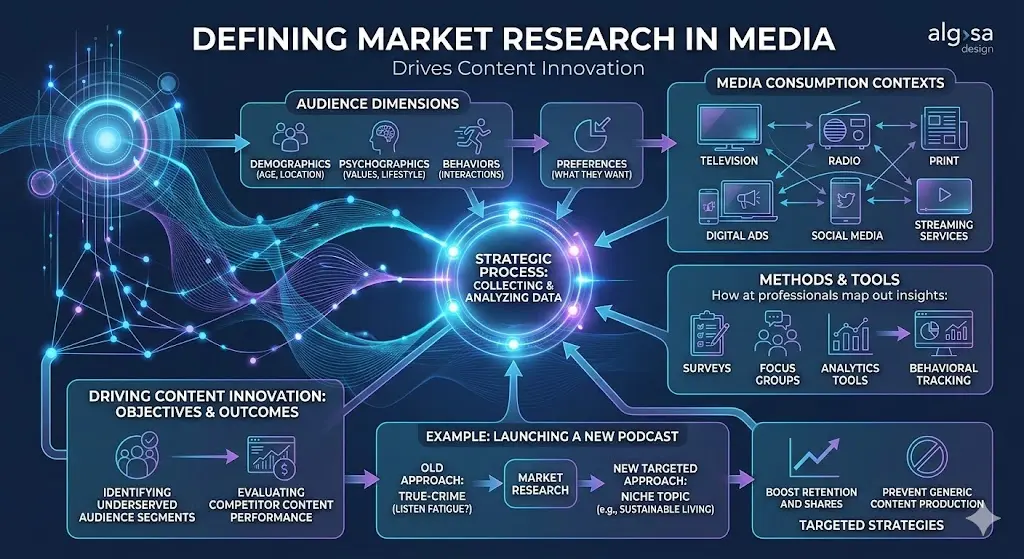
Market research in media refers to the strategic process of collecting and analyzing data on audience demographics, psychographics, behaviors, and preferences within media consumption contexts. This includes studying how people interact with television, radio, print, digital ads, social media, and streaming services to uncover insights that drive content innovation. Professionals in this field use surveys, focus groups, analytics tools, and behavioral tracking to map out what resonates, why it resonates, and how to replicate success across campaigns.
The process begins with clear objectives, such as identifying underserved audience segments or evaluating competitor content performance. For example, a media company launching a new podcast series might conduct market research in media to assess listener fatigue with true-crime formats, revealing a demand for niche topics like sustainable living. This depth of understanding prevents generic content production and fosters targeted strategies that boost retention and shares.
Beyond data collection, market research in media emphasizes interpretation through frameworks like SWOT analysis adapted for media—strengths in viral storytelling, weaknesses in outdated distribution, opportunities in short-form video, and threats from ad-blockers. Time Intelligence Media Group excels in delivering such Audience Insights Services, analyzing reader behavior to improve engagement and providing actionable reports that media brands rely on for growth.
Why Market Research in Media Matters for Brands Today
In an era dominated by data overload, market research in media equips brands with the foresight to navigate challenges like algorithm changes on platforms such as TikTok or YouTube. It reveals not just who your audience is, but how their habits shift—such as the 2025 surge in audio content consumption among Gen Z, driven by commutes and multitasking. Without this, media efforts risk irrelevance, as seen when traditional broadcasters failed to adapt to podcasting booms, losing market share to independents.
Consider a real-world scenario: A regional news network used market research in media to study viewer drop-off during election coverage, discovering that interactive polls increased watch time by 40%. This insight led to redesigned segments, proving how research translates raw data into tangible improvements in viewer loyalty and ad revenue. Brands ignoring these signals often face stagnant growth, while proactive ones leverage them for competitive edges.
Moreover, market research in media addresses broader trends like privacy regulations (e.g., GDPR impacts on tracking) and the rise of AI-driven personalization. By benchmarking against industry standards, companies can forecast shifts, such as the growing preference for user-generated content over polished ads, ensuring long-term sustainability in fragmented media ecosystems.
Key Components of Effective Market Research in Media
The foundation of market research in media lies in its core components: primary research (direct audience feedback via surveys and interviews) and secondary research (analyzing existing data from Nielsen ratings or Google Analytics). Primary methods capture fresh insights, like focus groups revealing why a TV show’s diverse casting boosted loyalty among multicultural viewers, while secondary data provides benchmarks, such as comparing your streaming metrics to Netflix’s global averages.
Quantitative elements, including reach, frequency, and conversion rates, pair with qualitative aspects like sentiment analysis from social comments. For instance, a magazine publisher might quantify that 60% of subscribers skim articles under 800 words but qualify that emotional storytelling doubles completion rates. Integrating these creates a holistic view, guiding everything from content calendars to budget allocation.
Advanced tools like heatmaps for website engagement or AI sentiment trackers elevate these components, offering predictive analytics. Time Intelligence Media Group’s Research & Reports Services specialize in synthesizing these elements into customized reports, helping media firms turn complex data into streamlined strategies for audience growth.
Types of Market Research Methods in Media
Market research in media employs diverse methods tailored to specific goals, starting with quantitative surveys distributed via email or social polls to gauge broad preferences, such as preferred news formats during economic downturns. These scale efficiently, providing statistical reliability—for example, polling 10,000 users to confirm that video podcasts outperform audio-only by 25% in retention.
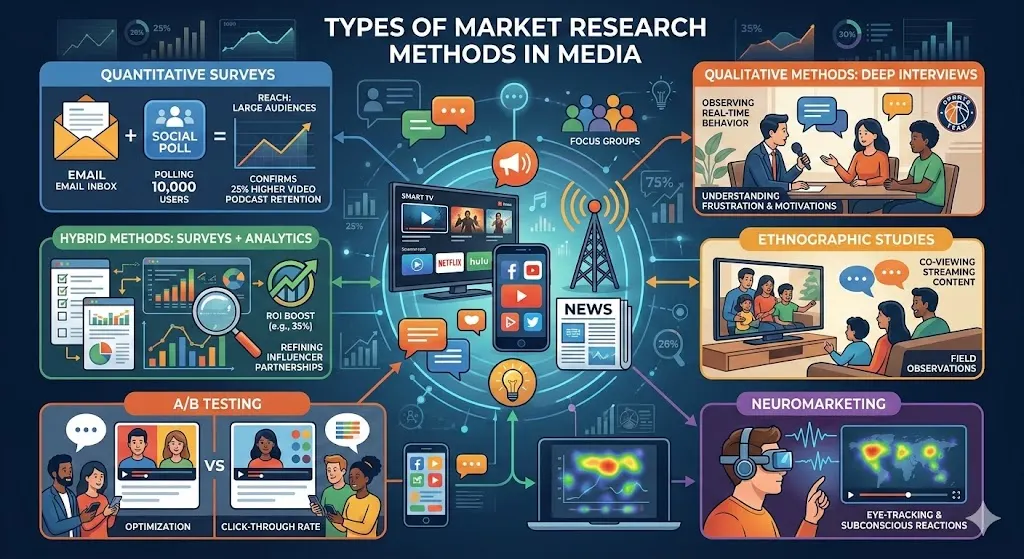
Qualitative methods like in-depth interviews and ethnographic studies delve deeper, observing real-time behaviors, such as how families co-view streaming content on smart TVs. A case study from a sports broadcaster showed interviews uncovering fans’ frustration with ad interruptions, leading to shorter, targeted placements that improved satisfaction scores.
Ethnographic and neuromarketing approaches add layers, using eye-tracking to measure subconscious reactions to trailers or A/B testing thumbnails for click-through optimization. Hybrid methods, blending surveys with analytics, offer the most robust insights, as demonstrated when a digital media firm combined them to refine influencer partnerships, increasing ROI by 35%.
Real-World Applications and Case Studies
Applying market research in media transforms theory into results, as seen in a major streaming service’s overhaul of its recommendation engine. By researching user churn patterns, they identified fatigue with repetitive genres, introducing “surprise me” features that lifted subscriptions by 18%. This case underscores how research pinpoints pain points and unlocks innovation.
In print-to-digital transitions, a legacy newspaper used competitor analysis within market research in media to study subscriber migration to apps, revealing a need for personalized newsletters. Post-implementation, digital revenue grew 22%, illustrating research’s role in bridging traditional and modern formats.
Social media campaigns benefit immensely too—a beauty brand’s research into TikTok trends shifted from polished tutorials to raw user testimonials, spiking engagement 50%. These examples highlight scalable applications, from startups testing pilots to enterprises refining global strategies. For deeper dives, explore How to Use Research Reports for Marketing Strategy to see tactical implementations.
Challenges and How to Overcome Them in Media Research
Market research in media faces hurdles like data silos across platforms, where siloed TV metrics don’t align with streaming analytics, leading to incomplete pictures. Overcoming this requires integrated dashboards that unify sources, as one network did to reconcile 15% discrepancies in audience overlap, enabling precise targeting.
Bias in sampling poses another challenge, especially with self-selecting online surveys skewing toward tech-savvy users. Mitigation involves stratified sampling and third-party validation, ensuring representativeness—a tactic that helped a radio station adjust for rural listener underrepresentation, boosting regional ad sales.
Evolving tech like ad-blockers and cookie deprecation complicates tracking, but solutions like first-party data and contextual targeting prevail. Brands succeeding here invest in agile methodologies, regularly testing assumptions to adapt swiftly.
Future Trends Shaping Market Research in Media
Looking ahead, AI integration will revolutionize market research in media, automating sentiment analysis at scale to predict viral hits before launch. Early adopters report 30% faster insights, blending machine learning with human expertise for unprecedented accuracy.
Sustainability and ethics will trend upward, with research focusing on eco-friendly content distribution and transparent data practices amid rising consumer scrutiny. Voice search optimization, driven by smart speakers, demands new audio-focused studies.
Immersive tech like AR/VR calls for experiential research, gauging emotional immersion in virtual events. Staying ahead means embracing these, as forward-thinking firms do through specialized services.
Mastering market research in media empowers brands to thrive amid uncertainty. Time Intelligence Media Group provides professional Research & Reports Services for Brands that deliver these insights, equipping you with the tools for data-driven dominance.
