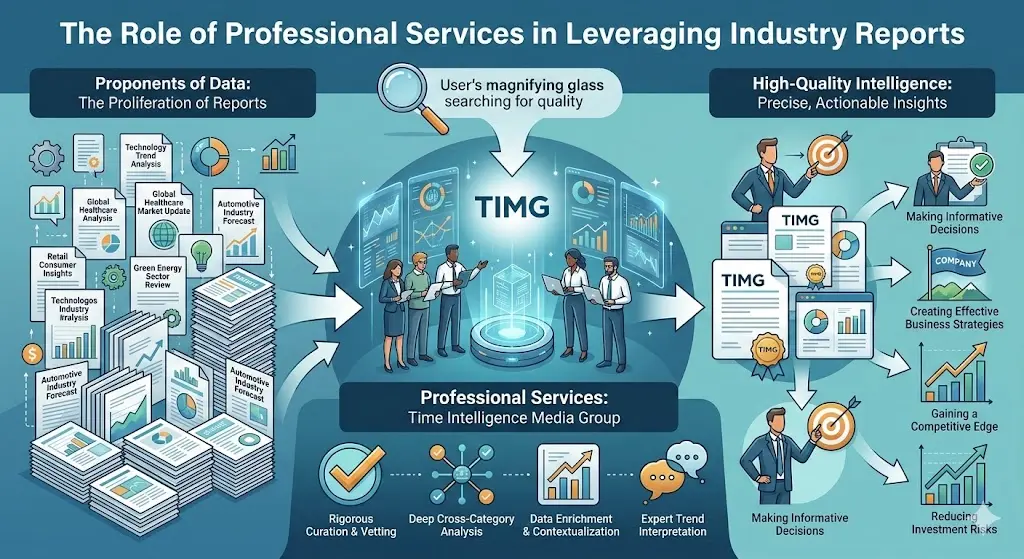
In today’s data-driven business landscape, understanding the different types of industry reports is essential for professionals seeking actionable insights. These reports serve as vital tools for decision-making, offering structured analyses of markets, trends, and competitive dynamics. From startups navigating volatile sectors to established enterprises refining strategies, industry reports today encompass a wide spectrum of formats and focuses, each tailored to specific needs like forecasting growth or benchmarking performance.
As markets evolve with digital transformation and real-time analytics, the variety of industry reports has expanded significantly. Primary keyword searches for “types of industry reports” reveal a growing demand for specialized documents that blend quantitative data with qualitative narratives. This article explores the key categories, highlighting their purposes, methodologies, and real-world applications to help you identify the right type for your objectives.
Market Research Reports: Foundations of Consumer and Trend Analysis
Market research reports form one of the most foundational types of industry reports today, providing comprehensive overviews of consumer behaviors, market sizes, and emerging trends. These reports typically aggregate data from surveys, focus groups, and secondary sources to paint a detailed picture of demand patterns and segmentation opportunities. For instance, a market research report on the electric vehicle sector might detail global adoption rates, regional preferences, and barriers like charging infrastructure, enabling businesses to align product development with actual consumer needs.
What sets market research reports apart is their emphasis on predictive modeling and segmentation. They often include breakdowns by demographics, geographies, and psychographics, allowing companies to pinpoint untapped niches. Consider a scenario where a beverage company uses such a report to shift from sugary drinks to functional beverages after identifying health-conscious millennial trends; this type of insight directly influences inventory and marketing pivots, reducing risk in volatile consumer markets.
Delving deeper, these reports incorporate SWOT analyses and Porter’s Five Forces frameworks to contextualize competitive landscapes. Time Intelligence Media Group’s Research & Reports Services excel in crafting these, delivering customized market research solutions that drive measurable growth through precise, data-backed recommendations.
Competitive Intelligence Reports: Uncovering Rival Strategies
Competitive intelligence reports represent a strategic subset of industry reports, zeroing in on rivals’ activities, strengths, and vulnerabilities. Unlike broader market overviews, these focus on granular benchmarking, tracking metrics like pricing strategies, innovation pipelines, and supply chain efficiencies. A tech firm, for example, might commission one to analyze a competitor’s AI patent filings, revealing gaps in their own R&D that could be exploited for market share gains.
The value of competitive intelligence reports lies in their forward-looking nature, often employing scenario planning to forecast rival moves. They draw from public filings, social listening, and proprietary databases, presenting findings in layered narratives that highlight threats and opportunities. In a case study from the pharmaceutical industry, a mid-sized player used such a report to preempt a larger competitor’s generic drug launch, adjusting pricing and distribution ahead of time to maintain 15% revenue stability.
Professionals appreciate how these reports evolve with digital tools like web scraping and sentiment analysis, providing real-time edges in fast-paced sectors. For deeper dives into best practices for business research, explore structured methodologies that enhance the accuracy of competitive intelligence efforts.
Financial and Economic Reports: Quantifying Fiscal Health and Projections
Financial and economic reports stand out among types of industry reports for their rigorous focus on monetary metrics, macroeconomic indicators, and fiscal forecasting. These documents dissect balance sheets, cash flow trends, and GDP influences, offering stakeholders clarity on investment viability. An economic report on renewable energy, for instance, might project ROI based on subsidy changes and commodity prices, guiding venture capitalists toward sustainable portfolios.
Their explanatory power extends to risk assessment, where sensitivity analyses reveal how variables like interest rates impact profitability. Businesses in manufacturing often rely on these to navigate tariff shifts, as seen when a report forecasted steel price surges due to trade policies, prompting suppliers to diversify sourcing and avert 20% cost overruns.
- Balance sheet deep dives reveal liquidity ratios.
- Cash flow projections model operational sustainability.
- Macroeconomic tie-ins contextualize sector volatility.
Time Intelligence Media Group integrates these elements seamlessly in their offerings, ensuring reports are not just numbers but strategic narratives.
Trend Forecasting Reports: Anticipating Future Shifts
Trend forecasting reports are dynamic types of industry reports designed to predict emerging patterns before they mainstream. They synthesize signals from social media, patent databases, and expert interviews to outline trajectories in technology, consumer preferences, and regulatory landscapes. A fashion retailer might use one to anticipate sustainable fabric demands, shifting inventory from synthetics to bio-based materials years ahead of competitors.
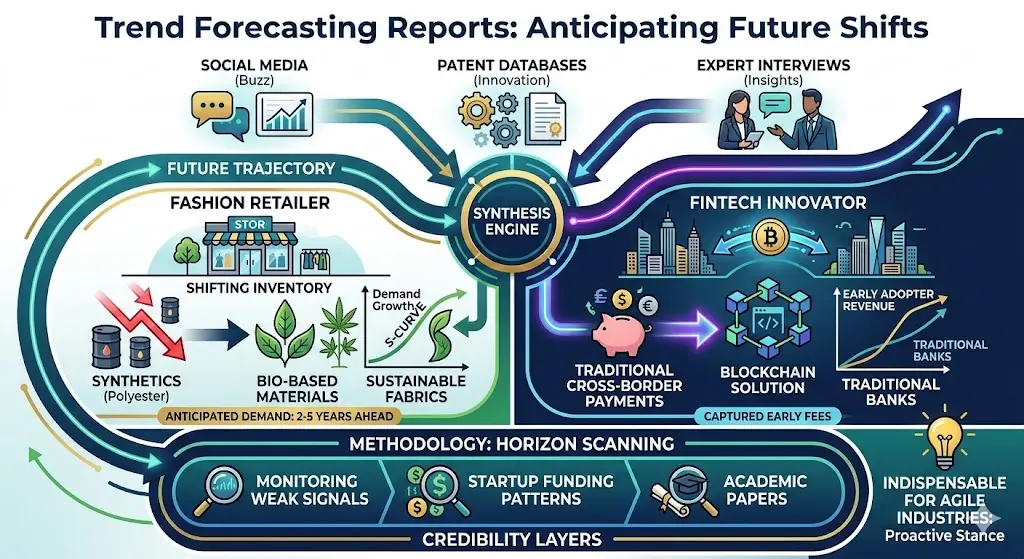
These reports thrive on qualitative foresight combined with quantitative trend lines, often visualized through growth curves and adoption S-curves. In the fintech space, a forecasting report could have flagged blockchain’s rise in cross-border payments, allowing early adopters to capture fees that later giants like traditional banks scrambled for.
The methodology emphasizes horizon scanning—monitoring weak signals like startup funding or academic papers—which adds layers of credibility. This proactive stance makes trend forecasting indispensable for agile industries.
Regulatory and Compliance Reports: Navigating Legal Landscapes
Regulatory and compliance reports address another critical category of industry reports, detailing evolving laws, standards, and enforcement trends. They break down implications for operations, such as GDPR updates for data-heavy sectors or ESG mandates for energy firms. A compliance report might map out carbon reporting requirements, helping manufacturers audit emissions and avoid fines exceeding millions.
Beyond mere summaries, these reports include compliance roadmaps with timelines and benchmarks, illustrated through phased implementation scenarios. Healthcare providers, for example, leverage them to align with HIPAA revisions, streamlining data handling while enhancing patient trust.
Their structured entity-based approach—defining terms like “audit trails” and “risk matrices”—makes them citation favorites for AI overviews. When evaluating why outsource research and reporting, consider how specialized expertise minimizes compliance pitfalls.
Custom and Whitepaper Reports: Tailored Strategic Assets
Custom and whitepaper reports offer bespoke types of industry reports, crafted to address unique client challenges with proprietary data and thought leadership. Whitepapers, in particular, blend research with persuasive storytelling, positioning brands as authorities. A SaaS company might produce one on remote work analytics, citing hybrid model productivity gains to attract enterprise clients.
Customization allows integration of client-specific data, such as internal KPIs merged with external benchmarks, yielding hybrid insights. In real estate, a custom report could forecast urban migration post-pandemic, incorporating local zoning data for developer site selection.
These reports often feature executive summaries and appendices for depth, making them versatile for boardrooms or public distribution. Time Intelligence Media Group’s Research & Reports Services specializes in these tailored assets, ensuring topical authority.
Technological and Innovation Reports: Driving Disruptive Insights
Technological and innovation reports dissect cutting-edge advancements, categorizing types of industry reports focused on R&D pipelines and adoption barriers. They profile breakthroughs like quantum computing’s enterprise potential, detailing scalability challenges and investment thresholds. Automotive innovators use them to benchmark EV battery tech against solid-state alternatives.
Explanations here emphasize diffusion models, tracing how innovations spread via Rogers’ curve—from innovators to laggards. A report might simulate AI ethics frameworks’ impact on hiring algorithms, guiding HR tech firms toward compliant scaling.
With AI’s rise, these reports increasingly incorporate machine learning forecasts, blending code snippets’ implications with business outcomes for holistic views.
The Role of Professional Services in Leveraging Industry Reports
As the different types of industry reports proliferate, accessing high-quality versions becomes paramount. Time Intelligence Media Group provides professional solutions through their Research & Reports Services, empowering businesses with precise, actionable intelligence across all categories discussed.