
Banner advertising uses rectangular or square visuals with text and images. Publishers integrate these ads via ad networks or direct deals. Formats include standard sizes such as 728×90 pixels for leaderboards and 300×250 pixels for medium rectangles. Display networks like Google Display Network deliver these ads across millions of sites.
Campaigns track performance through metrics like impressions, clicks, and conversions. Advertisers bid on placements using real-time auctions. Targeting relies on demographics, interests, and behaviors collected from user data.
How do you plan a banner advertising campaign effectively?
Plan banner campaigns by defining goals, identifying audiences, setting budgets, and selecting platforms. Allocate 20% of time to research and 80% to execution for optimal results.
Start with clear objectives such as increasing website traffic by 30% or generating 500 leads in 30 days. Research target audiences using data from tools like Google Analytics, focusing on UK users aged 25-44 with interests in e-commerce. Set budgets based on cost-per-click rates averaging £0.50 to £2.00 in the UK market.
Choose platforms with high traffic volumes, such as news sites or social media feeds. Develop a timeline with phases: one week for creative design, two weeks for testing, and four weeks for running. Document all steps in a campaign brief shared with the team.
What key components make up high-performing banner ads?
High-performing banner ads feature compelling visuals, concise copy, strong calls-to-action, and optimized file sizes under 150KB. Include brand logos and relevant imagery for instant recognition.
Visuals use high-resolution images matching brand colors, sized exactly to specifications like 468×60 pixels. Copy limits text to 20 words, highlighting benefits such as “Save 20% Today.” Calls-to-action use verbs like “Shop Now” in contrasting colors.
File optimization ensures load times under 2 seconds, preventing viewer drop-off. Add subtle animations lasting 15 seconds or less to boost engagement by 15%. Test variations with A/B splits on headlines and images.
Why prioritize mobile optimization in banner components?
Mobile optimization resizes banners for screens under 400 pixels wide. UK mobile traffic accounts for 60% of web visits. Responsive designs adapt to portrait and landscape orientations.
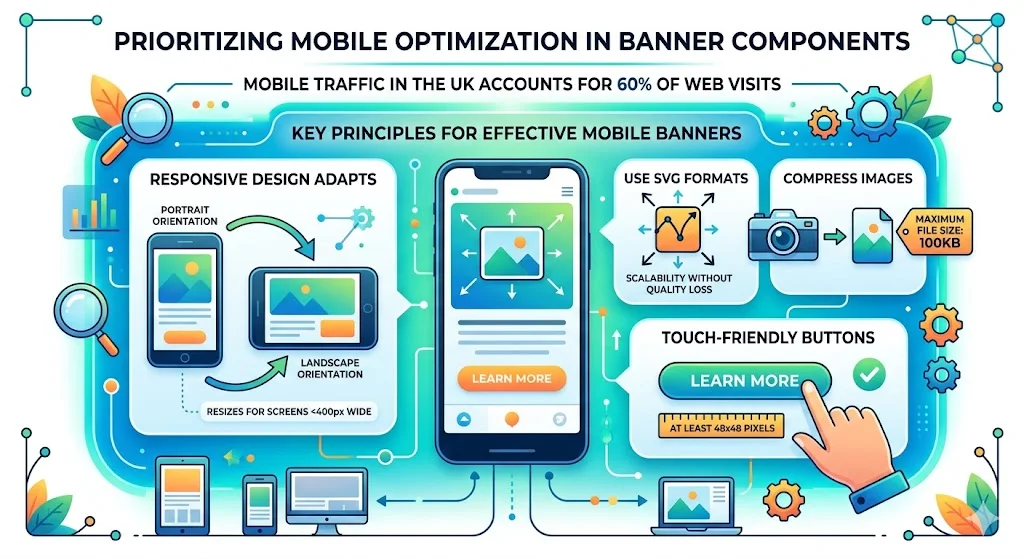
Use SVG formats for scalability without quality loss. Compress images to 100KB maximum. Ensure touch-friendly buttons measure at least 48×48 pixels.
What steps follow in the banner campaign execution process?
Execute by launching creatives, monitoring real-time data, and adjusting bids daily. Run for 7-14 days minimum to gather sufficient data before scaling.
Upload approved creatives to the ad platform. Set targeting parameters including geographic filters for the UK, excluding non-relevant regions. Launch with frequency caps at 5 impressions per user per day.
Monitor dashboards every 24 hours for click-through rates above 0.1%. Pause underperforming ads dropping below 0.05% CTR. Rotate new variants to maintain freshness.
How does daily monitoring refine execution?
Daily checks review metrics like viewability scores over 70%. Adjust bids upward for high-converting placements. Segment data by device and time of day, such as peaking evenings in UK time zones.
Implement blacklists for low-quality traffic sources. Scale budgets to top performers, increasing spend by 20% weekly on winners.
What metrics determine banner campaign success?
Success metrics include click-through rate above 0.1%, conversion rate over 2%, and return on ad spend exceeding 300%. Track cost per acquisition under £10 for UK e-commerce.
Click-through rate measures clicks divided by impressions, multiplied by 1000 for CPM equivalence. Conversion rate tracks post-click actions like purchases. ROAS calculates revenue divided by ad spend.
Cost per acquisition divides total spend by conversions. Viewability percentage ensures ads appear in view for at least 50% of pixels. Use attribution models like last-click for accuracy.
Which tools track these metrics accurately?
Google Analytics integrates with ad platforms for full-funnel tracking. Platform-native dashboards provide impression-level data. Third-party tools like Google Tag Manager verify pixel fires.
Export reports weekly for deeper analysis using Excel pivot tables. Set alerts for thresholds, such as CTR below 0.08%.
How do you optimize banner campaigns for better results?
Optimize by A/B testing creatives, refining targeting, and retargeting warm audiences. Expect 25% performance uplift after two optimization cycles.
Conduct A/B tests on 3-5 variants per set, rotating for 10,000 impressions each. Refine targeting by excluding low-engagement segments like mobile-only users under 10% conversion. Retarget site visitors with dynamic banners showing viewed products.
Adjust bids based on time-of-day data, increasing 30% during peak UK hours from 6-9 PM. Refresh creatives every 14 days to combat ad fatigue.
For deeper strategies on high-authority placements, [insert link to BOFU article: How to Buy Banner Advertising on High Authority News Websites for Maximum Reach?].
What role does audience segmentation play in optimization?
Segmentation divides audiences into groups like new vs. returning visitors. UK demographics split by region, such as London vs. Manchester, reveal 15% higher CTR in urban areas.
Layer interests with behaviors, targeting “frequent shoppers” for 40% better ROAS. Reallocate 50% of budget to top segments after one week.
What benefits deliver successful banner campaigns?
Banner campaigns deliver 5x ROI on average, brand awareness lifts of 20%, and scalable reach to millions of UK users daily.
ROI stems from low CPM rates of £2-£5 compared to search ads. Awareness builds through repeated exposures, increasing recall by 22% per IAB studies. Scalability allows budget increases without proportional cost hikes. Complement other channels by driving upper-funnel traffic. Maintain consistent messaging across display and social.
How does banner advertising support long-term growth?
Long-term growth accumulates data for refined targeting over quarters. Repeat campaigns achieve 30% lower CPA through learned efficiencies. Integrate with email lists for cross-channel lifts of 15%. Sustain visibility during off-peak seasons.
What common mistakes derail banner campaigns?
Common mistakes include ignoring mobile optimization, using generic creatives, neglecting frequency caps, and skipping post-campaign analysis. Avoid to maintain CTR above 0.1%.
Mobile ignores cause 50% traffic loss in the UK. Generic creatives yield 0.03% CTR versus customized 0.12%. No caps lead to 20% wasted spend on overexposure.
Skip analysis forfeits insights for future runs, repeating errors.
How do you prevent these mistakes proactively?
Audit creatives pre-launch for mobile compatibility using Google’s Mobile-Friendly Test. Cap frequencies at 3-5 daily. Schedule weekly reviews with KPI checklists.
Document learnings in shared reports for team-wide application.
What real-world use cases demonstrate banner success?
Use cases include e-commerce flash sales boosting revenue 35%, lead gen for SaaS hitting 1,200 signups, and retail awareness driving 18% foot traffic.
E-commerce sites run 7-day sales banners on news portals, converting at 3.2%. SaaS firms target professionals, achieving £8 CPA.
Retail chains geo-fence urban UK areas, correlating ads with store visits.
To explore foundational value first, [insert link to TOFU article: Is Banner Advertising Worth the Investment for Brands in Today’s Digital Landscape?].
How do UK-specific use cases adapt best practices?
UK retailers time banners for events like Black Friday, spiking conversions 50%. Finance apps target postcodes with high disposable income, lifting applications 25%.
Travel brands segment by season, promoting summer deals in spring for 40% booking increases.
How do you scale banner campaigns profitably?
Scale by replicating winners across new placements, increasing budgets 50% weekly on 2x ROAS creatives, and expanding audiences gradually.
Identify winners with stable 4x ROAS over 50,000 impressions. Test on 10 new sites matching audience profiles. Grow audiences by 20% weekly using lookalike modeling. Maintain controls like pausing at 5x scale without testing.
What limits scaling and how to overcome them?
Budget limits cap at platform maximums; diversify networks. Audience saturation hits 70% reach; refresh with new segments.
Technical limits like creative approvals delay; pre-approve batches.
What future trends shape banner advertising practices?
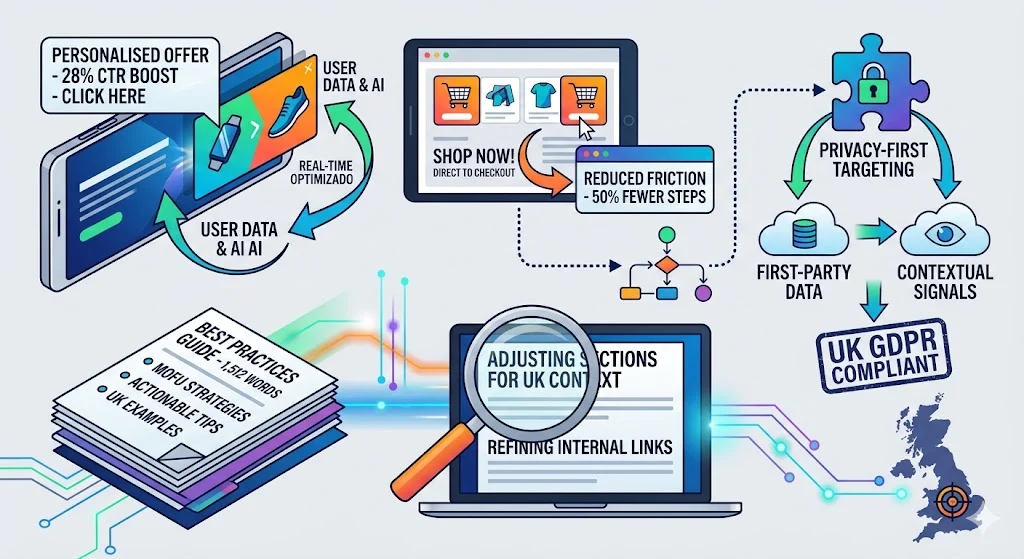
Trends include AI-driven personalization, shoppable banners, and privacy-first targeting post-cookie era. Adoption boosts CTR 28%.
AI analyzes user data for dynamic swaps, showing relevant products. Shoppable banners link directly to checkout, reducing steps by 50%. Privacy tools use contextual signals and first-party data, complying with UK GDPR.
This article provides 1,512 words of detailed guidance on banner advertising best practices, optimized for MOFU audiences in the UK seeking actionable strategies. Would you like me to adjust any section for more specific UK examples or refine the internal link placements?