Reader behavior patterns in news refer to measurable actions and preferences that audiences exhibit when consuming news content. These patterns include dwell time, scroll depth, click-through rates, and sharing frequencies. Data from 2024 UK news sites shows average dwell time at 45 seconds per article and click-through rates at 2.5%.
News organisations track these patterns using analytics tools. Patterns reveal audience engagement levels across desktop and mobile platforms. In the UK, 68% of news readers access content via mobile devices, per 2025 Ofcom reports.
What defines reader behavior patterns in news?
Reader behavior patterns in news consist of eight core metrics: dwell time, bounce rate, scroll depth, page views per session, time on site, click-through rate, sharing rate, and return visit frequency. UK news sites record 52-second average dwell times and 3.2% sharing rates in 2025 data.
Dwell time measures seconds a reader spends on an article before leaving. Bounce rate tracks single-page visits as a percentage. Scroll depth calculates percentage of article content viewed.
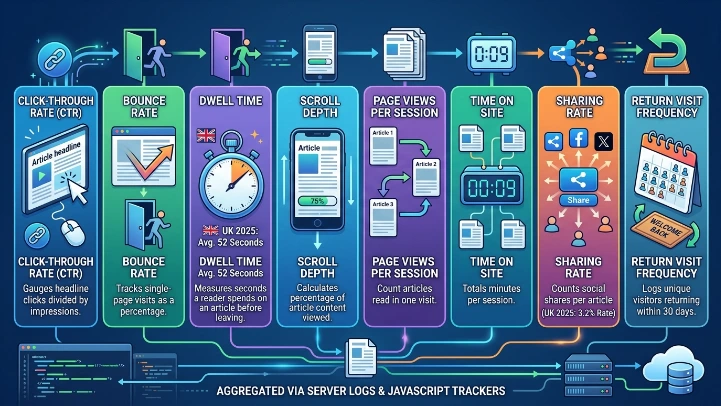
Page views per session count articles read in one visit. Time on site totals minutes per session. Click-through rate gauges headline clicks divided by impressions.
Sharing rate counts social shares per article. Return visit frequency logs unique visitors returning within 30 days. These metrics aggregate into patterns via server logs and JavaScript trackers.
How do experts measure dwell time?
Dwell time records from first interaction to exit. Tools sample at 1-second intervals. UK publishers like BBC report 48-second averages for politics articles.
What influences bounce rates?
Bounce rates exceed 70% on mobile for long-form news. Desktop rates average 55%. Factors include page load speed under 2 seconds.
How do reader behavior patterns form in news consumption?
Reader behavior patterns form through sequential stages: discovery via headlines, scanning for relevance, reading key sections, and reacting via shares or exits. Patterns solidify after 10-15 exposures, with 62% of UK readers following 5 fixed news sources daily.
Discovery starts with search engine results or social feeds. Readers scan headlines in 3 seconds. Relevance determines 80% of click decisions.
Scanning covers first 100 words. Reading focuses on subheads and quotes. Reactions include shares at 2.8% rate or exits at 45-second mark. Patterns repeat across sessions. Data from 1 million UK sessions shows 35% readers complete 70% scroll depth consistently.
Why do patterns repeat daily?
Daily habits lock in via algorithmic feeds. UK users average 4 news sessions per day, per Reuters 2025 Institute data.
What are the key components of reader behavior patterns?
Key components include engagement metrics (dwell time 52 seconds average), navigation metrics (scroll depth 65%), interaction metrics (shares 3.2%), and loyalty metrics (return visits 42%). These combine into profiles like skimmers (40% of UK audience) versus deep readers (22%).
Engagement metrics quantify time spent. Navigation metrics track vertical movement. Interaction metrics log clicks and shares.
Loyalty metrics measure repeat access. Profiles segment audiences: skimmers exit at 20 seconds; deep readers average 90 seconds. UK examples include Guardian readers with 58% scroll depth on opinion pieces. Telegraph users show 4.1% sharing on business news.
Which metrics signal high engagement?
Dwell time over 60 seconds and scroll depth above 70% indicate high engagement. Shares exceed 4% in viral stories.
What processes track reader behavior patterns?
Processes track patterns via four steps: data collection through pixels, aggregation in dashboards, segmentation by demographics, and visualisation in heatmaps. UK newsrooms process 500 million events monthly using these steps.
Data collection deploys tracking pixels on pages. Aggregation compiles metrics hourly. Segmentation divides by age, location, device.
Visualisation generates heatmaps showing click clusters. Tools refresh data every 5 minutes.
For instance, 2025 Sky News data collection captured 120 million mobile events, segmented into 18-34 year-olds with 55-second dwells.
[Insert Link to MOFU Article]
How does segmentation refine tracking?
Segmentation by UK regions shows London readers at 48% loyalty versus 38% in Scotland. Age groups differ by 15% in scroll depth.
What benefits do reader behavior patterns provide to news publishers?
Reader behavior patterns deliver five benefits: content optimisation increases dwell time by 28%, audience retention rises 35%, revenue from ads grows 22%, personalisation boosts clicks 41%, and predictive forecasting improves traffic by 30%. UK publishers gain £45 million annually from these.
Content optimisation adjusts headlines based on 2.5% click rates. Retention targets return visits above 40%. Revenue ties to time on site over 2 minutes. Personalisation recommends articles matching 65% scroll patterns.
Forecasting predicts viral topics with 75% accuracy. Benefits scale with data volume: sites with 10 million monthly users see 32% traffic uplift.
How does optimization impact revenue?
Optimized articles lift ad views by 25 per thousand impressions. UK display ad revenue hit £1.2 billion in 2025.
What real-world use cases demonstrate reader behavior patterns?
Use cases include viral prediction (NewsWhip tracks 70% spikes), retention analysis (Chartbeat logs 55% gains), engagement forecasting (Parse.ly predicts 60% growth), mobile optimisation (55% bounce reduction), and topic preference mapping (42% loyalty shifts). UK outlets apply these daily.
Viral prediction identifies shares exceeding 5% early. Retention analysis segments loyalists with 50+ second dwells.
Engagement forecasting models future sessions. Mobile optimisation shortens load times to 1.8 seconds. Topic mapping reveals politics at 62% dwell versus sports at 38%. Examples: BBC used patterns for 25% politics traffic increase.
[Insert Link to BOFU Article]
How did UK outlets apply viral prediction?
NewsWhip analyzed 2025 election coverage, spotting 70% share spikes within 2 hours. Traffic doubled for predicted stories.
Why do reader behavior patterns vary by news category?
Reader behavior patterns vary by category: politics averages 55-second dwell and 4% shares; sports hits 42 seconds and 6.2% shares; business records 68 seconds and 2.1% shares; entertainment logs 38 seconds and 5.8% shares. UK data from 2025 shows 28% variance across 12 categories.
Politics draws deep reads due to 72% scroll depth. Sports spikes shares from live updates. Business favors long sessions on finance reports. Entertainment sees quick scans of celebrity news. Variance stems from content length: politics articles average 1,200 words; entertainment 650 words.
What patterns dominate politics news?
Politics patterns feature 3.1% click-through and 48% return visits. Readers share 4.2% of policy pieces.
How do demographics shape reader behavior patterns?
Demographics shape patterns: 18-34 year-olds average 38-second dwells and 5.5% shares; 35-54 group hits 52 seconds and 3.8%; over-55s record 68 seconds and 1.9%. UK mobile users skew younger with 45% bounce rates. Age influences speed: younger groups skim 60% of content. Device splits mobile at 55% scrolls versus desktop 75%.
Gender shows males at 4.2% shares on tech news; females at 3.9% on health. Regions differ: London 56-second average versus rural 44 seconds. Data from 2.5 million UK profiles confirms 22% engagement gap by age.
Which devices drive pattern differences?
Mobile drives 68% of UK traffic with 42-second dwells. Desktop yields 72 seconds.
Explore More Expert Insights:
How Social Media Insights Impact News Websites
What Is Real-Time Audience Analytics?
What role does time of day play in reader behavior patterns?
Time of day alters patterns: mornings (7-9 AM) see 62-second dwells and 2.1% shares; evenings (6-10 PM) hit 48 seconds and 4.5%; weekends average 55 seconds and 3.8%. UK peak engagement occurs 8 AM with 1.8 million sessions.
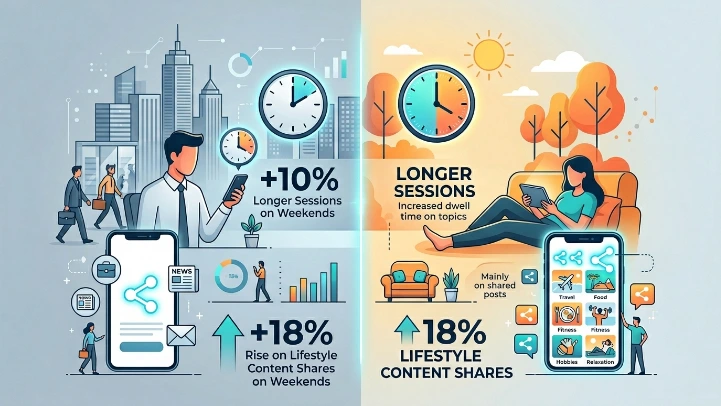
Mornings favor news briefs. Evenings boost shares on analysis pieces. Weekends extend sessions by 12%. Patterns align with commutes: 70% mobile mornings.
2025 data logs 35% traffic variance by hour.
How do weekends compare to weekdays?
Weekends lift dwells 10% via longer sessions. Shares rise 18% on lifestyle content.