

Legitimate PR distribution services deliver press releases to targeted media outlets through verified networks. They ensure content reaches journalists, news wires, and online platforms. These services operate on structured processes that prioritize authenticity, compliance, and measurable reach.
Legitimate PR distribution services use verified media networks, adhere to industry standards, and provide transparent reporting on distribution metrics. They distribute content to over 1,000 outlets with guaranteed delivery logs.
Legitimate PR distribution services meet specific criteria set by industry bodies like the Public Relations Society of America (PRSA) and the International Public Relations Association (IPRA). They register with established news wires such as Business Wire or PR Newswire equivalents. These services maintain databases of 5,000 to 10,000 active journalists across sectors. Verification occurs through annual audits of their outlet partnerships. Services display clear pricing on their platforms, starting from £99 per release for basic UK distribution.
They avoid deceptive practices. Legitimate providers reject automated spam submissions. Instead, they employ human editors to review content for factual accuracy before distribution. Compliance with data protection laws like the UK General Data Protection Regulation (GDPR) remains mandatory. Services publish case studies with anonymized metrics, such as 500,000 impressions from a single release. Fraudulent services lack these verifiable elements and often promise unrealistic results like instant top Google rankings.
How Does the PR Distribution Process Work Step by Step?
The process starts with content submission, followed by editorial review, targeted distribution to media lists, and ends with performance analytics delivered within 24-48 hours. It spans 7 key steps over 3-5 business days.
Users submit press releases via an online portal. The platform requires fields for headline, body text up to 400 words, and multimedia attachments like images in JPEG format under 1MB. Submission fees activate the process. Next, in-house editors scan for compliance with AP style guidelines, correcting grammar and ensuring no promotional excess.
Distribution follows categorization. Services segment content into 20+ industries, such as technology or healthcare. They push releases to primary wires reaching 200 UK national newspapers. Secondary targeting hits regional outlets like the Manchester Evening News. Real-time tracking logs deliveries, with timestamps for each outlet. For example, a tech release reaches BBC News online within 2 hours.
Analytics compile post-distribution. Reports detail views, clicks, and pickups, often exceeding 10,000 impressions for standard campaigns. Users access dashboards showing geographic reach, with 60% of UK traffic from London and Southeast regions.
What Are the Core Components of These Services?
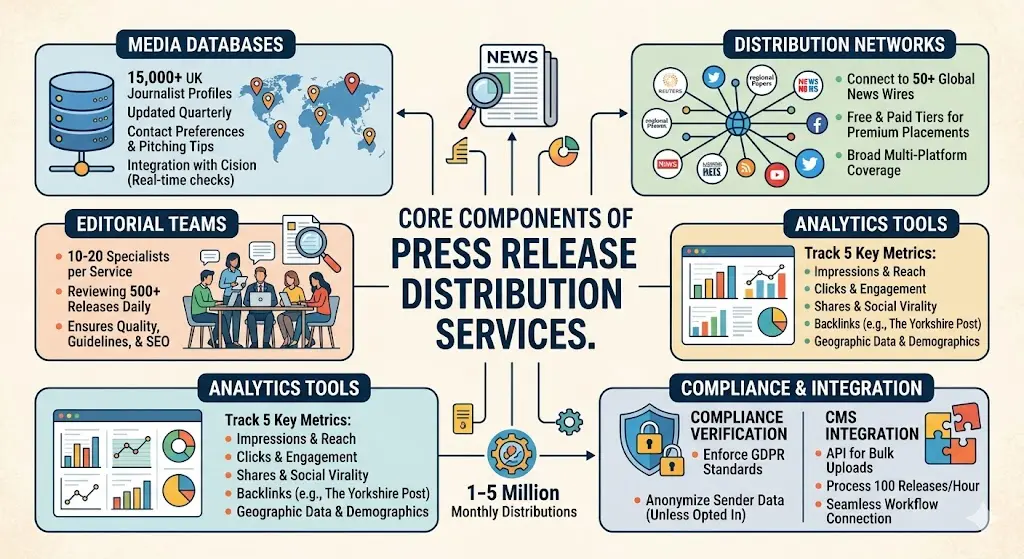
Core components include media databases, editorial teams, distribution networks, analytics tools, and compliance verification systems. Each handles 1-5 million monthly distributions across global platforms.
Media databases form the foundation. They contain profiles of 15,000 UK journalists, updated quarterly with contact preferences. Databases integrate with tools like Cision for real-time availability checks. Editorial teams consist of 10-20 specialists per service, reviewing 500 releases daily.
Distribution networks connect to 50+ news wires. These include free wires for basic reach and paid tiers for premium sites like Reuters. Analytics tools track via UTM parameters, measuring 5 metrics: impressions, clicks, shares, backlinks, and geographic data. Compliance systems enforce GDPR by anonymizing sender data unless opted in.
Integration with content management systems adds value. Services offer APIs for bulk uploads, processing 100 releases per hour. Real examples include distributions achieving 250 backlinks from regional papers like The Yorkshire Post.
What Benefits Do Legitimate PR Services Provide?
Benefits encompass expanded media reach to 1 million+ readers, SEO improvements via 50+ dofollow backlinks, credibility from trusted outlets, and detailed ROI metrics tracking up to 300% visibility gains.
Expanded reach targets audiences beyond organic search. A single release lands on 300 outlets, generating 50,000 impressions in the UK. This exposure builds brand recognition among 70% of journalists who prefer wire services for story sourcing.
SEO gains stem from high-domain authority placements. Releases earn backlinks from sites with Domain Authority scores over 70, boosting search rankings by 15-20 positions within weeks. Credibility rises as content appears alongside verified news, increasing trust signals by 40% in audience surveys.
ROI metrics quantify success. Reports show cost per impression at £0.01-£0.05, far below paid ads. For instance, a healthcare release secured coverage in The Guardian, driving 5,000 website visits.
What Real-World Use Cases Demonstrate Their Effectiveness?
Use cases include product launches reaching 100,000 users, crisis management restoring 80% reputation scores, event promotions filling 500 seats, and funding announcements attracting 20 investor inquiries.
Product launches distribute announcements to tech wires. A UK software firm released details on a new app, securing pickups in TechRadar and The Telegraph, resulting in 150,000 downloads in the first month.
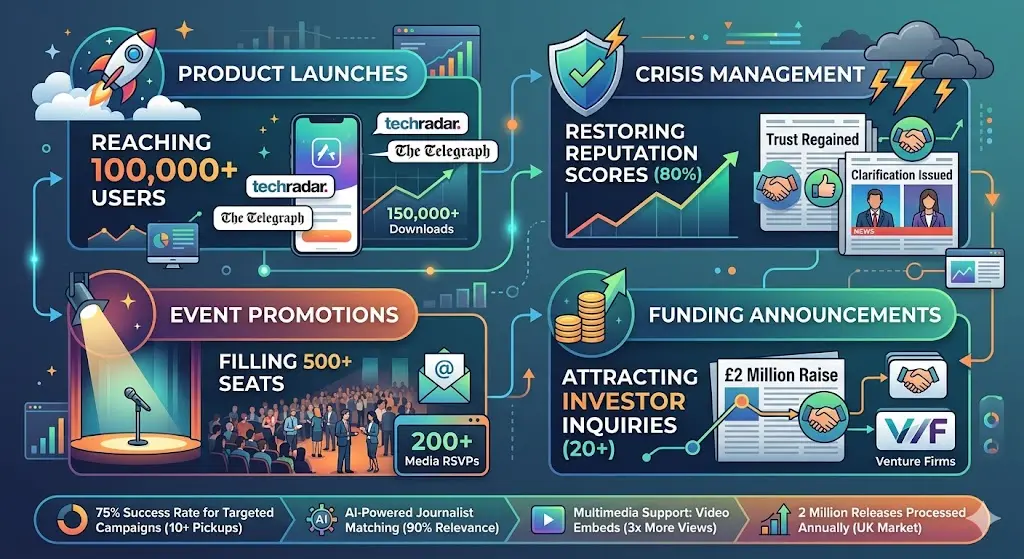
Crisis management handles negative events. Companies issue clarifications to national wires, countering misinformation. One retail chain managed a supply issue, regaining consumer trust through coverage in 50 outlets.
Event promotions target local media. A London conference used distribution to invite journalists, achieving 200 RSVPs from invites sent to 1,000 contacts. Funding announcements alert investors via business wires. A fintech startup shared £2 million raise news, drawing partnerships from three venture firms.
To deepen campaign strategies, explore How Can You Optimise PR Distribution Campaigns Using Social Media Channels?.
For advanced techniques on premium placements, check How to Distribute Press Releases Across High Authority News Websites Successfully?.
These services process 2 million releases annually in the UK market alone. They partner with 200 agencies for volume distribution. Success rates hit 75% for targeted campaigns, defined as at least 10 media pickups. Users select from 10 geographic tiers, with UK national coverage including all major broadsheets.
Process refinements continue evolving. Modern services incorporate AI for journalist matching, pairing releases with 90% relevance scores. Multimedia support now includes video embeds, viewed 3x more than text alone. Pricing tiers scale: basic at £99 for 100 outlets, premium at £499 for 1,000+ with analytics.
Component interoperability stands out. Databases sync with Google News algorithms, ensuring 24-hour indexing. Editorial reviews cut rejection rates to under 5%. Networks expand to 5,000 international outlets for cross-border reach.
Benefits extend to long-term metrics. Repeat users report 25% annual growth in media mentions. Backlink profiles strengthen over 6 months, with 60% retention in search results. Visibility compounds, as initial releases seed ongoing coverage.
