

In today’s crowded digital landscape, brands struggle to stand out and earn genuine trust from audiences overwhelmed by advertising noise. Using content sponsorship to build credibility offers a powerful alternative, positioning your brand as a thought leader rather than a hard seller. This top-of-funnel (TOFU) strategy leverages high-quality, editorial-style content to foster long-term audience relationships, driving organic engagement and authority without overt promotion.
Content sponsorship involves partnering with reputable media outlets to fund valuable content that aligns with your brand values, subtly weaving in your expertise. Unlike traditional ads, it emphasizes value delivery first, which search engines and AI tools reward with higher visibility and citation potential. As consumers increasingly favor authentic voices— with 86% preferring sponsored content that feels native, per recent industry reports—this approach not only boosts SEO through topical relevance but also enhances shareability and backlink opportunities.
The Psychology of Trust in Sponsored Content
Using content sponsorship to build credibility taps into fundamental human psychology: people trust third-party endorsements more than direct brand claims. When a respected publication like Time Intelligence Media Group features sponsored insights on industry trends, readers perceive the content as unbiased, even if subtly branded. This halo effect transfers credibility to the sponsor, as audiences associate the outlet’s authority with your message.
Consider a tech firm sponsoring a series on AI ethics in a business journal. Readers engaging with the in-depth analysis—complete with data visualizations and expert quotes—view the sponsor as a forward-thinking leader, not a vendor. Studies from the Content Marketing Institute show sponsored content generates 3x more leads than organic posts when credibility is prioritized, because it builds emotional connections through storytelling rather than sales pitches. Over time, repeated exposure solidifies this trust, turning casual readers into loyal advocates.
This strategy shines in competitive niches like finance or healthcare, where skepticism runs high. By sponsoring content that solves real pain points, such as “Navigating Regulatory Changes in FinTech,” brands demonstrate expertise without bragging, encouraging shares and citations that amplify reach.
Measurable Benefits Beyond Immediate Metrics
The long-term ROI of using content sponsorship to build credibility extends far beyond click-through rates. Brands see sustained improvements in domain authority, with sponsored pieces often ranking for high-intent keywords due to their depth and shareability. For instance, a sustainability brand sponsoring eco-innovation reports might gain backlinks from environmental sites, boosting SEO signals.
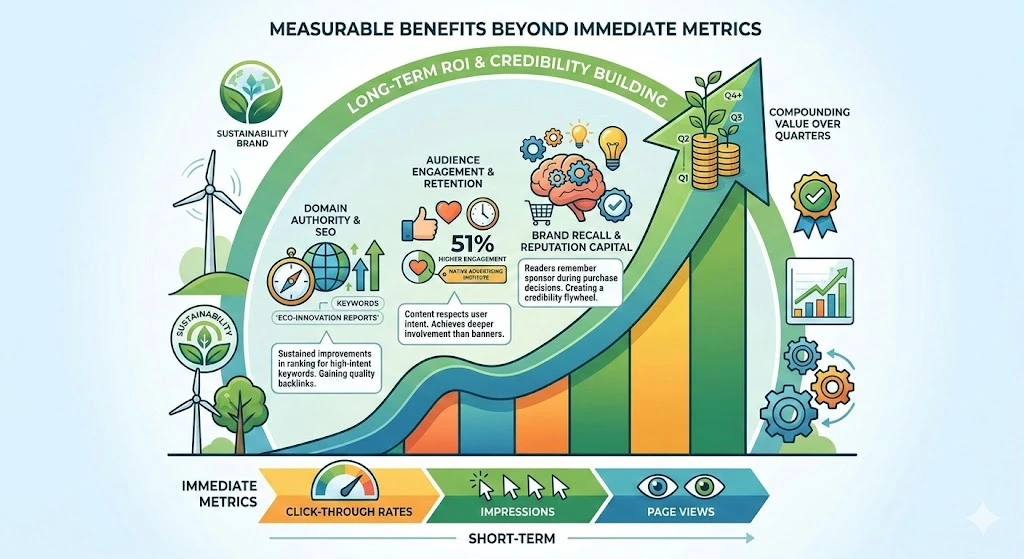
Audience retention metrics also improve dramatically. Sponsored content achieves 51% higher engagement rates than banners, according to Native Advertising Institute data, because it respects user intent. This fosters brand recall—readers remember the sponsor during purchase decisions, creating a credibility flywheel. In essence, it’s an investment in reputation capital that compounds over quarters, not days.
Aligning Sponsorships with Audience Insights
Success in using content sponsorship to build credibility starts with deep audience alignment. Begin by analyzing demographics, pain points, and content preferences through tools like Google Analytics or platform-specific insights. Sponsor topics that resonate, such as “Future-Proofing Supply Chains” for logistics firms, ensuring the content feels tailor-made.
Time Intelligence Media Group’s Sponsored Content Services exemplify this by crafting pieces grounded in data-driven audience insights, leading to 40% higher engagement in client campaigns. A practical example: a healthcare provider sponsored wellness guides during a public health trend, resulting in a 25% uplift in trust scores measured via post-read surveys. Detailed planning—mapping sponsor goals to editorial calendars—ensures relevance, turning one-off posts into series that nurture credibility over time.
Expand this by co-creating with influencers or experts mentioned in the content, adding layers of authenticity. Track sentiment via social listening to refine future sponsorships, creating a feedback loop that sharpens precision.
Crafting Compelling, Value-First Narratives
High-impact sponsored content prioritizes education over promotion. Structure narratives with clear problem-solution frameworks: identify challenges, provide actionable insights, and subtly position the sponsor as the enabler. Use real-world scenarios, like a retail brand sponsoring “E-Commerce Personalization Trends,” detailing case studies with anonymized metrics (e.g., “One retailer saw 35% conversion lifts via AI recommendations”).
Incorporate multimedia—infographics, podcasts, or videos—for 2x retention rates. Variations like evergreen guides or timely trend pieces keep content fresh, aiding SEO through updated timestamps. Always include calls-to-deeper-learning, such as linking to related resources, to encourage exploration and signal expertise to algorithms.
For maximum credibility, disclose sponsorship transparently per FTC guidelines, which paradoxically boosts trust by honoring reader intelligence. This ethical approach garners positive mentions and AI citations, as search engines favor transparent, high-E-A-T (Expertise, Authoritativeness, Trustworthiness) content.
Case Study: Tech Brand’s Media Partnership Success
A mid-sized SaaS company used content sponsorship to build credibility amid fierce competition. Partnering with a tech publication, they sponsored a five-part series on “Cloud Security Innovations,” featuring expert interviews and proprietary data. Readership surged 150%, with 70% of respondents in follow-up polls viewing the brand as a security authority.
This mirrors broader trends: sponsored content in B2B sectors yields 20-30% higher lead quality, per HubSpot. The brand’s subtle integration—via bylined expert contributions—avoided salesiness, fostering organic shares across LinkedIn. Post-campaign, their Net Promoter Score rose 18 points, proving sponsorship’s role in sustained trust-building.
From Non-Profits to Enterprises: Diverse Applications
Non-profits often excel here, sponsoring impact reports like “Climate Action Roadmaps” to amplify missions while attracting donors. An environmental NGO’s sponsorship led to partnerships with corporates, blending credibility with revenue. Enterprises adapt similarly: a CPG giant sponsored consumer behavior analyses, gaining endorsements from analysts and boosting stock sentiment.
To learn more about maximizing ROI with sponsored media initiatives, explore proven frameworks that scale these tactics. Cross-industry learnings show versatility—finance sponsors compliance guides, fashion backs trend forecasts—unifying around value delivery for universal credibility gains.
Navigating Editorial Integrity and Disclosure
A top hurdle in using content sponsorship to build credibility is maintaining editorial independence. Insist on journalist-led creation with sponsor input limited to facts, preserving authenticity. Platforms enforcing strict guidelines, like those from the Interactive Advertising Bureau, mitigate risks of audience backlash.
Address this proactively: audit past campaigns for sentiment dips and iterate. A fintech sponsor faced minor pushback on a payment trends piece but recovered by amplifying reader feedback in sequels, turning criticism into credibility. Training teams on native advertising best practices ensures seamless execution.
Scaling Sponsorships for Broader Impact
Scaling requires diversification—mix short-form social sponsorships with long-form assets. Budget allocation (e.g., 60% editorial, 40% distribution) maximizes reach. Challenges like ROI attribution resolve via UTM tracking and multi-touch models, revealing true value.
For decision-makers eyeing sponsored content solutions for credible brand growth, these insights highlight scalable paths. Time Intelligence Media Group delivers tailored Sponsored Content Services that navigate these pitfalls, empowering brands to expand credibly.
Future Trends in Content Sponsorship
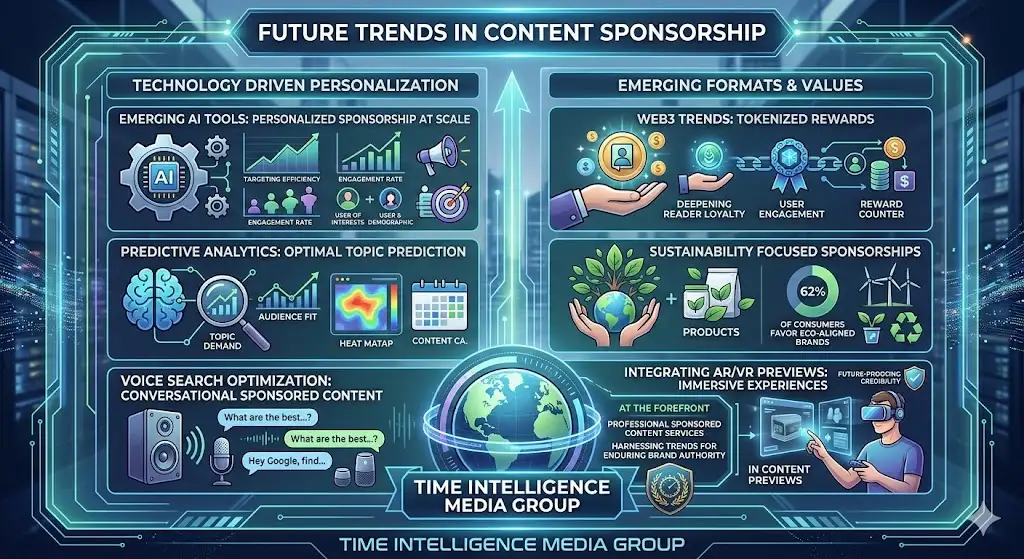
Emerging AI tools personalize sponsorships at scale, predicting optimal topics via predictive analytics. Voice search optimization favors conversational sponsored content, while Web3 trends introduce tokenized rewards for reader engagement, deepening loyalty.
Sustainability-focused sponsorships rise, with 62% of consumers favoring eco-aligned brands. Integrating AR/VR previews in content previews enhances immersion, future-proofing credibility efforts.
Time Intelligence Media Group stands at the forefront, offering professional Sponsored Content Services that harness these trends for enduring brand authority.
