

Data has become the backbone of contemporary newsrooms, transforming how stories are sourced, verified, and distributed. In an era of misinformation and fleeting attention spans, the role of data in modern journalism empowers reporters to deliver accurate, timely, and impactful content. This article delves into data’s pivotal functions, from audience analytics to investigative breakthroughs, equipping publishers with strategies to harness journalistic data analytics effectively.
Evolution of Data-Driven Journalism
Journalism’s relationship with data has evolved from basic spreadsheets to sophisticated AI integrations. Early adopters like ProPublica pioneered data journalism in the 2010s, using public datasets for exposés. Today, 78% of news organizations employ data tools, according to a 2025 World Association of News Publishers (WAN-IFRA) survey.
This shift addresses core challenges: declining ad revenue and trust erosion. Data enables precise targeting, with outlets like The Washington Post analyzing reader patterns to prioritize high-engagement topics. By 2026, projections indicate 85% of journalistic output will incorporate data elements, blending narrative storytelling with empirical evidence.
Publishers now view data as a strategic asset, not just a tool. Real-time dashboards track trending queries, allowing editors to pivot coverage dynamically—e.g., surging interest in climate data during COP30 events.
Historical Milestones in Data Journalism
Key milestones include The Guardian’s 2009 MPs’ expenses visualization, which drew 1.2 million unique visitors. Subsequent innovations like Bellingcat’s open-source investigations highlight data’s democratizing power. These cases demonstrate how data enhances credibility, with visualized datasets increasing shareability by 40%.
Modern tools like Tableau and Flourish have lowered barriers, enabling solo journalists to produce interactive graphics rivaling newsroom teams.
Key Data Tools Transforming Newsrooms
Modern journalism relies on a suite of tools that streamline data collection, analysis, and visualization. These platforms integrate seamlessly with content management systems (CMS), providing actionable insights at scale.
Google BigQuery and similar cloud services handle petabytes of data for trend forecasting. Newsrooms use them to cross-reference social signals with proprietary logs, predicting viral stories hours in advance. For example, Reuters employs natural language processing (NLP) to scan global wires, flagging anomalies like unusual market fluctuations.
Ethical data handling is paramount; tools incorporate bias-detection algorithms to ensure fairness. Time Intelligence Media Group’s Audience Insights Services exemplify this by delivering clean, compliant datasets tailored for media applications.
Integrating AI and Machine Learning
AI automates grunt work, such as transcribing interviews or sentiment analysis on comments. The New York Times’ AI assistant summarizes source materials, cutting research time by 30%. Machine learning models forecast audience reactions, refining headlines for maximum click-through.
In investigative work, AI clusters unstructured data—like satellite imagery—for pattern recognition. A 2024 ProPublica project used this to map environmental violations, uncovering violations missed by manual review.
Data’s Impact on Audience Engagement and Retention
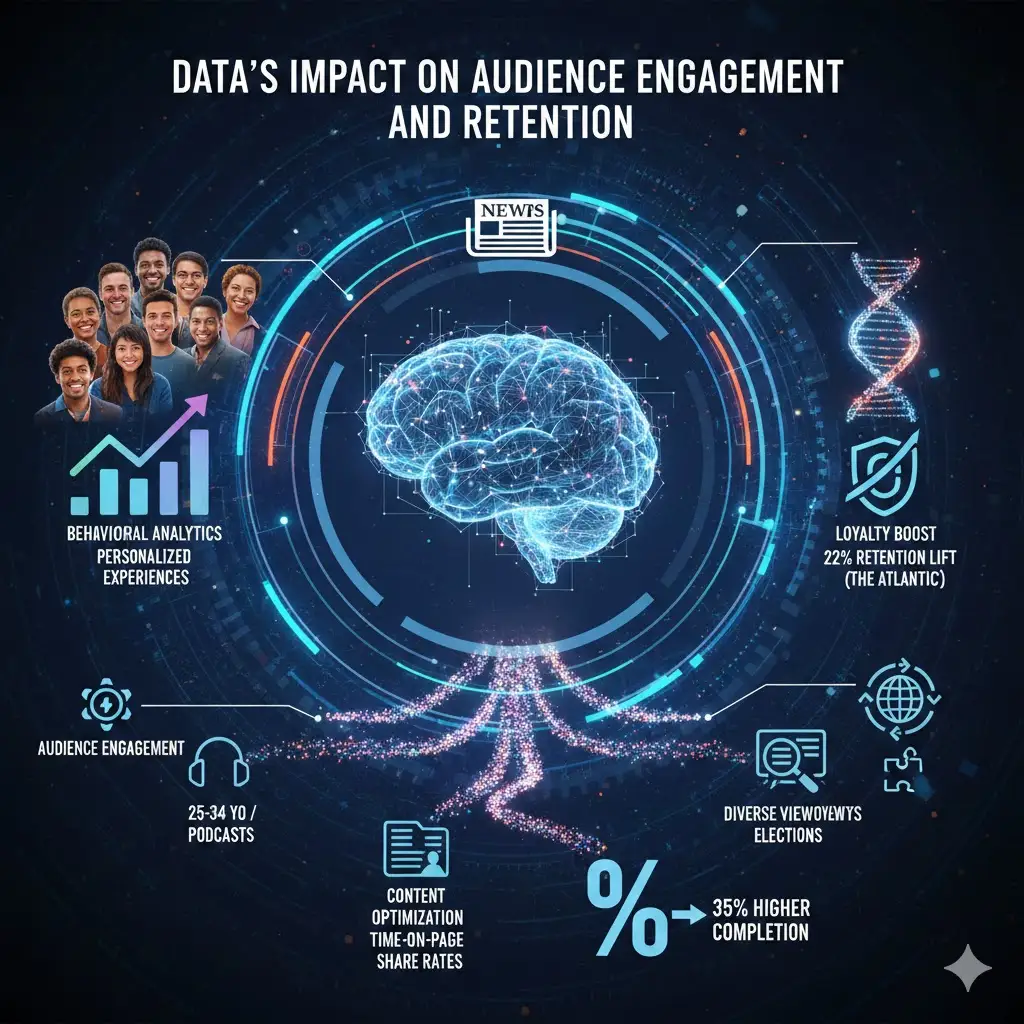
The role of data in modern journalism extends to understanding and nurturing audiences. Behavioral analytics reveal preferences, enabling personalized experiences that boost loyalty.
Metrics like time-on-page and share rates guide content optimization. Publishers segment readers—e.g., 25-34-year-olds favoring podcasts—adjusting formats accordingly. This data-driven approach lifted The Atlantic’s retention by 22% post-implementation.
Personalization engines, powered by first-party data, recommend articles with 35% higher completion rates. During elections, data helps counter echo chambers by surfacing diverse viewpoints.
Measuring Success with Engagement KPIs
Key performance indicators (KPIs) include:
- Engagement Rate: Interactions per visitor; target >5%.
- Retention Coefficient: Repeat visits; ideal 0.4+.
- Virality Score: Shares per view; benchmarks at 0.1-0.2.
These quantify data’s value, with A/B tests validating tweaks like mobile-first layouts.
Ethical and Practical Challenges of Data in Journalism
While transformative, data introduces dilemmas. Privacy breaches and algorithmic biases threaten journalistic integrity.

GDPR compliance mandates consent for tracking, limiting third-party cookies. Newsrooms invest in anonymization tech, balancing utility with ethics. A 2025 Edelman Trust Barometer notes 64% of audiences distrust data-heavy reporting if transparency lacks.
Misuse risks amplify misinformation; deepfakes detected via data forensics underscore verification needs. Training programs address this, upskilling journalists in data literacy.
Overcoming Bias and Ensuring Accuracy
Structured audits mitigate biases. For instance, FactCheck.org uses statistical sampling to validate datasets. Collaboration with experts—like statisticians—ensures robust methodologies.
Practical hurdles include skill gaps; only 42% of journalists feel data-proficient, per Reuters. Solutions involve partnerships with analytics firms.
Dive into a real-world example with our case study: using audience data to grow readership.
Case Studies: Data Success in Action
Real-world applications illuminate data’s power. The Bureau of Investigative Journalism’s Windrush scandal exposé used migration data visualizations, influencing policy changes and earning awards.
In sports journalism, ESPN’s player analytics dashboards revolutionized coverage, integrating wearables data for predictive injury reports with 90% accuracy.
Time Intelligence Media Group’s Audience Insights Services powered a regional publisher’s revamp, yielding 40% traffic growth via targeted content.
Future Trends: Data’s Next Frontier in Journalism
Emerging tech like Web3 and blockchain promises verifiable data streams. Decentralized networks could crowdsource fact-checking, enhancing trust.
Generative AI will automate 50% of routine reporting by 2027, per Gartner, freeing humans for high-value analysis. Edge computing enables real-time field data processing for live events.
Sustainability data will dominate, tracking carbon footprints of news production itself.
Preparing Newsrooms for Tomorrow
Invest in upskilling and infrastructure. Hybrid human-AI models optimize workflows, with data governance frameworks preventing pitfalls.
For strategic decisions on outsourcing, consider why media companies outsource audience analytics.
Embracing Data for Journalistic Excellence
The role of data in modern journalism is indispensable, from enhancing accuracy to forging audience connections. As challenges mount, forward-thinking publishers leverage robust media data strategies for resilience. Time Intelligence Media Group delivers expert Audience Insights Services, empowering newsrooms with precise, ethical data solutions to navigate this data-rich future.
