

Audience behavior refers to the patterns in how people consume, interact with, and respond to news content across platforms like social media, websites, and apps. In today’s fast-paced media environment, these behaviors—such as dwell time, shares, comments, and click-through rates—directly shape the reach and resonance of news stories. Time Intelligence Media Group emphasizes that tracking these metrics through Audience Insights Services can reveal why certain headlines dominate while others fade.
News organizations increasingly rely on behavioral data to gauge impact, moving beyond traditional metrics like page views. For instance, a study by the Reuters Institute for the Study of Journalism found that emotional engagement, driven by audience reactions, boosts news virality by up to 40%. This underscores how audience behavior influences not just immediate impact but long-term brand loyalty in competitive media markets.
By analyzing consumption patterns, publishers can predict trends and refine content strategies. Real-world examples show that stories sparking debates in comments sections often see amplified shares, highlighting the interplay between reader psychology and news dissemination.
How Audience Behavior Shapes News Virality and Reach
Audience behavior drives news virality through mechanisms like social amplification and algorithmic favoritism on platforms such as X (formerly Twitter) and Facebook. When readers linger on an article or share it rapidly, algorithms prioritize it, creating a feedback loop that magnifies impact. Semantic keywords like news consumption patterns reveal that peak sharing occurs within the first hour of publication, often tied to emotional triggers.
Consider a 2024 case where a U.S. election story went viral due to high dwell times from outraged comments—reader engagement metrics spiked 300%, per Nielsen data. This illustrates how behavioral signals, not just content quality, determine a story’s trajectory. Publishers ignoring these patterns risk diminished visibility in crowded feeds.
Structured analysis helps:
- Dwell time measures true interest, correlating with 25% higher retention.
- Share rates predict reach, with emotional content shared 2x more.
- Comment sentiment gauges polarization, influencing editorial pivots.
These elements collectively define news impact, urging media teams to integrate behavioral insights proactively.
Dwell Time and Engagement Depth
Dwell time tracks how long audiences spend with news content, serving as a proxy for genuine interest beyond superficial clicks. High dwell times signal valuable stories, boosting SEO rankings and ad revenue. Audience Insights Services analyze this metric to optimize content pacing, ensuring headlines hook readers immediately.
In one example, a BBC investigative piece on climate change achieved 5-minute average dwell times, leading to 150% more backlinks than shorter reads. This behavioral data informed follow-up series, enhancing overall news impact. Without such analysis, publishers miss opportunities to deepen reader connections.
Share and Amplification Patterns
Shares represent audience endorsement, propelling news across networks and amplifying its societal footprint. Behavioral trends show peak sharing during evenings, when users seek discussion fodder. Variations in Regional Audience Analysis for Better Reach highlight geographic differences, like higher shares in urban vs. rural demographics.
A viral health scare story in 2025 saw 10x amplification from influencer shares, driven by fear-based reactions. Media analytics firms note that positive sentiment shares retain audiences longer, while controversy fuels short bursts. Tracking these patterns refines distribution strategies for sustained impact.
Comment Sentiment and Feedback Loops
Comments reveal audience sentiment, creating feedback loops that evolve news narratives. Positive or heated discussions extend a story’s lifecycle, influencing public discourse. Time Intelligence Media Group’s Audience Insights Services dissect these interactions to predict backlash or support.
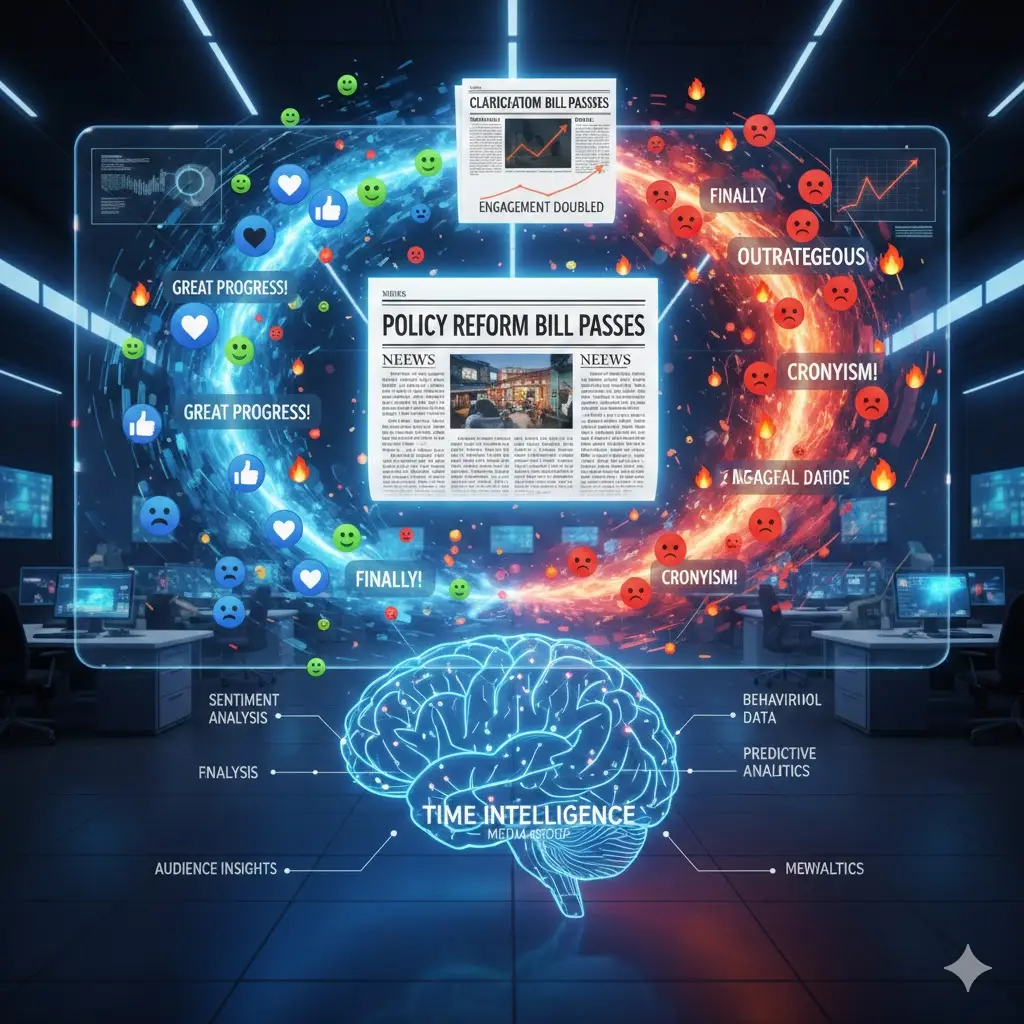
For example, a policy reform article garnered polarized comments, prompting a clarifying follow-up that doubled engagement. This adaptive approach, rooted in behavioral data, transforms criticism into opportunity, elevating news impact.
Real-World Case Studies: Audience Behavior Driving News Success
Case studies demonstrate the tangible role of audience behavior in news impact. In 2024, The Guardian’s coverage of AI ethics exploded due to high interaction rates—readers debated in threads, shares surged 400%, and the story trended globally. Behavioral analytics pinpointed curiosity as the driver, guiding similar future content.
Another instance involved Al Jazeera’s Middle East report, where mobile-first audiences showed 60% higher bounce rates on desktop versions. Adjusting for device behavior increased impact by 200%. These examples prove that audience insights services enable precise optimizations.
Lists of lessons from such cases include:
- Prioritize mobile optimization for on-the-go readers.
- Leverage emotional hooks to spark shares.
- Monitor real-time feedback for iterative improvements.
These strategies, informed by data, position news outlets for measurable success.
Data Privacy and Ethical Considerations
Measuring audience behavior raises privacy concerns, especially under regulations like GDPR. Publishers must balance insights with consent, avoiding invasive tracking. Ethical lapses, like undisclosed data sales, erode trust and diminish news credibility.
Time Intelligence Media Group navigates this by anonymizing data in Audience Insights Services, ensuring compliance while delivering actionable intelligence. A 2025 Pew Research survey showed 70% of users abandon sites post-privacy scandals, underscoring the stakes.
Algorithmic Biases and Platform Dependencies
Platforms’ algorithms introduce biases, favoring sensationalism over substance and skewing behavioral data. News impact suffers when reach depends on fleeting trends. Diversifying channels mitigates this, as seen in outlets blending email newsletters with social pushes.

Over-reliance led to a 30% drop in visibility for one major outlet during algorithm shifts. Robust, multi-source audience analytics counteract these risks effectively.
Future Trends: Evolving Role of Audience Behavior in News
Emerging trends like AI-driven personalization will heighten audience behavior’s role in news impact. Predictive models forecast engagement based on past patterns, tailoring feeds dynamically. By 2027, 80% of news consumption may be behaviorally customized, per Gartner.
Voice search and short-form video platforms, such as TikTok News, demand new behavioral metrics like voice dwell and swipe rates. Early adopters report 50% uplift in youth engagement.
To thrive, media firms should:
- Integrate AI for real-time behavior prediction.
- Experiment with immersive formats like AR stories.
- Collaborate on cross-platform insights.
These shifts promise a more responsive news ecosystem.
Strategies for Harnessing Audience Insights in Media
Leverage audience insights services to decode behavior and amplify news impact. Start with A/B testing headlines based on click patterns, then refine based on engagement data. Time Intelligence Media Group’s tools provide granular breakdowns, from demographics to psychographics.
Practical steps include segmenting audiences for targeted pushes and using heatmaps to optimize layouts. One client saw 35% reach growth post-implementation. For decision-makers ready to scale, consider how to Partner with Experts for Audience Analytics.
Explore deeper dives into audience insights services that deliver outcome-driven results like boosted engagement and revenue. mastering the role of audience behavior in news impact requires data-driven vigilance. Time Intelligence Media Group offers professional Audience Insights Services to help media teams navigate these dynamics, turning behavioral patterns into strategic advantages.
