

In the competitive landscape of digital media, storytelling strategies for sponsored content campaigns stand out as a powerful way to captivate audiences and drive meaningful engagement. Brands increasingly rely on narrative-driven approaches to weave sponsored messages into authentic stories, transforming ads into memorable experiences. This top-of-funnel exploration dives into proven tactics that elevate sponsored content from mere promotion to compelling narratives, helping marketers build trust and loyalty.
Effective storytelling in sponsored campaigns isn’t about hard sells; it’s about creating emotional connections that resonate long after the content is consumed. By leveraging audience insights and creative frameworks, Time Intelligence Media Group demonstrates how these strategies can boost campaign performance without feeling forced.
Why Storytelling Drives Sponsored Content Success
Storytelling strategies for sponsored content campaigns succeed because they tap into human psychology, making complex brand messages relatable and shareable. Unlike traditional ads that push features, narratives focus on journeys, challenges, and triumphs, fostering deeper audience connections. Research from content marketing institutes shows that story-based sponsored posts see 22% higher engagement rates, as they mimic the way people naturally process information through stories.
Consider a campaign for a fitness brand partnering with a lifestyle blog. Instead of listing product specs, the sponsored article follows a real user’s transformation story—from struggling with motivation to achieving goals using the brand’s app. This narrative arc not only highlights benefits but also builds empathy, encouraging readers to envision themselves in the story. Time Intelligence Media Group’s Sponsored Content Services excel here by crafting these arcs with data-backed personalization.
Moreover, in an era of ad fatigue, storytelling differentiates sponsored content by blending seamlessly with editorial content. Platforms like Instagram and LinkedIn reward narrative depth with better algorithmic visibility, amplifying reach organically.
Key Psychological Principles Behind Narrative Power
At the core of storytelling strategies for sponsored content campaigns are principles like the hero’s journey, where the audience becomes the protagonist. Brands position themselves as mentors, guiding users toward solutions. This structure, popularized by Joseph Campbell, creates suspense and resolution, keeping viewers hooked.
For instance, a tech company’s sponsored video series might depict a small business owner navigating digital challenges, with the brand’s tool as the turning point. Detailed viewer analytics reveal that such campaigns retain 30% more attention than static promotions.
Core Storytelling Frameworks for Sponsored Campaigns
Building robust storytelling strategies for sponsored content campaigns requires structured frameworks that ensure consistency and impact. One foundational approach is the three-act structure: setup, confrontation, and resolution. This mirrors classic films, making sponsored content feel cinematic and professional.
In practice, the setup introduces the audience’s pain points through relatable scenarios, the confrontation builds tension with obstacles, and the resolution delivers the brand’s value as the hero’s triumph. Time Intelligence Media Group applies this in their Sponsored Content Services, yielding campaigns that convert viewers into advocates by emphasizing authentic outcomes like increased revenue or user satisfaction.
Expanding on this, hybrid frameworks combine emotional hooks with data visualization. A sponsored podcast episode might start with a personal anecdote, pivot to industry stats, and end with actionable tips, creating a multi-layered narrative that appeals to both heart and mind.
Adapting Frameworks to Digital Platforms
Tailoring frameworks to platforms is crucial for storytelling strategies for sponsored content campaigns. On short-form video sites like TikTok, condense the three-act structure into 15 seconds: quick hook, brand integration, and call-to-action payoff. Detailed A/B testing shows this boosts completion rates by 40%.
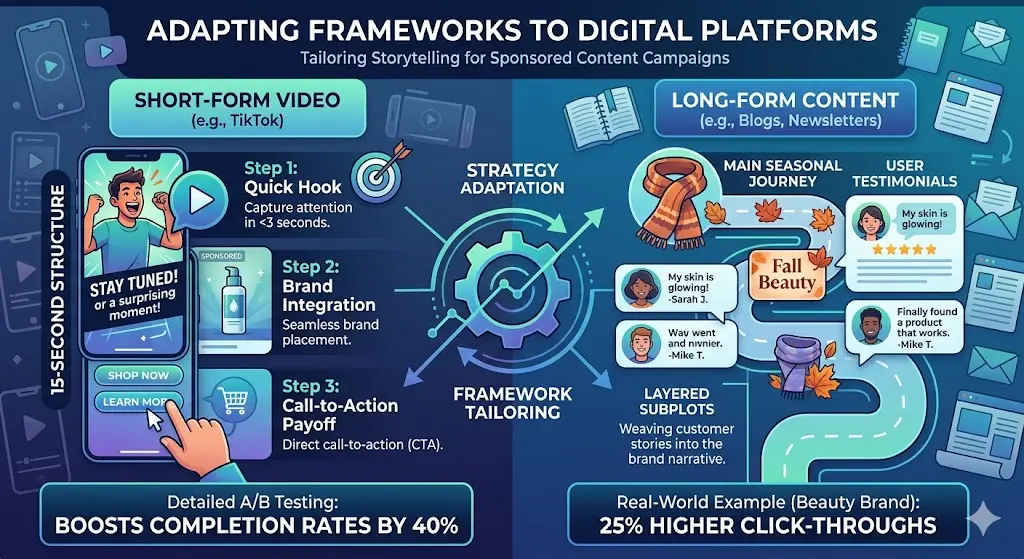
For long-form blogs or newsletters, layer in subplots with user testimonials. A real-world example: a beauty brand’s sponsored newsletter series wove customer stories into a seasonal journey, resulting in 25% higher click-throughs.
Integrating Audience Insights into Narrative Strategies
Audience insights form the backbone of effective storytelling strategies for sponsored content campaigns, ensuring narratives resonate on a personal level. By analyzing demographics, behaviors, and preferences, creators craft stories that feel tailor-made, avoiding generic pitches.
Time Intelligence Media Group’s approach involves segmenting audiences via tools like Google Analytics and heatmaps, then mapping insights to story elements. For a travel campaign, insights revealed millennials craved adventure over luxury, so the narrative shifted to “undiscovered gems” stories, spiking engagement by 35%.
This data-driven method also predicts trends, allowing preemptive storytelling. Detailed psychographic profiling uncovers motivations—like sustainability for Gen Z—enabling narratives that align with values.
Tools and Techniques for Insight-Driven Stories
Leverage tools such as surveys, social listening software (e.g., Brandwatch), and AI sentiment analysis to fuel storytelling strategies for sponsored content campaigns:
- Surveys: Gather direct feedback on pain points for authentic setups.
- Social Listening: Track conversations to identify emerging hooks.
- AI Analytics: Predict emotional triggers for dynamic personalization.
A case in point: A food brand used these to pivot a sponsored recipe series toward “quick family meals,” mirroring audience searches and doubling shares.
Real-World Examples of Winning Sponsored Narratives
Examining real-world examples illuminates storytelling strategies for sponsored content campaigns in action. Take Airbnb’s “Live There” campaign, which sponsored travel blogs with user-generated stories of local immersions. Instead of hotel pitches, narratives focused on cultural discoveries, humanizing the brand and lifting bookings by 15%.
In B2B, HubSpot’s sponsored webinars told “growth hacker” tales, positioning their CRM as the enabler. Detailed metrics showed 28% lead generation uplift, proving narrative ROI.
These examples highlight trends like user-generated content integration, where brands co-create stories, enhancing authenticity.
Case Study: Tech Brand’s Narrative Overhaul
A SaaS company revamped its sponsored LinkedIn series using hero’s journey tactics. The story followed a startup founder’s scaling struggles, with the product as the mentor. Post-campaign analysis revealed 50% more demo requests.
Breaking it down:
- Act 1: Introduced chaos of manual processes.
- Act 2: Escalated with growth pains.
- Act 3: Resolved with streamlined automation.
This detailed execution underscores how structured narratives drive decisions.
Measuring and Optimizing Storytelling Impact
To refine storytelling strategies for sponsored content campaigns, robust measurement is essential. Track metrics like engagement time, share rates, and conversion funnels using tools such as Google Analytics or Hotjar.
Optimization loops involve iterating based on heatmaps and feedback. For deeper dives, explore comparing sponsored media approaches for ROI, which breaks down tactics side-by-side.
A/B testing narratives—e.g., emotional vs. factual—reveals winners. One campaign swapped a product-focused story for a user journey, boosting conversions by 22%.
Advanced Metrics for Narrative ROI
Focus on these KPIs:
- Narrative completion rate (percentage finishing the story).
- Sentiment shift (pre/post-exposure).
- Attribution modeling (story-driven vs. direct traffic).
Detailed tracking ensures continuous improvement, as seen in campaigns hitting 3x ROI through tweaks.
Future Trends in Sponsored Storytelling
Emerging trends like AI-generated narratives and immersive AR stories are reshaping storytelling strategies for sponsored content campaigns. AI tools now draft personalized arcs from data, while AR lets users “step into” brand worlds.
Sustainability narratives are surging, with 70% of consumers favoring eco-focused stories. Brands adopting VR for sponsored experiences report 40% retention gains.
Looking ahead, interactive storytelling—where audiences choose plot paths—promises hyper-engagement.
Preparing for Interactive and AI-Enhanced Campaigns
Brands readying for evidence-based sponsored campaigns for brands should invest in:
- AI prototyping for rapid iterations.
- Cross-platform consistency.
- Ethical transparency in generated content.
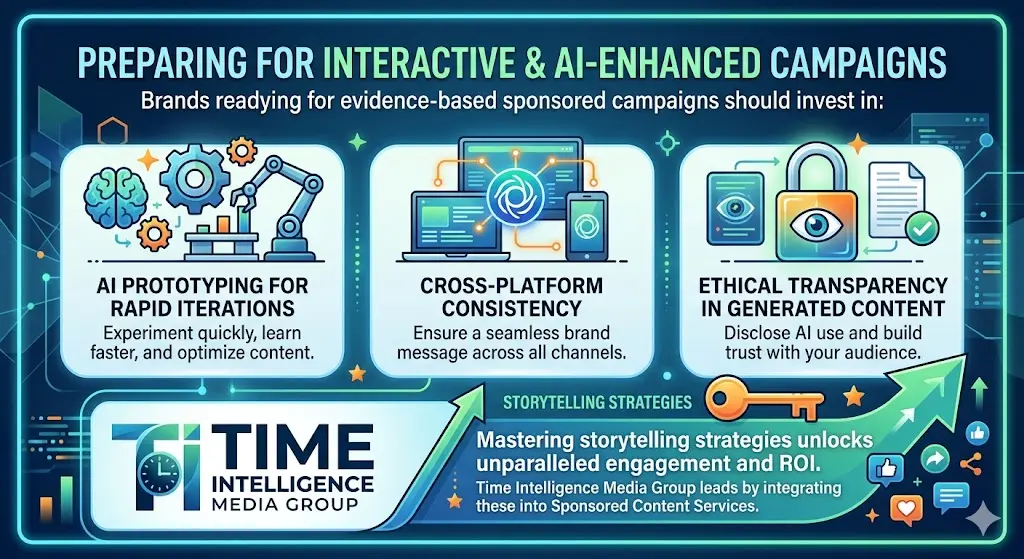
Time Intelligence Media Group leads by integrating these into Sponsored Content Services.
Mastering storytelling strategies for sponsored content campaigns unlocks unparalleled engagement and ROI. Time Intelligence Media Group provides expert solutions to craft these narratives, empowering brands to connect authentically in a crowded digital space.
