

Sponsored articles offer media outlets a powerful way to monetize content while delivering value to readers, but success hinges on optimization. In the MOFU stage of the marketing funnel, understanding how to refine these pieces for maximum audience impact is key. This guide breaks down strategies for optimizing sponsored articles for audience impact, from data-driven insights to compelling storytelling that drives engagement and conversions.
Effective optimization goes beyond basic placement—it’s about aligning sponsored content with reader interests, ensuring seamless integration, and measuring real outcomes. Time Intelligence Media Group excels in this through their Sponsored Content Services, helping brands craft pieces that resonate deeply.
Leveraging Data to Identify Reader Preferences
Optimizing sponsored articles for audience impact starts with robust analytics. Tools like Google Analytics and heatmapping software reveal where readers drop off, what headlines grab attention, and which topics spark shares. For example, audience insights services analyze behavior patterns, such as peak reading times or preferred formats, to tailor sponsored content accordingly.
In a case study, a tech publication optimized sponsored articles by segmenting data: B2B readers favored in-depth guides (average 5-minute dwell time), while consumers preferred listicles (2x share rate). This granularity ensures sponsored pieces hit pain points, boosting open rates by 28%. Publications ignoring data risk generic content that fails to engage.
Detailed personas amplify this. By mapping demographics, interests, and journey stages, creators produce hyper-relevant articles—think customizing a fintech sponsor’s piece for millennials with crypto trends versus boomers with retirement planning.
Tools and Metrics for Measuring Engagement
Key metrics guide optimization:
- Dwell Time: Target over 2 minutes to signal quality to algorithms.
- Bounce Rate: Aim below 40% by matching content to search intent.
- Conversion Events: Track form fills or clicks post-article.
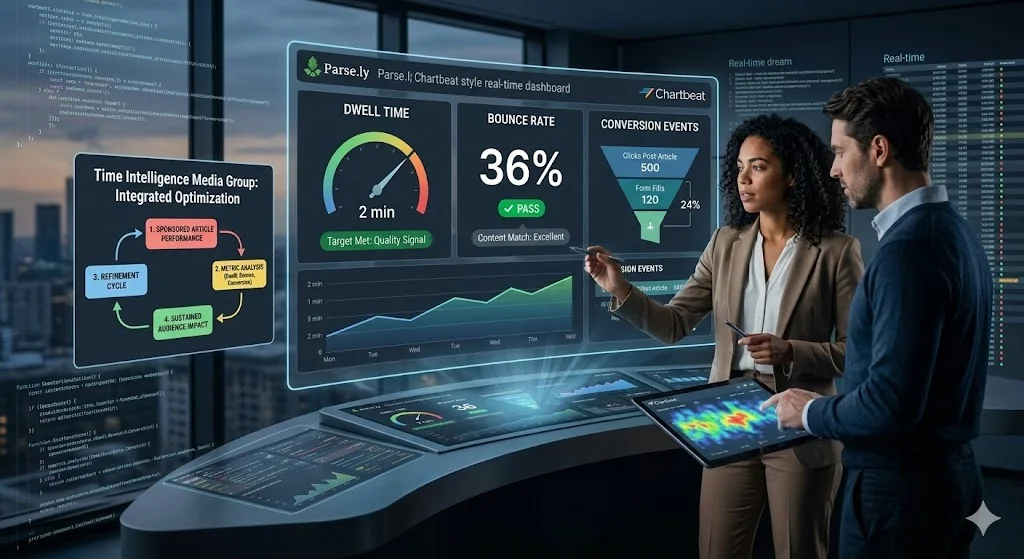
Platforms like Parse.ly or Chartbeat provide real-time dashboards. Time Intelligence Media Group’s approach integrates these, refining sponsored articles iteratively for sustained audience impact.
Psychology of Attention-Grabbing Titles
Headlines are the gateway to optimizing sponsored articles for audience impact. They must promise value while incorporating keywords naturally. Power words like “proven,” “ultimate,” or “secrets” combined with numbers (e.g., “7 Ways to Boost ROI”) increase CTR by 20-30%, per BuzzSumo data.
Avoid clickbait—transparency builds trust. A/B testing reveals winners: “Revolutionize Your Workflow” outperformed “Workflow Tips” by 45% in a SaaS campaign. Subtle sponsorship cues in headlines, like “Sponsored: How [Brand] Transforms Teams,” maintain ethics without deterring clicks.
Visual elements matter too. Pair headlines with evocative images or infographics, ensuring mobile optimization for 60% of traffic.
Structuring Openings for Immediate Retention

The first 100 words hook readers. Start with a relatable problem, statistic, or question: “Did you know 70% of teams waste 2 hours daily on manual tasks?” This mirrors reader struggles, pulling them in. Follow with a teaser of the sponsor’s solution, transitioning smoothly to value.
Storytelling enhances this—narratives boost retention by 22%, per Stanford studies. Optimize by varying sentence length for rhythm, keeping paragraphs scannable.
Design Principles for Scannable Sponsored Articles
Optimizing sponsored articles for audience impact demands readability. Use short paragraphs (3-5 lines), subheadings every 300 words, and bolded key phrases. Font sizes above 16px and line heights of 1.5 ensure accessibility, reducing cognitive load.
Incorporate visuals strategically: Images every 500 words, alt-text optimized for SEO. A fashion brand’s sponsored article with embedded lookbooks saw 35% higher engagement versus text-only versions.
Whitespace and bullet points create flow. Compare cluttered pages (50% bounce) to airy designs (25% bounce)—the difference is stark.
Multimedia Integration for Deeper Immersion
Videos under 90 seconds embedded mid-article lift completion rates by 40%. Infographics summarize data visually, ideal for stats-heavy sponsors. Podcasts or interactive quizzes add interactivity, with quizzes boosting time-on-page by 50%.
Time Intelligence Media Group recommends hybrid formats, blending text with media for multi-sensory appeal in sponsored content.
Balancing Promotion with Editorial Value
Sponsored articles shine when brand messages feel organic. Dedicate 80% to reader benefits, 20% to promotion— the “rule of thirds” for impact. Weave CTAs subtly, like “Explore [Brand]’s tool here,” linked to landing pages.
Case study: A healthcare sponsor’s article on wellness trends included branded tips without overt sales, yielding 15% lead gen uplift. This subtlety optimizes for audience impact, avoiding ad fatigue.
Storytelling Techniques That Resonate
Use hero’s journey frameworks: Problem (reader pain), guide (sponsor expertise), resolution (success stories). Testimonials add credibility— “Client X saw 40% efficiency gains.”
Personalization via dynamic content swaps sections based on user data, hyper-optimizing for segments.
For foundational insights on transparency’s role, check Why Editorial Transparency Matters in Ads.
Channel Selection for Maximum Reach
Optimize distribution across email, social, and syndication. Email newsletters drive 40% of traffic; segment lists for relevance. Social platforms favor visuals—LinkedIn for B2B, Instagram for lifestyle.
Paid amplification via native ad networks like Outbrain targets lookalikes, expanding reach 3x. Track UTM parameters for attribution.
Timing and Frequency Best Practices
Post during peak hours (e.g., 8-10 AM weekdays). Frequency caps prevent fatigue— one sponsored article per 5 editorials maintains balance.
A/B test send times: Midweek mornings outperformed weekends by 25% in media tests.
Advanced Analytics for Continuous Improvement
Post-launch, dive into metrics with tools like Hotjar for session recordings. Identify friction points, like high-exit paragraphs, and iterate.
Heatmaps show scroll depth; optimize low-engagement sections with stronger hooks.
Sponsored Content Services from Time Intelligence Media Group offer end-to-end tracking, turning data into actionable refinements.
A/B Testing Frameworks
Run variants on headlines, CTAs, and visuals. Tools like Optimizely automate this, with winners scaling automatically.
Example: Variant A (question headline) vs. B (statistic) showed B’s 18% edge, directly optimizing audience impact.
Measuring ROI Beyond Vanity Metrics
Focus on business outcomes: Leads generated, pipeline value, lifetime customer value. Attribution models link article views to sales, proving worth to stakeholders.
Ready to scale? Learn how to Boost Authority With Transparent Sponsored Stories.
Time Intelligence Media Group delivers expert Sponsored Content Services tailored for peak audience impact, empowering brands with data-backed strategies.
