

Publishers face intensifying pressures from ad blockers, algorithm changes, and audience fragmentation, making media partnership strategies for publishers more critical than ever. These strategies transform traditional revenue models into diversified, sustainable ecosystems by collaborating with brands, tech platforms, and content creators. At the MOFU stage, this guide dives into actionable tactics to help publishers identify opportunities, negotiate deals, and scale alliances effectively.
Drawing from industry data, successful partnerships can boost publisher revenues by 30-50% while enhancing audience loyalty through premium, co-branded content. Whether you’re a digital magazine, niche blog, or news outlet, mastering these strategies positions you for long-term growth. Explore foundational concepts in our TOFU piece on How Brands Collaborate with Media Companies.
Understanding Core Media Partnership Models for Publishers
Media partnership strategies for publishers begin with selecting models that align with your content pillars and audience strengths. Sponsored content remains a staple, where brands fund editorial-style pieces that blend seamlessly with your inventory. This model excels for publishers with high domain authority, as it drives organic traffic via shareable, value-driven assets.
Another powerhouse is affiliate partnerships, integrating trackable links into reviews or guides for commission-based earnings. Publishers leveraging first-party data can personalize these, increasing conversion rates by up to 25%. Time Intelligence Media Group’s Media Partnerships Solutions exemplify how structured models like these create predictable revenue streams without compromising editorial integrity.
Revenue-sharing pacts with platforms like newsletters or podcasts offer scalability. A mid-sized publisher might partner with a SaaS brand for co-hosted webinars, splitting ticket sales 50/50 while cross-promoting audiences. These models evolve with trends, emphasizing transparency and performance metrics for sustained success.
Comparing Popular Partnership Models
Key models include:
- Sponsored Content: High upfront fees; ideal for evergreen topics.
- Affiliate Programs: Passive income; suits review-heavy sites.
- Joint Ventures: Equity shares; best for innovative projects like apps.
Case in point: A travel publisher’s affiliate tie-up with hotel chains generated $200K annually, proving data-informed model selection yields outsized returns.
Building a Publisher Partnership Pipeline
Developing a robust pipeline is essential in media partnership strategies for publishers. Start by auditing your assets—unique audience insights, niche expertise, and engagement data—to craft compelling pitches. Tools like CRM platforms help segment prospects: brands seeking your demographic sweet spot, such as millennials for lifestyle pubs.
Outreach via personalized emails or LinkedIn, highlighting mutual wins like amplified reach or co-branded authority. Follow up with case studies showing past ROI, such as a 40% traffic spike from prior collaborations. Consistent nurturing turns cold leads into warm opportunities.
Scaling the pipeline involves automation: use AI matchmakers to identify brands scanning for publisher partners. Time Intelligence Media Group aids this through Media Partnerships Solutions, providing prospect databases and outreach templates that streamline the process.
Steps to Construct Your Pipeline
Follow this sequence:
- Asset Inventory: Catalog audience data and content strengths.
- Prospect Research: Target brands with overlapping goals using tools like SimilarWeb.
- Pitch Customization: Tailor proposals with projected metrics.
A niche food publisher built a 50-partner pipeline this way, securing 12 deals in Q1 alone.
Negotiation Tactics for High-Value Deals

Negotiation forms the backbone of effective media partnership strategies for publishers. Anchor discussions with data: present audience demographics, engagement benchmarks, and historical performance to justify rates. Aim for tiered pricing—base fees plus bonuses for exceeding KPIs like click-through rates.
Incorporate clauses for creative control, ensuring brand content aligns with your voice. Hybrid models blending fixed payments with performance incentives reduce risk. For deeper dives into service evaluations, check What Are Professional Media Partnership Services?.
Address scalability early: negotiate evergreen rights or multi-year extensions. A business publisher’s deal with a fintech brand included expansion clauses, growing from one article to a quarterly series worth $150K.
Essential Negotiation Levers
Leverage these tactics:
- Data-Driven Valuations: Use benchmarks (e.g., $20-50 CPM for premium audiences).
- Performance Guarantees: Offer make-goods for underdelivery.
- Exclusivity Premiums: Charge 20-30% more for category exclusives.
These ensure publishers retain leverage while fostering repeat business.
Leveraging Data and Tech in Partnerships
Data is the currency of modern media partnership strategies for publishers. Audience insights services analyze behavior patterns, enabling hyper-targeted proposals that command premium pricing. Integrate tools like Google Analytics 4 with partner dashboards for real-time transparency.
AI enhances matching: algorithms predict partnership fit based on content affinity and past successes. Publishers using these see 35% higher deal close rates. Tech stacks also automate fulfillment, from content approval workflows to revenue tracking.
Future-proof by adopting blockchain for transparent revenue shares, building trust in complex alliances. Time Intelligence Media Group’s Media Partnerships Solutions incorporate these tech layers for seamless execution.
Tech Stack Recommendations
Prioritize:
- Analytics: GA4 for traffic insights.
- CRM: HubSpot for deal tracking.
- AI Tools: Custom models for audience segmentation.
A news publisher’s AI-driven personalization lifted partner ROI by 28%, solidifying long-term contracts.
Case Studies: Real-World Wins
Real examples illuminate media partnership strategies for publishers. A lifestyle publisher partnered with a wellness brand on a 6-month content series, blending recipes with product integrations. This drove 500K impressions and $80K revenue, with 15% audience growth.
In tech publishing, a SaaS alliance involved co-authored e-books distributed via email lists. Metrics showed 22% conversion uplift, attributed to trusted endorsements. Another: podcast publishers revenue-shared ad slots, achieving 3x industry-standard listenership.
These cases highlight diversification—mixing models mitigates risks from platform dependency.
Risk Mitigation and Long-Term Scaling
Mitigate risks in media partnership strategies for publishers by diversifying partners across industries and including exit clauses. Monitor brand reputation via sentiment tools to avoid misalignment. Legal reviews ensure IP protection in co-creations.
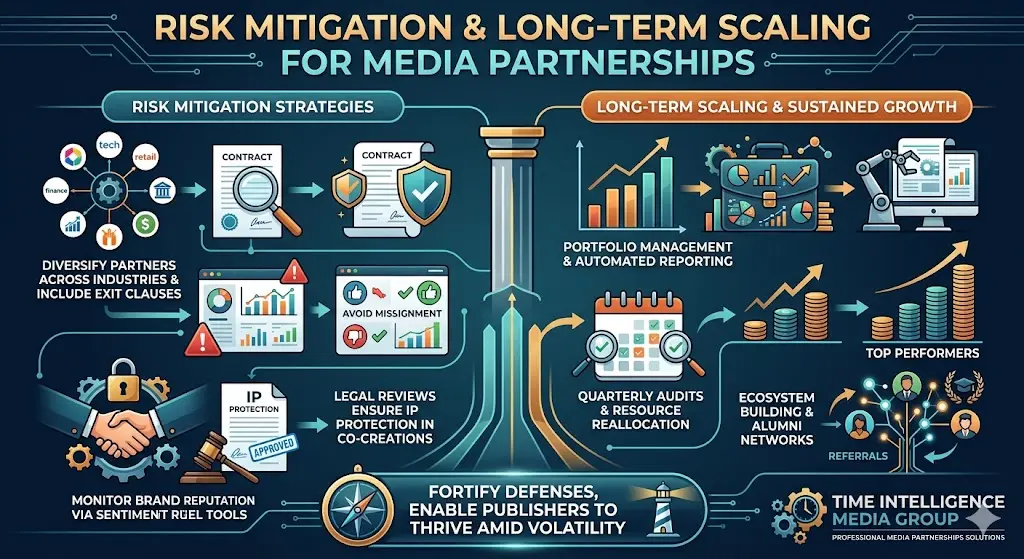
Scaling demands portfolio management: prioritize high-LTV partners and automate reporting. Quarterly audits refine strategies, reallocating resources to top performers.
Sustained growth comes from ecosystem building—nurture alumni networks for referrals. Time Intelligence Media Group delivers professional Media Partnerships Solutions to fortify these defenses, enabling publishers to thrive amid volatility.
