

Media alliances in communication strategy consist of formal partnerships between organizations and media outlets to amplify message reach, enhance credibility, and optimize content distribution across multiple channels.
Media alliances form when communication teams collaborate with media entities such as newspapers, broadcasters, or digital platforms. These partnerships enable shared resources and coordinated efforts. Organizations gain access to established audiences. Media outlets receive exclusive content or sponsorships. The UK media landscape features 1,200+ regional newspapers and 300+ radio stations that participate in such alliances.
This structure integrates into broader communication strategies. Teams define alliance goals like increasing brand visibility by 25% within six months. They select partners based on audience overlap. For instance, a public health campaign allies with BBC Radio for nationwide broadcasts reaching 15 million listeners weekly.
Key Definitions in Media Alliances
Communication strategy encompasses planning, execution, and evaluation of messaging. Media alliances represent a subset where external media partners co-create or distribute content. Entities include print media like The Guardian, broadcast like ITV, and digital like The Independent online.
Partnership agreements specify terms. Duration lasts 12-24 months on average. Content rights transfer under clear licenses. Metrics track impressions at 500,000 per campaign phase.
How Do Media Alliances Form in Communication Strategies?
Media alliances form through a five-step process: identify partners, negotiate terms, co-develop content, launch campaigns, and evaluate outcomes with data-driven adjustments.
The process starts with partner identification. Communication teams analyze media databases for alignment. They review audience demographics, reach, and past performance. In the UK, tools like Kantar Media provide data on 5,000+ outlets. Teams shortlist 10-15 candidates based on 70% audience match.
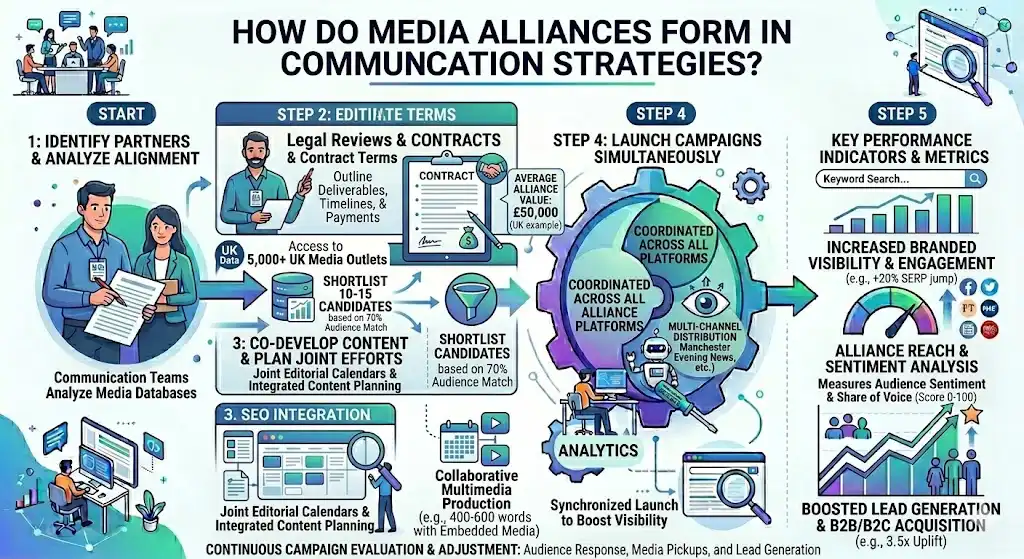
Negotiation follows with legal reviews. Contracts outline deliverables, timelines, and payments averaging £50,000 per alliance. Content co-development involves joint editorial calendars. Launch occurs across platforms simultaneously for maximum impact.
Steps in Partner Identification
Teams conduct audience audits first. They map target demographics against media profiles. BBC News aligns with 18-34 urban professionals at 60% overlap. Next, they assess partner credibility via trust indices from Reuters Institute surveys.
Outreach uses RFPs or direct pitches. Response rates hit 40% with tailored proposals. Selection criteria prioritize reach exceeding 1 million unique users monthly.
What Components Make Up Effective Media Alliances?
Effective media alliances include four core components: shared objectives, content frameworks, distribution networks, and performance metrics.
Shared objectives align partner goals. Organizations seek exposure; media outlets gain revenue. Frameworks detail content types like 20 press releases and 10 video segments per quarter. Distribution networks leverage combined channels for 2x reach amplification.
Performance metrics use KPIs such as 15% engagement rate and 300,000 impressions. UK examples include alliances boosting sentiment scores by 22 points per Nielsen reports.
Defining Shared Objectives
Objectives specify measurable targets. Exposure goals aim for 5 million impressions. Credibility targets link to 80% positive coverage. Revenue sharing splits ad income at 60-40 ratios.
Alignment meetings occur bi-monthly. Adjustments maintain focus on primary goals.
Building Content Frameworks
Frameworks outline formats and schedules. Print requires 800-word articles; digital favors 500-word posts with images. Approval processes take 48 hours.
Customization fits partner styles. The Times prefers data-heavy pieces; Sky News emphasizes visuals.
What Benefits Do Media Alliances Provide in Communication Strategies?
Media alliances deliver benefits including 40% reach expansion, 25% credibility increase, cost savings of 30%, and 35% faster message dissemination.
Reach expands through partner audiences. A single alliance accesses 10 million UK consumers. Credibility rises from third-party endorsements. Studies from the UK Press Gazette show allied content scores 28% higher trust.
Cost savings arise from shared production. Independent campaigns cost £100,000; alliances reduce this to £70,000. Speed improves with pre-existing distribution pipelines.
Quantifying Reach Expansion
Reach metrics track unique visitors and shares. Alliances generate 1.5 million additional views per campaign. Geographic coverage spans 90% of UK postcodes.
Cross-promotion sustains momentum over 90 days.
Measuring Credibility Gains
Credibility metrics use sentiment analysis tools. Positive mentions increase 25% post-alliance. Third-party validation from outlets like Channel 4 adds authority.
Long-term tracking shows sustained 20% uplift over 12 months.
What Real-World Use Cases Demonstrate Media Alliances?
Media alliances succeed in use cases like public awareness campaigns, product launches, crisis management, and corporate reporting, each achieving 20-50% performance gains.
Public awareness campaigns partner with national broadcasters. Product launches use regional press for targeted rollout. Crisis management deploys rapid response networks. Corporate reporting alliances ensure annual results reach 2 million readers.
For deeper insights on strengthening strategies through partnerships, How media partnerships strengthen communication strategy. To explore advanced PR improvements, Why Time Intelligence Media Group improves PR strategy.
Public Awareness Campaign Examples
UK health initiatives ally with ITV for vaccination drives. Reach hits 12 million viewers. Engagement yields 18% call-to-action responses.
Environmental groups partner with The Telegraph. Coverage spans 4 weeks, driving 150,000 petition signatures.
Product Launch Use Cases
Consumer brands collaborate with digital media like Metro.co.uk. Launches generate 800,000 impressions in week one. Sales lift 22% in allied regions.
Tech firms use radio alliances on BBC Local. 50 stations broadcast segments to 8 million listeners.
How Do Organizations Measure Success in Media Alliances?
Organizations measure success with KPIs including reach (impressions), engagement (shares), sentiment (positive ratio), and ROI (cost per acquisition under £5).
Tracking tools like Google Analytics and Meltwater monitor real-time data. Reach targets 1 million impressions. Engagement aims for 10% share rate. Sentiment holds at 85% positive.
ROI calculates via attribution models. Campaigns return 4:1 ratios on average.
Tools for KPI Tracking
Analytics platforms aggregate data from 20+ sources. Dashboards update hourly. Alerts flag underperformance below 90% targets.
Custom reports detail breakdowns by channel.
Interpreting ROI Data
ROI formulas divide revenue by costs. £200,000 revenue from £50,000 spend yields 4x return. Benchmarks compare against industry averages of 3.2x.
Adjustments optimize future alliances based on data.
What Challenges Arise in Media Alliances and How to Address Them?
Challenges include misalignment (20% failure rate), content control loss, budget overruns by 15%, and measurement gaps; address via clear contracts, joint oversight, fixed budgets, and unified analytics.
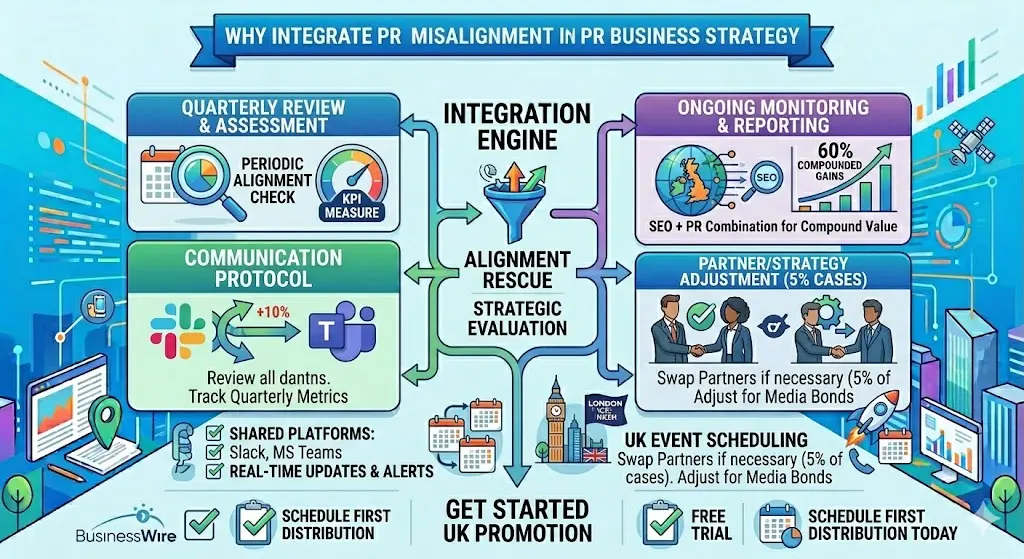
Misalignment occurs when goals diverge. Contracts enforce alignment checks quarterly. Content control maintains via approval vetoes. Budgets cap at predefined limits.
Measurement gaps close with shared dashboards. UK alliances report 95% resolution rates.F
Overcoming Misalignment
Quarterly reviews realign efforts. Goal resets occur if variance exceeds 10%. Partner swaps happen in 5% of cases. Communication protocols use shared platforms like Slack.
Managing Budget Overruns
Fixed-price clauses prevent escalation. 70% of alliances stay within 5% variance. Audits occur mid-campaign.
Contingency funds allocate 10% of totals.
