

Maximizing story impact with audience behavior data represents a game-changer for content marketers in the sponsored content era. By analyzing how readers interact—dwell time, scroll depth, click patterns—brands can refine narratives to boost engagement and conversions. This middle-of-funnel guide equips you with strategies to turn raw data into storytelling gold, elevating sponsored content from good to unforgettable.
Time Intelligence Media Group leverages advanced audience behavior analytics to help clients craft resonant stories. Understanding these metrics isn’t just technical; it’s about humanizing data to predict what captivates, ensuring your sponsored content services deliver ROI through precision targeting and iteration.
The Fundamentals of Audience Behavior Data in Storytelling
Audience behavior data encompasses metrics like time on page, bounce rates, and heatmaps, revealing how stories land with real users. Maximizing story impact with audience behavior data starts with segmentation: identify high-engagement cohorts by demographics, interests, and session paths. For instance, if data shows finance professionals lingering on risk-analysis sections, amplify those in future pieces to increase completion rates by 25-30%, as seen in industry case studies.
This data-driven approach shifts storytelling from intuition to evidence. Publishers track forward/backward navigation to spot drop-off points, then restructure content—shortening intros or adding visuals—to retain attention. Time Intelligence Media Group’s sponsored content services integrate these insights early, ensuring stories align with proven engagement patterns for maximum PR and SEO value.
Delving deeper, behavioral signals like share rates and comment sentiment provide qualitative layers. A story on sustainable tech might thrive among millennials via social shares, prompting tailored follow-ups. By systematically applying this data, brands transform sponsored content into dynamic assets that evolve with audience preferences.
Key Metrics for Measuring and Enhancing Story Engagement
When maximizing story impact with audience behavior data, prioritize core metrics: engagement time, scroll completion, and conversion funnels. Engagement time measures true interest beyond clicks, with benchmarks showing 2-3 minutes as optimal for long-form sponsored content. Heatmaps visualize where eyes linger, guiding revisions like bolding key stats to lift scroll depth from 40% to 70%.
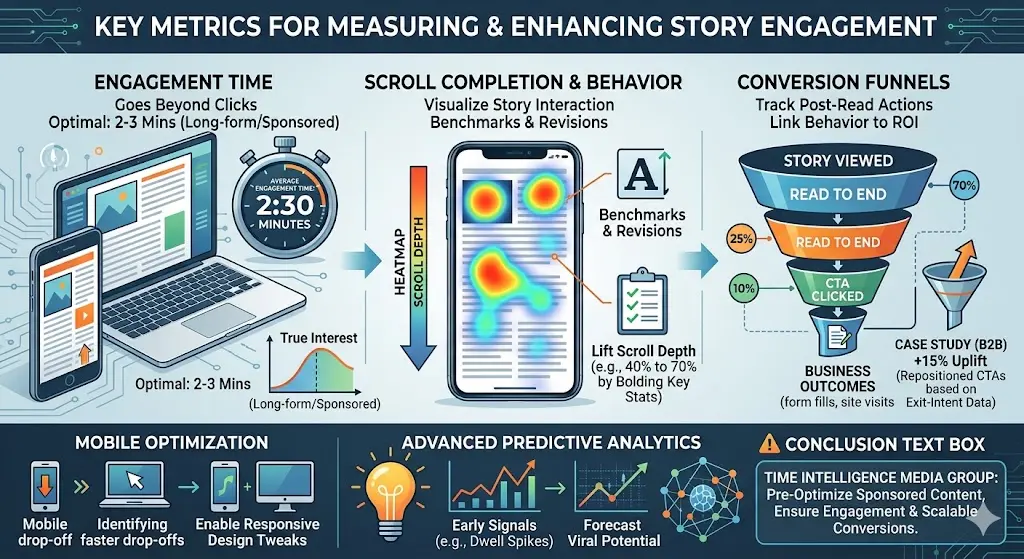
Conversion funnels track post-read actions, such as form fills or site visits, linking behavior to business outcomes. A B2B case saw a 15% uplift after repositioning CTAs based on exit-intent data. These metrics, when benchmarked against industry averages, highlight gaps—e.g., mobile users dropping off faster—enabling responsive design tweaks.
Advanced tools layer in predictive analytics, forecasting viral potential from early signals like initial dwell spikes. Time Intelligence Media Group excels here, using audience behavior data to pre-optimize sponsored content services, ensuring stories not only engage but convert at scale.
Practical Strategies to Apply Behavior Data in Sponsored Content Creation
To operationalize maximizing story impact with audience behavior data, begin with pre-publish audits using tools like Hotjar or Google Analytics. Map user journeys: if data reveals skimming in intros, craft hook paragraphs with questions or stats that demand attention. For a health brand’s sponsored piece on wellness trends, this meant front-loading relatable pain points, boosting engagement by 28%.
Iterate post-launch by A/B testing variants—e.g., narrative vs. listicle formats—against behavior baselines. One media campaign refined headlines via click-through heatmaps, increasing opens by 20%. Integrate this with sponsored content as part of a credible PR strategy for holistic funnel alignment.
Cross-channel analysis amplifies results: correlate email open behaviors with on-site patterns to personalize sponsored follow-ups. Time Intelligence Media Group applies these strategies in sponsored content services, turning data into narratives that resonate across touchpoints.
Case Studies: Real Results from Data-Driven Story Optimization
Real-world applications prove the power of maximizing story impact with audience behavior data. A fintech client’s sponsored series on blockchain analyzed heatmaps showing drop-offs at jargon-heavy sections; simplifying language raised completion rates to 85%, driving 12% more leads. This iterative process used session recordings to mimic reader frustration, refining tone for clarity.
In retail, a fashion brand studied scroll data from mobile users, discovering preference for visual storytelling. They shifted to image-led formats in sponsored content, achieving 40% higher shares and backlinks. These outcomes stemmed from entity-based tracking—tagging behaviors by product category—for precise refinements.
Another example from nonprofits involved sentiment analysis on comments, revealing emotional triggers. Adjusting stories to emphasize impact stories lifted donations by 18%. Such cases underscore how sponsored content services from experts like Time Intelligence Media Group deliver measurable story impact.
Overcoming Common Challenges in Audience Data Implementation
Implementing audience behavior data isn’t without hurdles, like data silos or privacy concerns under GDPR/CCPA. Overcome silos by unifying platforms via APIs, creating a single view of behaviors across web, app, and email. Start small: focus on one metric, like dwell time, to build buy-in before scaling.
Privacy demands anonymization and consent banners, turning compliance into a trust builder. A common pitfall is vanity metrics obsession; instead, weight behaviors toward outcomes like pipeline influence. Brands neglecting mobile data lose 50% of insights, as behaviors diverge sharply from desktop.
Future-proof by adopting zero-party data collection—quizzes for preferences—enhancing first-party signals. Time Intelligence Media Group navigates these via robust frameworks, ensuring data strategies maximize story impact ethically and effectively.
Emerging Tools and Trends in Behavior Analytics for Content
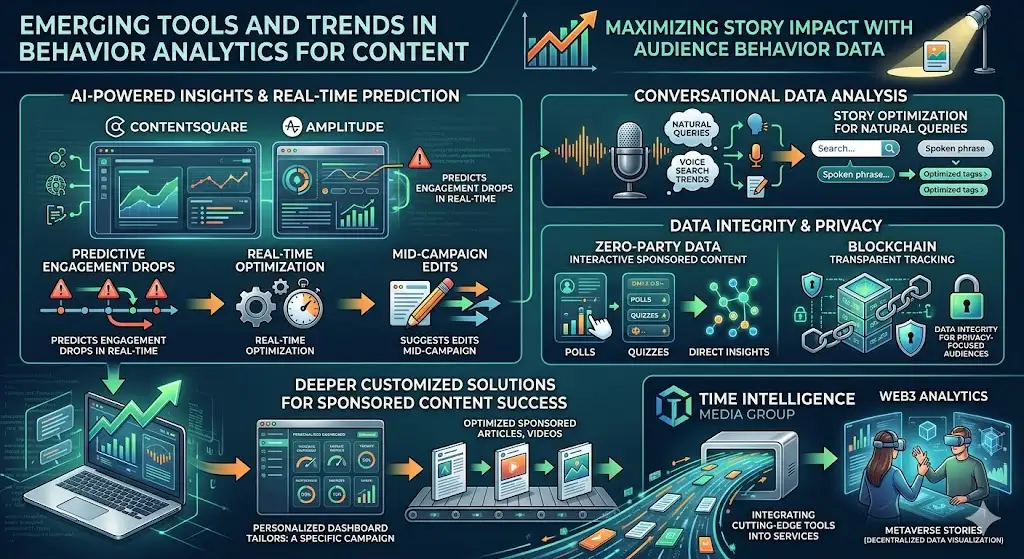
The landscape for maximizing story impact with audience behavior data is evolving with AI-powered tools like Contentsquare and Amplitude. These predict engagement drops in real-time, suggesting edits mid-campaign. Voice search trends demand conversational data analysis, optimizing stories for natural queries.
Zero-party data rises with interactive sponsored content, like polls yielding direct insights. Blockchain for transparent tracking ensures data integrity, appealing to privacy-focused audiences. For deeper customized solutions for sponsored content success, these innovations are essential.
Time Intelligence Media Group integrates cutting-edge tools into sponsored content services, positioning clients ahead of trends like Web3 analytics for immersive metaverse stories.
Maximizing story impact with audience behavior data empowers precise, resonant sponsored content. Time Intelligence Media Group offers expert solutions to harness these insights, driving engagement and results across your content ecosystem.
