

Sponsored media initiatives represent a high-leverage tactic for brands seeking measurable returns in competitive markets. Maximizing ROI with sponsored media initiatives requires blending strategic planning, precise targeting, and rigorous analytics to turn content investments into sustained revenue growth. At the middle-of-funnel (MOFU) stage, this approach nurtures leads by delivering targeted value that accelerates conversion paths.
Unlike scattershot advertising, sponsored media focuses on contextually relevant placements in trusted outlets, where audience intent aligns with brand goals. Industry data from the Association of National Advertisers indicates sponsored campaigns yield 2.5x higher ROI than display ads when optimized properly. This article breaks down proven frameworks, metrics, and case studies to help you refine your strategy for optimal financial outcomes.
Defining and Measuring Key ROI Metrics
Maximizing ROI with sponsored media initiatives starts with clear metric definitions. Track direct indicators like cost-per-lead (CPL) and return on ad spend (ROAS), alongside indirect ones such as engagement rate and lifetime value (LTV) uplift. For example, a B2B software firm might calculate ROAS as revenue from sponsored leads divided by total spend, aiming for 4:1 ratios.
Advanced tools like Google Analytics 4 or platform dashboards enable attribution modeling—multi-touch or data-driven—to credit sponsorships accurately across journeys. A common benchmark: sponsored content achieves 15-20% conversion rates for nurtured leads, per Content Marketing Institute reports. Regularly auditing these metrics reveals optimization opportunities, such as reallocating budget from underperforming topics.
In practice, segment data by audience cohorts: new vs. returning visitors. This granularity uncovers hidden ROI drivers, like how video-embedded sponsorships boost LTV by 28% through deeper engagement.
The Role of Attribution in ROI Accuracy
Proper attribution prevents underestimating sponsored media’s impact. Linear models overlook the nurturing role of MOFU content, so adopt time-decay or position-based methods that value early touchpoints appropriately. Case in point: a retail sponsor’s initiative generated 12% of sales via direct clicks but 45% through assisted conversions, revealed only via enhanced tracking.
Integrate CRM data for closed-loop reporting, linking sponsorship interactions to downstream revenue. Time Intelligence Media Group’s Sponsored Content Services emphasize this integration, delivering clients 30% more accurate ROI forecasts through unified dashboards.
Audience Targeting and Personalization Tactics
Precision targeting is core to maximizing ROI with sponsored media initiatives. Leverage first-party data and lookalike audiences to place content where high-intent users congregate, such as industry newsletters or niche forums. Personalization—tailoring headlines or CTAs based on user behavior—lifts click rates by 35%, according to Dynamic Yield studies.
Here’s a step-by-step approach:
- Profile ideal customers via surveys and analytics.
- Select outlets with overlapping demographics (e.g., 65%+ match).
- A/B test creatives for resonance.
- Retarget engaged users with sequels.
A logistics brand applied this, sponsoring supply chain webinars that converted 22% of attendees, far exceeding benchmarks.
Content Optimization for Conversion Pathways
Craft sponsorships as lead magnets: include gated assets like ebooks or calculators post-read. Optimize for mobile with scannable formats—short paragraphs, bolded insights—and SEO-friendly keywords to extend organic lifespan. Evergreen topics like “AI in Supply Chain Optimization” sustain traffic, compounding ROI over 12+ months.
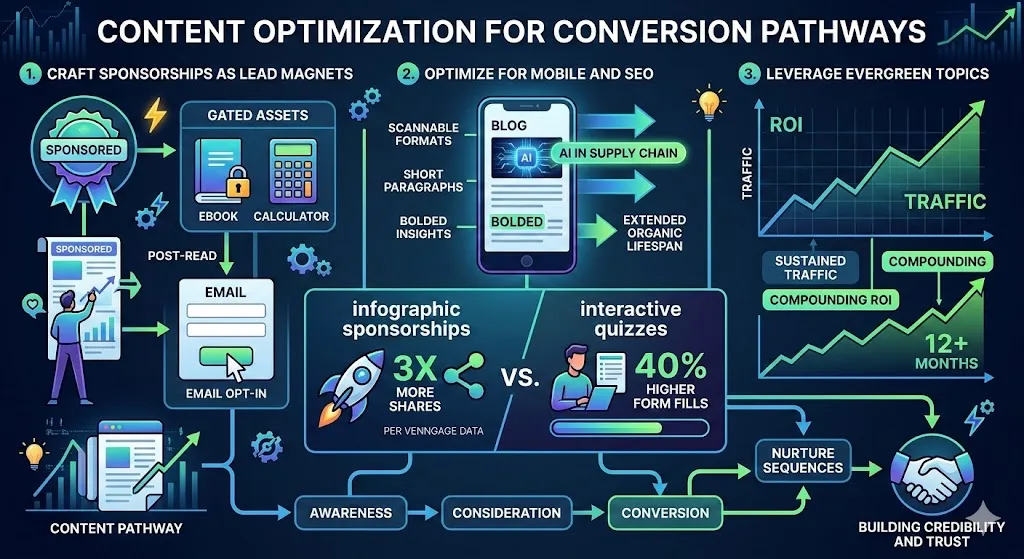
Compare formats: infographic sponsorships yield 3x shares vs. text, per Venngage data, while interactive quizzes drive 40% higher form fills. Always align with funnel progression, linking to nurture sequences.
For foundational insights on using content sponsorship to build credibility, pair these tactics with trust-building basics.
B2B Tech Firm’s 5x ROAS Breakthrough
A cybersecurity provider maximized ROI with sponsored media initiatives by funding a “Threat Landscape Report” series in trade publications. With a $50K investment, they generated $250K in pipeline within 90 days—5x ROAS—via tracked downloads and demo requests.
Key drivers: expert bylines, data visualizations citing 2025 breach stats (up 22% YoY), and CRM-integrated forms. Post-campaign analysis showed 60% of leads closed within six months, validating the approach. This scenario highlights how data-rich content positions sponsors as indispensable.
E-Commerce Retailer’s Seasonal Scaling
An apparel retailer sponsored holiday trend guides across fashion media, achieving 4.2x ROAS amid peak shopping. Tactics included geo-targeted distribution and urgency CTAs (“Limited Edition Insights”), converting 18% of traffic to sales.
Scaling involved programmatic amplification, adding 25% incremental reach without diluting quality. Lessons: timing matters—Q4 sponsorships averaged 2.8x higher ROI than off-peak.
Leveraging AI and Automation for Efficiency
AI transforms ROI maximization by automating bid adjustments and content recommendations. Tools like Albert.ai predict optimal sponsorship slots, boosting efficiency by 27%. Predictive analytics forecast LTV from early signals, enabling proactive scaling.
Automate A/B testing for headlines and visuals, iterating weekly. A media agency using this saw CPL drop 40%, proving AI’s edge in dynamic markets.
Multi-Channel Amplification Strategies
Extend sponsorship reach via owned channels: repurpose into emails (40% open rates), social clips (3x engagement), and podcasts. Cross-promotion with partners amplifies without extra spend.
Budget 20% for amplification; track via UTM parameters. For brands ready for sponsored content solutions for credible brand growth, this creates exponential returns.
Avoiding Budget Waste and Measurement Errors
Overlooking vanity metrics like impressions leads to misallocation—focus on revenue-attributed KPIs. Mitigate with quarterly audits and sunset underperformers.
Poor creative testing wastes 30% of budgets; counter with data-backed iterations.
Scaling Sustainably Without Dilution
Rapid scaling risks brand dilution; cap at 20% monthly growth, monitoring quality scores. Diversify outlets to hedge risks.
Time Intelligence Media Group provides expert Sponsored Content Services to navigate these, ensuring scalable, high-ROI outcomes.
Emerging Trends Shaping Sponsored Media ROI
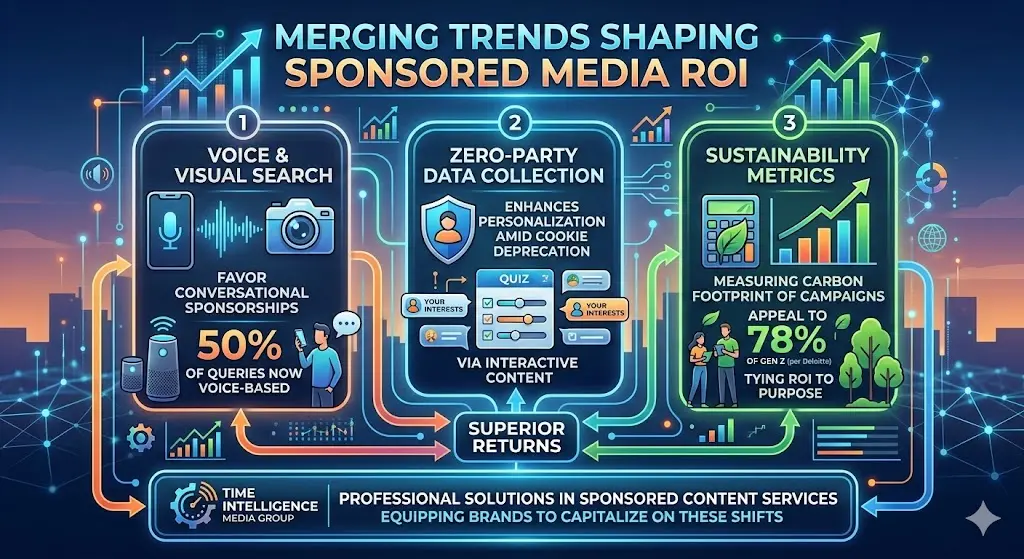
Voice and visual search favor conversational sponsorships, with 50% of queries now voice-based. Zero-party data collection via interactive content enhances personalization amid cookie deprecation.
Sustainability metrics—measuring carbon footprint of campaigns—appeal to 78% of Gen Z, per Deloitte, tying ROI to purpose.
Time Intelligence Media Group offers professional solutions in Sponsored Content Services, equipping brands to capitalize on these shifts for superior returns.
