
Banner advertising consists of rectangular or square visuals that appear at fixed positions on web pages. Publishers place these banners in headers, sidebars, footers, or within content flows. The format originated in 1994 with the first web banner on HotWired.com, which featured a 468×60 pixel ad. Today, standard sizes include 728×90 leaderboard, 300×250 medium rectangle, and 320×50 mobile banner.
Websites load banners via ad servers that deliver creatives based on user data. Advertisers upload designs in formats like GIF, JPEG, PNG, or HTML5 for richer interactions. Impressions count each time the banner appears on a user’s screen, while clicks track user engagement. Viewability metrics ensure the ad displays in the viewport for at least one second with 50% visibility.
How does banner advertising work in digital marketing?
Banner advertising works through ad networks that match brand ads to publisher inventory using real-time bidding auctions. Targeting relies on demographics, behavior, and location to deliver 1,000 to 10 million impressions daily.
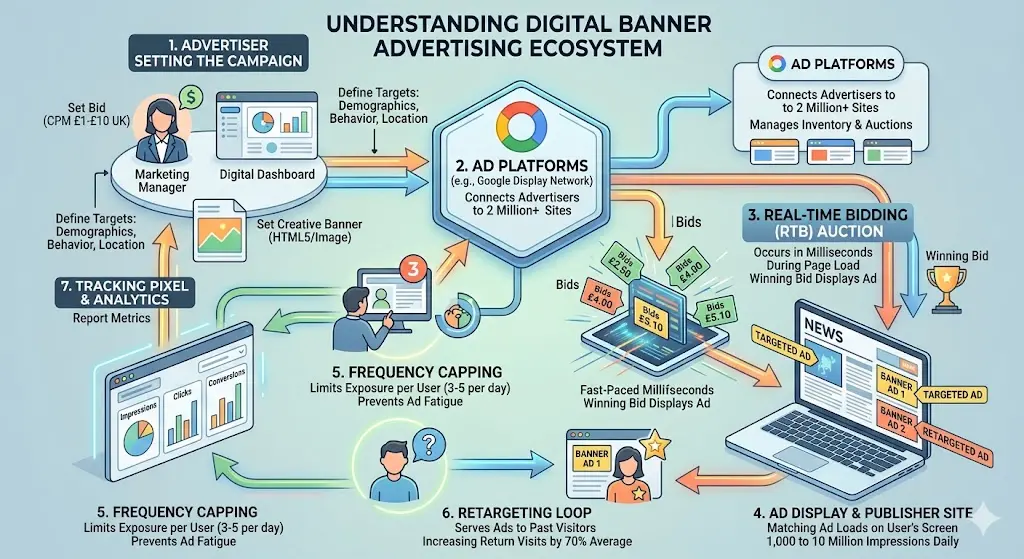
Ad platforms like Google Display Network connect advertisers to over 2 million sites. Real-time bidding (RTB) occurs in milliseconds during page loads. Advertisers set bids per thousand impressions (CPM), typically ranging from £1 to £10 in the UK market. Winning bids display the ad to matching users.
Frequency capping limits exposures per user to 3-5 per day, preventing ad fatigue. Tracking pixels embedded in banners report metrics such as impressions, clicks, and conversions. Retargeting serves ads to users who visited the brand site earlier, increasing return visits by 70% on average.
What are the key components of banner advertising?
Key components include creative design, targeting parameters, ad serving technology, and performance analytics. Creatives use compelling visuals and calls-to-action; targeting segments audiences by age, interests, and geography.
Creative design starts with high-resolution images and concise text limited to 25 words. Colors match brand guidelines, and animations run under 15 seconds to comply with guidelines. Targeting parameters filter audiences: 18-34-year-olds in London show 20% higher engagement rates.
Ad serving technology uses content delivery networks (CDNs) for fast loading under 100KB file size. Performance analytics track click-through rates (CTR) averaging 0.05-0.1%, conversion rates at 1-2%, and return on ad spend (ROAS) targeting 3:1 ratios.
What benefits does banner advertising offer brands?
Banner advertising delivers scalable reach to 90% of global internet users, boosts brand recall by 48%, and generates cost-effective leads at £0.50-£2 per click. It complements search and social strategies.
Brands reach audiences across devices with 95% fill rates on premium inventory. Frequency builds familiarity; users exposed 7 times recall brands 2.5 times better. Cost per mille (CPM) stays low at £2-£5 for UK desktop traffic, scaling to millions without proportional expense increases.
Sequential messaging rotates ad variations to tell stories over multiple impressions. Integration with first-party data enhances personalization, lifting CTR by 15%. Long-term exposure drives unaided recall, essential for new product launches reaching 500,000+ users weekly.
What are the main challenges of banner advertising?
Challenges include banner blindness where 86% of users ignore ads, ad blockers affecting 40% of traffic, and fraud inflating impressions by 20%. Rising costs and privacy laws add complexity.
Banner blindness stems from trained user habits; eyes skip ad-like rectangles. Ad blockers like uBlock Origin filter 350 million devices monthly, reducing inventory by 25% in the UK. Fraud bots generate fake clicks, costing advertisers $35 billion globally in 2024.
Privacy regulations like GDPR limit third-party cookies, forcing contextual targeting. CPM rates rose 15% in 2025 due to reduced supply. Measurement discrepancies between platforms create attribution gaps, undercounting cross-device conversions by 30%.
How has banner advertising evolved in the digital landscape?
Banner advertising evolved from static GIFs in 1994 to HTML5 rich media and programmatic video banners by 2026. Mobile optimization and AI-driven personalization now dominate, with 70% of spend on automated buying.
Early banners featured simple text and images with 44% CTRs. Flash enabled interactivity until 2020 deprecation shifted to HTML5. Programmatic buying automated 80% of transactions via demand-side platforms (DSPs).
Mobile banners adapted to vertical formats, capturing 60% of UK display spend. AI optimizes creatives in real-time, testing 100 variants per campaign. Privacy-first tech like clean rooms enables federated learning without data sharing.
What metrics determine banner advertising success?
Success metrics include CTR at 0.1%, view-through conversions at 2%, and ROAS exceeding 4:1. Brands track 1,000 impressions per £5 spend and 5% lift in site traffic.
CTR measures clicks divided by impressions, benchmarked at 0.07% for finance sectors. Viewability hits 70% standards from Media Rating Council. Conversion value tracks post-click purchases, averaging £20 per acquisition.
Engagement rate counts hovers and expansions, reaching 1% for interactive units. Brand lift studies survey exposed users, showing 12% awareness increase. Lifetime value (LTV) attributes £50-£100 per customer from initial banner exposure.
Is banner advertising cost-effective for UK brands?
Banner advertising proves cost-effective for UK brands with CPMs at £3.50 average, yielding 300,000 impressions for £1,000. It delivers 2.5x ROAS versus TV at similar scale.
UK display market spend hit £4.2 billion in 2025, with 65% programmatic. Small brands access premium sites via networks, achieving 1 million reach for £2,500. Efficiency stems from precise geo-targeting to 68 million UK internet users.
Comparisons show banners outperform email at £0.80 CPC versus £1.20. Seasonal peaks like Black Friday drop CPMs to £2, boosting holiday sales by 18%. Long-tail targeting to niches like Manchester tech firms cuts waste by 40%.
For deeper strategies on execution, [Insert Link to MOFU Article: What Are the Best Practices for Running Successful Banner Advertising Campaigns Today?].
What use cases demonstrate banner advertising value?
Use cases include e-commerce retargeting with 4x conversion lifts, awareness for apps reaching 1 million downloads, and lead gen for SaaS at 3% form fills. Automotive brands drive 15% showroom visits.
E-commerce retargets cart abandoners; 2% of 500,000 impressions convert at £15 average order value. App installs surge 25% from full-screen interstitials on gaming sites. SaaS firms use lead forms in banners, capturing 5,000 emails monthly.
Automotive campaigns geo-fence dealerships, tracking 10% foot traffic via mobile location data. FMCG brands refresh packaging awareness pre-launch, hitting 80% household penetration. Non-profits raise £50,000 from donation banners during events.
How does banner advertising compare to other digital channels?
Banner advertising offers broader reach than search at 90% coverage versus 20%, lower CPC than social at £0.60 versus £1.10, and longer visibility than video at 10 seconds average dwell.
Search captures intent-driven 5% of traffic; banners build top-funnel awareness for 40% unaided recall. Social platforms limit frequency to algorithms; banners control pacing across 10,000+ sites. Native ads blend better but cost 2x CPM.
Video banners engage 3x CTR but load slower; static banners suit quick scans. Email lists decay 22% yearly; banners tap evergreen inventory. Combined funnels amplify: banners prime 15% more search conversions.
What factors influence banner advertising ROI?
ROI factors include audience quality driving 5x returns on premium inventory, creative relevance boosting CTR 3x, and optimization cycles improving ROAS 40% after 2 weeks. Budgets of £10,000 yield £40,000 revenue.
Premium publishers like news sites deliver 2% conversion rates versus 0.5% on general networks. Relevance scores from AI match creatives to content, lifting engagement. A/B testing 10 variants weekly refines winners.
Scale matters: £50,000 monthly budgets access direct deals at 20% discounts. Seasonality adjusts bids; Q4 yields 2.2x ROI. Cross-channel attribution credits banners for 25% of total revenue in multi-touch models.
For high-reach placements, [Insert Link to BOFU Article: How to Buy Banner Advertising on High Authority News Websites for Maximum Reach?].
Why consider banner advertising investments now?
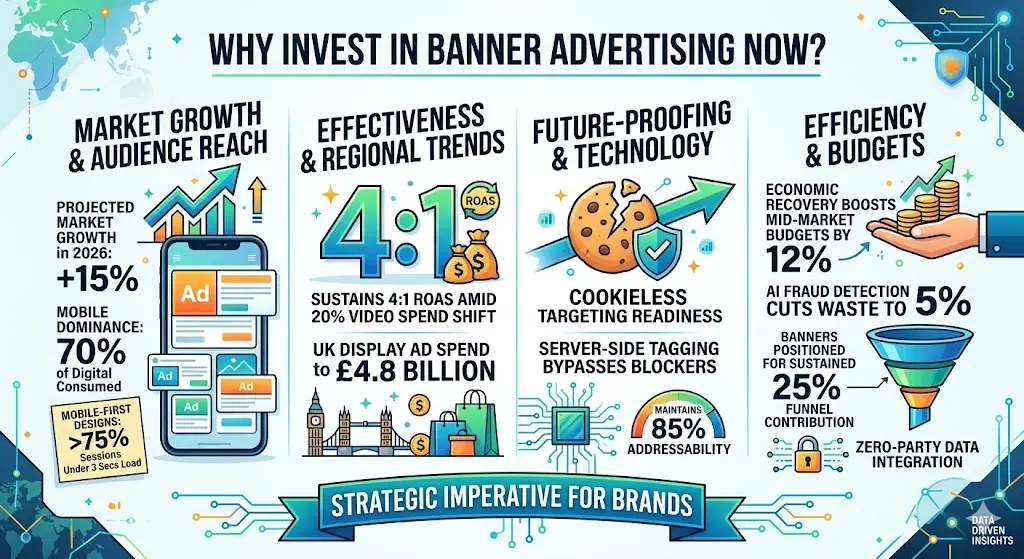
Brands invest in banner advertising now for 15% market growth in 2026, cookieless targeting readiness, and 70% mobile dominance. It sustains 4:1 ROAS amid 20% video spend shifts.
UK display ad spend grows to £4.8 billion, fueled by retail and finance. Server-side tagging bypasses blockers, maintaining 85% addressability. Mobile-first designs capture 75% of sessions under 3 seconds load time.
Economic recovery boosts mid-market budgets by 12%, favoring scalable display. AI fraud detection cuts waste to 5%. Integration with zero-party data ensures compliance and precision, positioning banners for sustained 25% funnel contribution.