

Measuring ROI of sponsored articles has become essential for brands investing in content marketing amid rising ad costs and fragmented audiences. Sponsored articles, a form of native advertising, deliver value through authentic storytelling on trusted media platforms, but success hinges on quantifiable metrics beyond vanity stats like views. This guide breaks down proven methods to track returns, helping you justify budgets and optimize future campaigns.
In today’s data-driven landscape, ROI calculation for sponsored content reveals true impact—whether through lead generation, brand lift, or sales attribution. For instance, a single sponsored article can yield 3-5x ROI when measured holistically, per 2025 industry benchmarks from the Native Advertising Institute. By focusing on attributable revenue against costs, brands like yours can refine strategies for sustained growth.
Defining ROI for Branded Content Campaigns
ROI for sponsored articles is calculated as (Revenue Generated – Campaign Cost) / Campaign Cost x 100, providing a clear percentage return. This formula accounts for direct sales from tracked links, but expands to include indirect benefits like increased site traffic or email sign-ups valued at lifetime customer worth. Audience insights services from media networks analyze reader behavior to assign precise monetary values to these actions.
Consider a B2B SaaS brand running a sponsored article on a tech publication: if it costs $10,000 and generates $40,000 in attributed pipeline, that’s a 300% ROI. Detailed attribution models, such as multi-touch, distribute credit across touchpoints, ensuring comprehensive measurement.
Why Traditional Metrics Fall Short
Pageviews and impressions offer surface-level insights but ignore engagement quality or conversion paths. For accurate ROI of sponsored articles for your brand, prioritize metrics like assisted conversions, where the article nurtures leads later in the funnel. Tools like Google Analytics 4 integrate UTM parameters to track this, revealing hidden value.
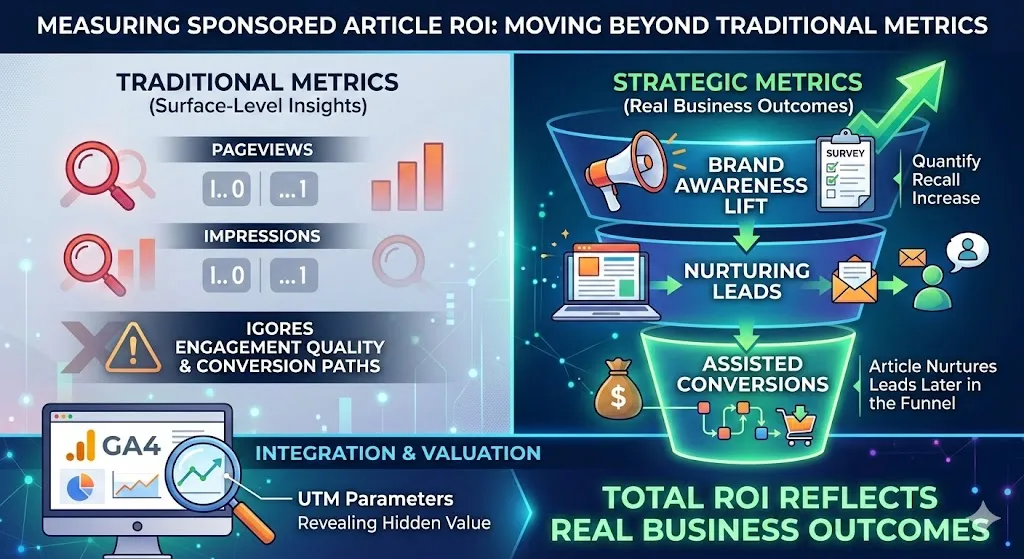
A common pitfall is overlooking brand awareness lift; surveys post-campaign can quantify recall increases worth thousands in equivalent ad spend. This layered approach ensures ROI reflects real business outcomes.
Engagement and Behavioral Metrics
Start with time-on-page, scroll depth, and social shares, which indicate content resonance. High engagement signals algorithm favor, amplifying organic reach. For ROI calculation, assign values: a share might equal $5 in earned media based on audience size.
In a case study, a retail brand’s sponsored article achieved 4-minute average dwell time, correlating to 22% higher conversion rates than low-engagement peers. Track these via heatmapping tools for granular insights.
Conversion and Attribution Metrics
Direct conversions—clicks to landing pages leading to sales—form ROI’s core. Use pixel tracking for closed-loop reporting, where CRM data links article exposure to revenue. Numbered lists help prioritize:
- Install UTM tags on all links (e.g., ?utm_source=sponsored-article).
- Segment traffic in analytics for unique attribution.
- Calculate customer acquisition cost (CAC) reduction from sponsored traffic.
A fintech firm’s sponsored series reduced CAC by 35%, boosting ROI to 450% through precise tracking.
Financial and Long-Term Value Metrics
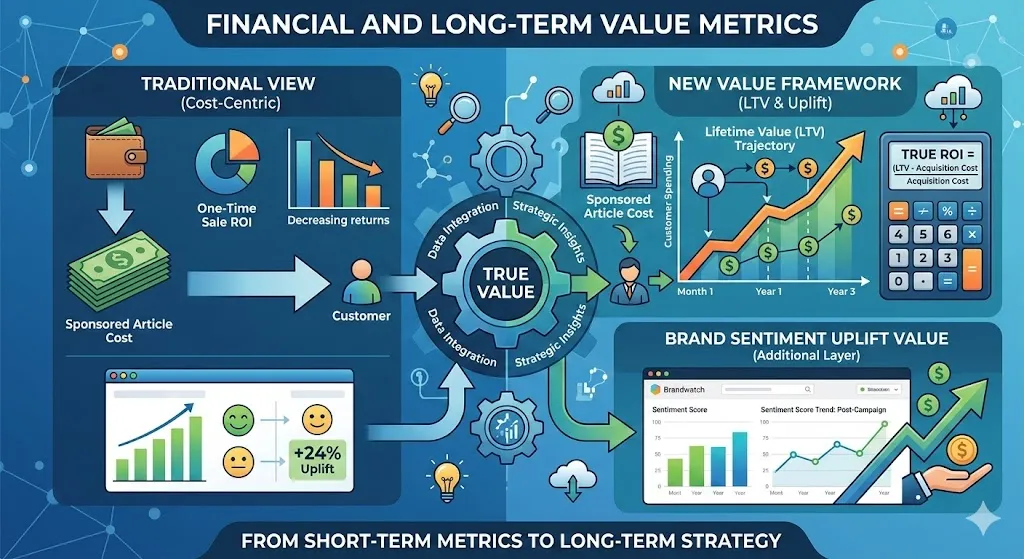
Lifetime value (LTV) multiplies one-time sales for true ROI. Compare sponsored article costs against LTV of acquired customers. Brand sentiment scores from tools like Brandwatch add uplift value.
Step 1: Set Up Tracking Infrastructure
Implement robust tracking from day one: tag links, set up event tracking for micro-conversions (e.g., form fills), and integrate with ad platforms. Media partners like Time Intelligence Media Group provide custom pixels for seamless data flow.
For example, embed conversion pixels in sponsored articles to capture downstream revenue, ensuring 100% attribution accuracy.
Step 2: Gather and Clean Data
Post-campaign, pull data from analytics, CRM, and surveys. Clean outliers, like bot traffic, using filters. Use cohort analysis to track retained customers from the article over 90 days.
A health brand cleaned data to reveal 28% of conversions stemmed from article-influenced sessions, refining their ROI model.
Step 3: Apply Formulas and Model Scenarios
Plug into the ROI formula, testing linear vs. exponential decay models for attribution. Sensitivity analysis—what-if cost changes—forecasts scalability.
- Baseline ROI: Direct revenue only.
- Full-funnel ROI: Include LTV and assisted conversions.
- Comparative ROI: Vs. other channels like PPC.
This yields actionable insights, like a 2025 campaign hitting 520% ROI after LTV adjustments.
Tools and Technologies for Accurate ROI Measurement
Sponsored content platforms like Parse.ly or Chartbeat offer real-time dashboards for sponsored articles ROI. Integrate with Google Analytics, HubSpot, or Marketo for end-to-end visibility.
Advanced AI tools from audience insights services predict ROI pre-launch by simulating audience reactions based on historical data.
Case Studies: Real ROI Wins from Sponsored Articles
A CPG brand’s sponsored article on sustainability trends generated $150,000 revenue from $20,000 spend (650% ROI), tracked via unique promo codes. Another, in SaaS, used multi-touch attribution to claim 15% of quarterly pipeline.
These demonstrate how structured measurement turns sponsored content into profit centers. For foundational strategies, read How Native Advertising Works to Engage Your Audience Fast.
To maximize outcomes, discover our Sponsored Content Services focused on measurable, high-ROI placements.
Common Challenges in Measuring Sponsored Articles ROI and Solutions
Cross-device tracking fragments data; use user-ID methods to unify paths. Long sales cycles delay visibility—employ probabilistic matching.
Solution: Hybrid models blending deterministic (logged-in users) and probabilistic data yield 85% accuracy. Budget for third-party audits to validate.
Advanced Techniques for Optimizing Future ROI
A/B test headlines and CTAs mid-campaign, using machine learning for personalization. Predictive analytics forecast ROI based on early signals.
Incorporate zero-party data from interactive elements to enhance precision.
When scaling, evaluate Why Choose a Media Network for Sponsored Content for expert optimization.
Mastering how to measure ROI of sponsored articles for your brand unlocks scalable content marketing success through data-backed decisions. Time Intelligence Media Group delivers Sponsored Content Services with built-in analytics, empowering brands to achieve and exceed ROI targets with precision.
