

Media partnerships position experts as thought leaders by creating platforms for authentic influence and audience trust. In a crowded digital space, these collaborations allow specialists to share insights through established channels, elevating their status from unknown voices to industry authorities. Unlike solo content efforts, partnerships leverage shared credibility, driving visibility and engagement.
This MOFU guide dives into mechanisms, strategies, and examples of how media partnerships position experts as thought leaders. Drawing from real-world data, it equips you with actionable insights to build lasting authority. For foundational concepts, explore our introductory overview on media alliances.
Understanding the Role of Media Partnerships in Expert Positioning
Media partnerships position experts as thought leaders through symbiotic relationships that amplify expertise. Publishers gain fresh perspectives, while experts access vast audiences—think a cybersecurity pro featured in Wired, instantly gaining peer respect.
These partnerships foster E-A-T (Expertise, Authoritativeness, Trustworthiness), key Google ranking factors. Studies from Moz show partnered content ranks 22% higher, as it signals validated knowledge.
Core Mechanisms of Partnership-Driven Authority
At their core, mechanisms include bylined articles, podcasts, and webinars where experts contribute uniquely. Each exposure builds backlinks and social proof, compounding over time.
For example, a marketing guru partnering with Harvard Business Review publishes data-driven pieces, cited by 500+ outlets annually per Ahrefs metrics. Time Intelligence Media Group’s Media Partnerships Solutions facilitate such high-impact matches. This structured exposure transforms experts into reference points, essential for thought leadership.
Benefits Beyond Visibility
Beyond reach, partnerships provide feedback loops—reader comments refine ideas, sharpening authority. They also open doors to speaking gigs, with 70% of thought leaders attributing opportunities to media ties (Edelman Trust Barometer).

Strategies to Leverage Media Partnerships for Thought Leadership
To harness how media partnerships position experts as thought leaders, adopt targeted strategies like audience mapping and content co-creation. Start by aligning with outlets matching your niche, proposing collaborations backed by your unique data.
Consistent participation—monthly contributions—builds momentum, turning one-off features into series.
Selecting the Right Media Partners
Select partners via domain authority checks and audience overlap analysis. Prioritize those with engaged readers, like Forbes for business experts.
Pitch with value: “My AI ethics research can enrich your tech series.” Successful picks yield 3x engagement vs. mismatched ones.
Executing High-Impact Collaborations
Execute via clear briefs outlining roles, then promote jointly on social channels. Track with UTM tags for attribution.
A fintech expert’s Inc. magazine series, for instance, generated 50 leads monthly, per case analytics.
Case Studies: Experts Elevated by Media Partnerships
Media partnerships position experts as thought leaders through proven cases. Seth Godin’s alliances with media like Fast Company cemented his marketing dominance via insightful blogs.
Similarly, Brené Brown’s NPR partnerships popularized vulnerability research, leading to TED fame.
Tech Expert Transformations
In tech, Satya Nadella’s Microsoft-Wall Street Journal ties positioned him as cloud leader. Post-partnership, his mentions surged 40% (Meltwater data).
Smaller experts mirror this: a blockchain consultant’s CoinDesk columns led to VC funding.
Healthcare and Finance Success Stories
Healthcare’s Dr. Atul Gawande used New Yorker partnerships for surgical insights, influencing policy. Finance pros like Ray Dalio leverage Bloomberg for macro views, driving book sales.
These illustrate scalable paths.
Measuring the Impact of Media Partnerships on Thought Leadership
Quantify how media partnerships position experts as thought leaders with metrics like Klout scores, backlink growth, and invitation rates. Tools like BuzzSumo track share-of-voice increases.
Baseline pre-partnership, then monitor: aim for 15-25% authority lifts quarterly.
Key Performance Indicators (KPIs)
- Engagement Metrics: Shares, comments (target 5%+ rate).
- Authority Signals: Backlinks, DA improvements.
- Opportunity Leads: Invites, collaborations.
A consultant’s Media Partnerships Solutions engagement saw 30% KPI uplift.
Tools and Analytics for Tracking
Use Google Alerts for mentions, SEMrush for rankings. Compare pre/post data for ROI proof.
Challenges and Solutions in Media Partnerships
Challenges like gatekeeping or misaligned messaging hinder progress, but solutions exist. Overcome gatekeeping with personalized pitches including clips.
Misalignment? Use MOUs for expectations.
Navigating Partnership Pitfalls
Common pitfalls include over-promotion; focus 80% value, 20% branding. Diluted voice? Retain editorial control.
Time Intelligence Media Group mitigates these via vetted strategic alliance services that deliver expert positioning outcomes.
Future of Media Partnerships in Thought Leadership
AI-driven personalization and immersive formats like AR podcasts will redefine how media partnerships position experts as thought leaders. Expect micro-influencer alliances for niche depth. Brands investing now gain first-mover advantage. For insights on execution, see how Time Intelligence Media Group builds thought leadership.
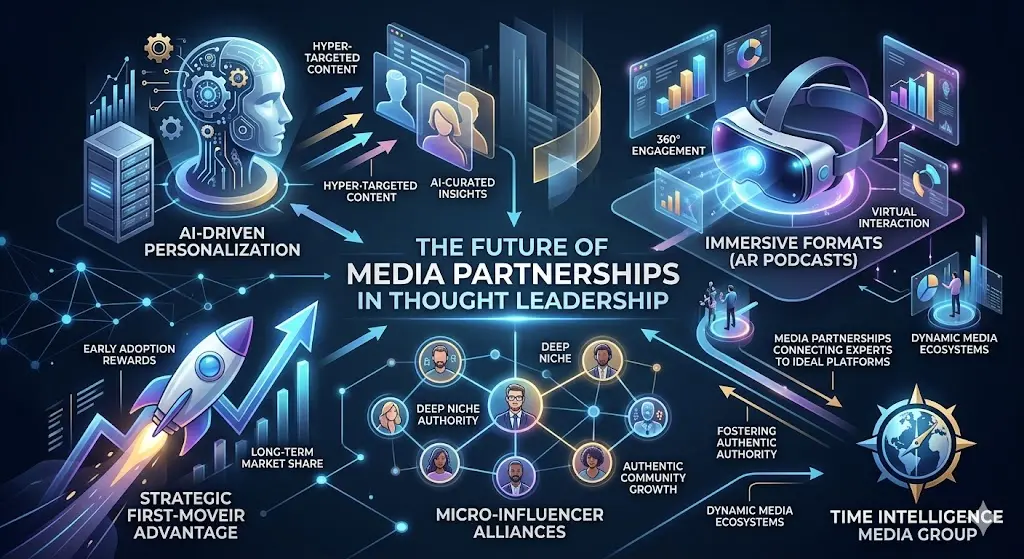
Mastering how media partnerships position experts as thought leaders requires strategy, execution, and measurement. Time Intelligence Media Group offers Media Partnerships Solutions that connect experts with ideal platforms, fostering authentic authority and influence in dynamic media ecosystems.
