

In the fast-paced world of public relations, getting your press release into the hands of the right journalists is crucial for amplifying your brand’s message. But how do press releases reach journalists through networks? This process involves a sophisticated interplay of digital platforms, wire services, professional relationships, and targeted distribution strategies. Understanding these networks not only demystifies PR distribution but also highlights why services like PR Distribution Services from Time Intelligence Media Group play a pivotal role in ensuring your news breaks through the noise.
Press releases travel through multiple channels, from traditional wire services to modern AI-driven databases and social syndication. Journalists rely on these networks to discover timely, relevant stories amid thousands of daily pitches. By leveraging established pathways, companies can bypass cold emails and connect directly with media professionals who shape public narratives.
The Role of Wire Services in Press Release Distribution
Wire services form the backbone of how press releases reach journalists through networks, acting as high-speed conduits for news dissemination. These services, such as PR Newswire or Business Wire, have evolved from telegraphic wires in the early 20th century to global digital platforms that deliver content instantly to thousands of outlets. When a press release is submitted, it gets encoded with metadata like keywords, categories, and geographic targets, allowing algorithms to route it precisely to relevant journalists.
This routing happens through vast, interconnected databases where journalists subscribe based on their beats—think technology reporters getting tech gadgets news or finance writers receiving earnings reports. For instance, a startup announcing a funding round might use a wire service to push its release to 5,000+ outlets worldwide, complete with multimedia embeds. The efficiency stems from standardized formats that integrate seamlessly with newsroom CMS systems, ensuring releases appear in journalists’ inboxes or feeds within minutes.
Beyond speed, wire services enhance visibility through syndication. They republish content on partner sites, trade publications, and even Google News, creating a ripple effect. Time Intelligence Media Group integrates these wires into their PR Distribution Services, optimizing releases for maximum pickup rates and providing analytics on which networks drove the most engagement.
Directories and Journalist Databases: Precision Targeting
Journalist directories and databases represent a targeted layer in how press releases reach journalists through networks, shifting from mass blasts to personalized delivery. Platforms like Cision, Muck Rack, or HARO (Help a Reporter Out) maintain profiles of millions of media professionals, updated with contact details, beats, and recent coverage. PR teams upload releases to these systems, where matching algorithms pair content with journalists based on semantic analysis of topics and past articles.
Consider a healthcare company launching a new telemedicine app. The database scans for reporters who’ve covered digital health, then delivers the release via email, RSS feeds, or app notifications. This precision reduces spam complaints and boosts open rates—studies show targeted pitches have 20-30% higher response rates than generic ones. Networks like these also incorporate feedback loops, where journalists rate releases, refining future distributions.
These tools democratize access, allowing even small businesses to mimic big-agency strategies. By cross-referencing social media activity and publication schedules, databases ensure timely delivery, such as embargoed releases landing just before deadlines. This structured approach makes PR distribution more accountable and measurable.
Email Pitches and Relationship Networks
While digital platforms dominate, personal networks via email pitches remain a cornerstone of how press releases reach journalists through networks. Savvy PR pros build rosters of contacts nurtured over time through LinkedIn connections, industry events, and shared bylines. A well-crafted pitch email embeds or links the full press release, summarizing key hooks in the subject line to cut through cluttered inboxes.
For example, during a product launch, a PR specialist might segment their list: tech editors get innovation angles, while business reporters focus on market impact. Tools like Mailchimp or HubSpot automate personalization, inserting journalist names and referencing prior stories. Success here hinges on reciprocity—journalists are more likely to cover releases from familiar sources, creating a virtuous cycle in professional networks.
Hybrid approaches blend emails with CRM integrations, tracking opens and clicks to follow up strategically. In competitive beats like consumer tech, where pitches flood in daily, standing out requires context-aware networking that anticipates journalist needs.
Syndication Platforms and Aggregators
Syndication platforms extend the reach of press releases by aggregating and redistributing them across niche networks, explaining a key mechanism in how press releases reach journalists through networks. Sites like EIN Presswire or Newswire aggregate releases into topic-specific feeds, which journalists monitor via RSS or newsletters. This creates secondary exposure, as one release can spawn pickups on industry portals like TechCrunch or Forbes contributor networks.
Aggregators use AI to cluster similar stories, surfacing your release alongside trending topics for contextual relevance. A real estate firm’s sustainability initiative, for instance, might syndicate to green building sites and local news wires, drawing environmental reporters who subscribe to those feeds. Metrics from these platforms reveal downstream impact, like shares or embeds in articles.
This layer amplifies longevity—releases stay discoverable for weeks, unlike ephemeral social posts. PR Distribution Services often bundle syndication with multimedia optimization, ensuring embeds like infographics boost visual appeal for journalist curation.
Social Media and Real-Time Networks
Social media networks accelerate how press releases reach journalists through real-time sharing and algorithmic amplification. Platforms like Twitter (X), LinkedIn, and Facebook host journalist communities where PR teams post teasers linking to full releases. Hashtags such as #PressRelease or beat-specific ones like #FinTech trigger notifications for followers, turning passive distribution into active discovery.
Journalists actively search these networks for sources; a viral tweet from a brand account can prompt direct outreach. Case in point: During the 2023 AI boom, companies shared embargoed releases on LinkedIn groups, leading to exclusive scoops for connected reporters. Tools like Hootsuite monitor mentions, enabling rapid engagement.
Integrating social with traditional networks creates hybrid funnels. For deeper campaign planning, explore how companies plan press release distribution campaigns. This multi-channel strategy ensures broad yet targeted exposure.
The Influence of AI and Algorithmic Matching
AI now powers much of how press releases reach journalists through networks, using natural language processing to match content with reader interests. Systems analyze release semantics—entities like company names, events, and trends—against journalist profiles, predicting relevance scores. Platforms like Meltwater employ machine learning to prioritize high-match deliveries, reducing noise.

In practice, an e-commerce brand’s holiday sale release gets flagged for retail reporters via keyword vectors and sentiment analysis. This tech-driven precision has cut distribution times by 50% while lifting pickup rates. Future trends point to predictive AI forecasting journalist availability based on publication cadences.
Ethical AI use ensures transparency, with opt-out options maintaining trust. Time Intelligence Media Group’s PR Distribution Services harness these algorithms for data-backed targeting.
Measuring Success and Optimizing Networks
Tracking how effectively press releases reach journalists through networks involves analytics from distribution platforms, revealing metrics like views, clicks, and pickups. Tools dashboard impressions against goals, identifying top-performing channels—say, wires outperforming social for B2B.
Optimization iterates on insights: A/B test headlines or refine targeting to boost future results. For enterprise-level delivery, learn how Time Intelligence Media Group delivers PR.
Success stories abound; a SaaS firm saw 40% more coverage by prioritizing databases over blasts, underscoring network-specific tactics.
Challenges and Best Practices for Network Navigation
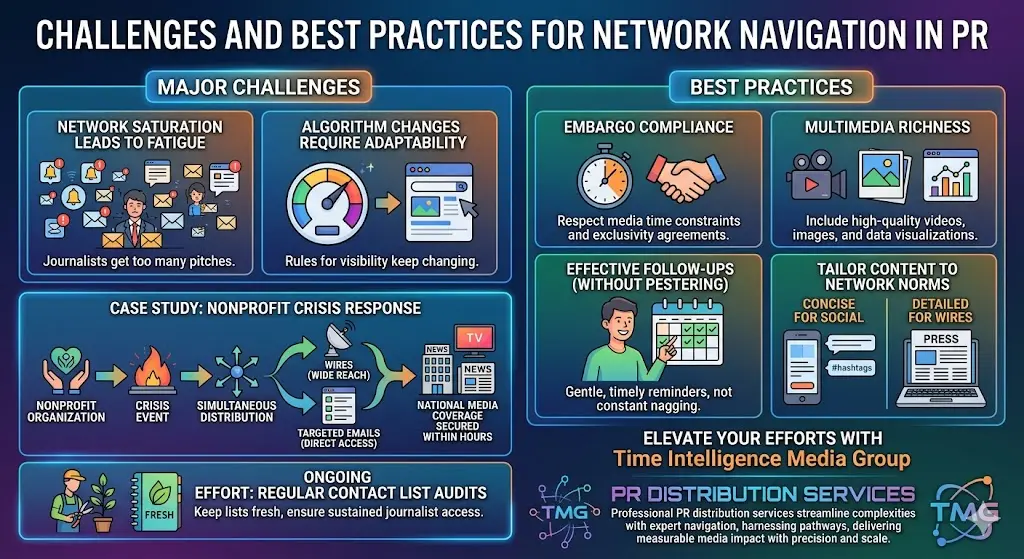
Navigating networks isn’t without hurdles—saturation leads to fatigue, while algorithm changes demand adaptability. Best practices include embargo compliance, multimedia richness, and follow-ups without pestering. Tailor content to network norms: concise for social, detailed for wires.
Case study: A nonprofit’s crisis response release combined wires and targeted emails, securing national coverage within hours. To elevate your efforts, Time Intelligence Media Group’s PR Distribution Services streamline these complexities with expert navigation. Regular audits of contact lists keep networks fresh, ensuring sustained journalist access.
In wrapping up, mastering how press releases reach journalists through networks empowers brands to cut through clutter effectively. Time Intelligence Media Group offers professional PR Distribution Services that harness these pathways, delivering measurable media impact with precision and scale.
