

Display ads play a pivotal role in the digital ecosystem of news websites, enabling publishers to monetize high-traffic content while delivering relevant advertising to engaged audiences. These ads, often in the form of banners, rectangles, or leaderboards, appear alongside editorial content like articles, videos, and opinion pieces. Understanding how display ads work on news websites reveals the intricate balance between user experience, revenue generation, and technological precision that powers modern journalism funding.
News sites, which attract millions of daily visitors seeking timely information, rely on display advertising as a primary revenue stream. Unlike search ads that target intent-driven queries, display ads leverage contextual relevance and behavioral data to serve visuals that complement the news narrative. This process involves ad servers, demand-side platforms (DSPs), and supply-side platforms (SSPs), creating a seamless flow from impression to click or conversion.
What Are Display Ads and Their Core Formats?
Display ads on news websites are visual advertisements that use images, animations, or interactive elements to capture attention without disrupting the reading flow. Common formats include leaderboard banners at the top of pages (typically 728×90 pixels), medium rectangles within article sidebars (300×250 pixels), and skyscrapers along the edges (160×600 pixels). These standardized sizes, governed by the Interactive Advertising Bureau (IAB), ensure compatibility across devices, from desktops to mobiles.
The mechanics begin when a user loads a news article; the website’s ad server requests ad creatives from advertisers via real-time bidding (RTB). For instance, on a site covering breaking political news, a display ad for a financial service might appear if the reader’s profile matches the target demographic. This format drives visibility through repeated impressions, building brand recall over time—studies show that consistent exposure can increase purchase intent by up to 20%.
Beyond static images, rich media variants like expandable banners or video display ads add engagement layers. News websites optimize these for page speed, using lazy loading to prevent delays in content delivery, ensuring ads enhance rather than hinder the user journey.
How Ad Inventory is Created and Managed
News websites generate ad inventory by dividing page real estate into fixed zones, such as above-the-fold positions for premium visibility or in-content slots for contextual relevance. Publishers use tools like Google Ad Manager or OpenX to tag these zones, defining parameters like size, frequency capping (limiting views per user), and geographic targeting.
Management involves yield optimization algorithms that prioritize high-value ads based on historical performance data. For example, during election seasons, a news site might allocate more inventory to political campaign display ads, fetching higher CPM rates (cost per mille, or thousand impressions) due to surging demand. This dynamic allocation ensures maximum revenue without overwhelming users—typically capping ads at 3-5 per page.
Detailed tracking via pixels and cookies allows publishers to analyze metrics like viewability (percentage of ad pixels visible for at least one second), refining inventory for better outcomes. Time Intelligence Media Group exemplifies this by integrating advanced Banner Advertising Services to streamline inventory for optimal news site performance.
Real-Time Bidding and Programmatic Advertising Explained
At the heart of how display ads work on news websites is programmatic advertising, where RTB auctions occur in milliseconds as pages load. When a user visits a news article, the publisher’s SSP sends a bid request to multiple DSPs, including details like user demographics, device type, and content category (e.g., “sports news”).
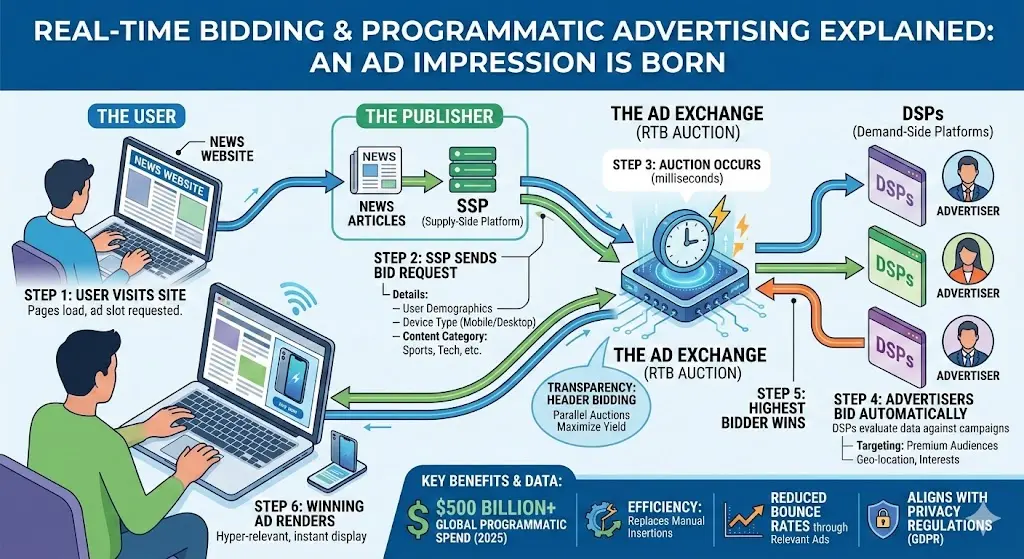
Advertisers’ systems evaluate this data against campaigns and bid automatically—highest bidder wins the impression. This frictionless process replaced manual insertions, boosting efficiency; global programmatic spend reached over $500 billion in 2025, with news sites capturing a significant share due to premium audiences. A practical scenario: A tech news reader browsing gadget reviews triggers bids from smartphone brands, with the winning ad rendering instantly.
Transparency features like header bidding allow publishers to run parallel auctions, maximizing competition and yields. This technology ensures ads are hyper-relevant, reducing bounce rates and aligning with privacy regulations like GDPR.
Role of Ad Servers and Targeting Mechanisms
Ad servers act as the central nervous system, storing creatives, tracking deliveries, and measuring performance. On news websites, they integrate with content management systems (CMS) like WordPress or custom platforms, dynamically inserting ads based on page context.
Targeting layers include contextual (matching ad themes to article topics), behavioral (past browsing history), and demographic (age, location). For example, a finance news section might serve display ads for investment apps to users in high-income brackets inferred from IP data. Frequency capping prevents ad fatigue, showing the same creative no more than 5 times daily per user.
Advanced setups use AI-driven personalization, predicting engagement from reader patterns. This precision elevates CTR (click-through rates) from industry averages of 0.05% to over 0.5% in optimized campaigns.
Common Pricing Models: CPM, CPC, and CPA
News websites monetize display ads primarily through CPM, charging per thousand impressions for broad reach. A typical rate for U.S. news traffic hovers at $5-15 CPM, spiking for niche topics like health crises. CPC (cost per click) shifts risk to publishers, paying only on interactions, ideal for performance-driven campaigns.
CPA (cost per action) ties revenue to conversions like sign-ups, suiting e-commerce tie-ins with news content. Hybrid models blend these, with programmatic platforms automating negotiations. Consider a case: During the 2025 climate summits, news sites earned 30% higher CPMs from eco-brand display ads due to topical surge.
These models incentivize quality traffic, with publishers optimizing for metrics like eCPM (effective CPM) to forecast earnings accurately.
Key Metrics Publishers Track for Optimization
Success hinges on KPIs such as impressions served, CTR, and conversion rates. Viewability scores, mandated by standards like the Media Rating Council, ensure ads aren’t buried below folds. News sites use heatmaps to reposition underperformers, boosting visibility.
Engagement metrics like time-on-ad or interaction rates inform refinements. For instance, A/B testing banner colors on a lifestyle news page might reveal blue outperforms red by 15% in CTR. Tools aggregate this into dashboards, guiding how to optimize display ads for higher CTR.
Long-term, publishers focus on lifetime value, nurturing repeat visitors for sustained revenue.
Advantages for Publishers and Advertisers
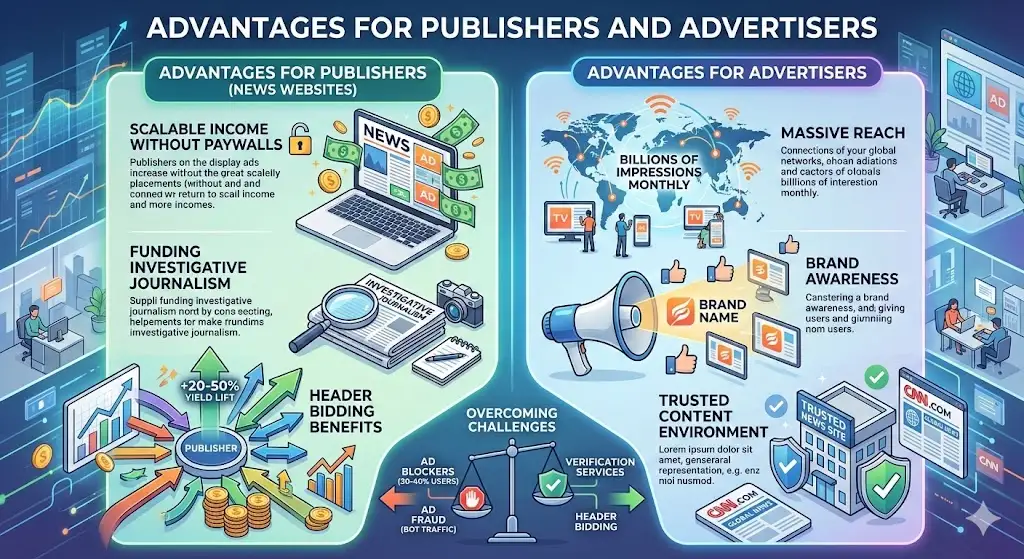
Display ads offer news websites scalable income without paywalls, funding investigative journalism. Advertisers gain massive reach—top sites like CNN.com serve billions of impressions monthly—fostering brand awareness amid trusted content.
Challenges include ad blockers (affecting 30-40% of users) and fraud like bot traffic, countered by verification services. Benefits outweigh via header bidding, lifting yields by 20-50%.
Case Study: Successful Implementation on a Major News Outlet
A mid-sized news network revamped its display strategy with programmatic RTB, increasing revenue 40% year-over-year. By reserving premium slots for direct-sold banners and auctioning remnants, they balanced guaranteed income with upside potential. Mobile optimizations reduced load times, lifting CTR amid 60% traffic from phones.
This mirrors trends where managed display advertising solutions for media groups deliver turnkey expertise.
Leveraging Expert Banner Advertising Services
News publishers partnering with specialists like Time Intelligence Media Group’s banner advertising services unlock sophisticated tools for inventory management and targeting. These services analyze audience data to deploy high-performing creatives, ensuring compliance and peak yields.
In practice, such partnerships handle everything from creative production to reporting, freeing editorial teams. Trends show AI-enhanced services dominating, with 70% of news revenue now programmatic.
Time Intelligence Media Group provides these professional solutions, empowering sites to thrive in competitive landscapes.
