

Brands today face the challenge of fragmented audiences spread across social media, podcasts, newsletters, and traditional outlets. Scaling stories across multiple media platforms requires a deliberate strategy to maintain narrative consistency while maximizing reach and engagement. This middle-of-funnel guide explores proven tactics for multi-platform storytelling, helping brands transition from awareness to consideration.
By leveraging diverse media ecosystems, companies can amplify their core messages without losing authenticity. Time Intelligence Media Group demonstrates this through targeted approaches that integrate platforms seamlessly, ensuring stories evolve dynamically across channels.
Understanding Multi-Platform Narrative Frameworks
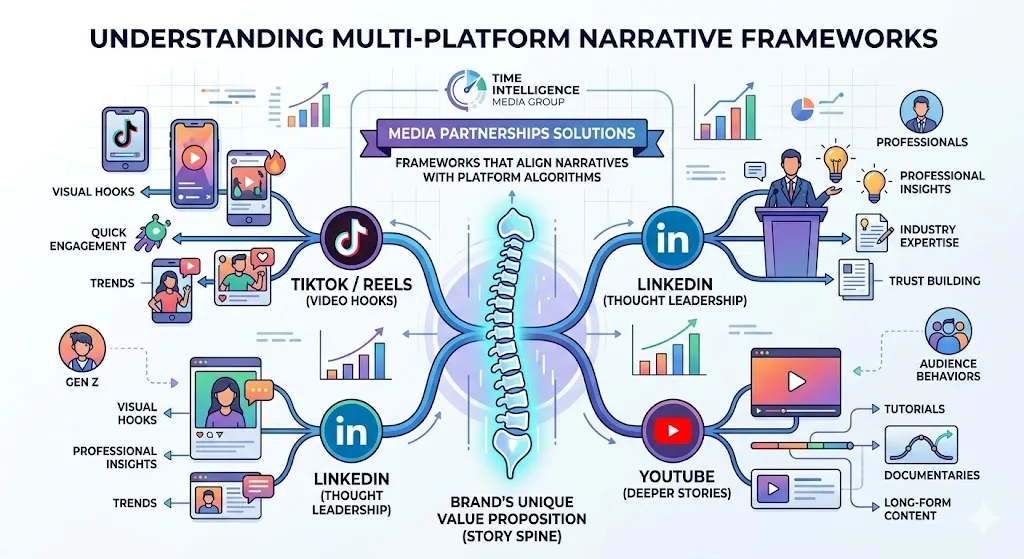
A solid multi-platform narrative framework starts with a central story pillar—your brand’s unique value proposition—then adapts it for each medium’s strengths. For video-heavy platforms like TikTok or YouTube, focus on visual hooks; for LinkedIn, emphasize thought leadership. This adaptation prevents cookie-cutter content that fails to resonate.
Brands succeed by creating a “story spine”: a consistent backbone with flexible branches. A fitness apparel company, for example, used its “empowerment through movement” spine across Instagram Reels (quick workouts), podcasts (athlete interviews), and email newsletters (progress trackers), achieving 2.5x engagement growth. Mapping audience behaviors per platform ensures relevance—Gen Z on Snapchat craves interactivity, while professionals on Twitter prefer bite-sized insights.
Time Intelligence Media Group’s Media Partnerships Solutions excel here, providing frameworks that align narratives with platform algorithms for optimal visibility and scaling.
Key Tactics for Cross-Platform Story Distribution
Effective distribution involves phased rollouts: seed stories on owned channels, then syndicate via partnerships. Use content repurposing tools to transform long-form blogs into threads, clips, and infographics without dilution. Prioritize platforms by audience overlap—e.g., expand from Instagram to Pinterest for visual brands.
Essential tactics include:
- Sequential Teasers: Launch a podcast episode, followed by social clips and newsletter deep-dives, creating a narrative trail that drives cross-traffic.
- Platform-Native Adaptations: Convert webinars into YouTube chapters or Twitter Spaces for audio platforms, boosting completion rates by 40%.
- Collaborative Amplification: Partner with micro-influencers per platform for authentic extensions.
For foundational strategies on scaling brand narratives through media partners, review how alliances kickstart multi-platform momentum. These tactics turn one story into a ecosystem-spanning campaign.
Case Studies: Brands Mastering Platform Scaling
Real-world examples illustrate success in scaling stories across multiple media platforms. A beauty brand scaled its “clean ingredients” narrative from Instagram Stories to Spotify podcasts and Forbes articles: short demos built hype, episodes delved into sourcing, and articles added credibility—resulting in 60% traffic uplift across sites.
In B2B, a SaaS provider distributed its “automation revolution” story via LinkedIn videos, Reddit AMAs, and industry webinars. This mix targeted decision-makers at each journey stage, shortening consideration time by 25%. Metrics showed podcasts driving deepest engagement, informing future weighting.
These cases underscore platform synergy: visual platforms spark interest, audio builds trust, written content converts. Challenges like voice consistency were overcome via brand style guides enforced across teams.
Integrating Analytics for Platform Optimization
Analytics integration is crucial for refining how brands scale stories across multiple media platforms. Track cross-platform journeys with tools like Google Analytics 4 or Hotjar, identifying drop-offs—e.g., Instagram traffic converting better on mobile-optimized landing pages. Set KPIs like multi-touch attribution scores to value each platform’s contribution.
Optimization loops involve weekly reviews: A/B test headlines per platform (e.g., emotive for Facebook vs. data-driven for LinkedIn) and reallocate budgets to top performers. A travel brand did this, shifting 30% from underperforming Twitter to thriving Pinterest, doubling bookings.
Advanced brands use AI sentiment analysis to predict narrative resonance pre-launch. Time Intelligence Media Group’s Media Partnerships Solutions incorporate these analytics for data-backed scaling, ensuring stories adapt in real-time.
Navigating Algorithm Changes and Platform Risks
Algorithms evolve rapidly, impacting story visibility—Instagram favors Reels, while X prioritizes replies. Brands mitigate risks by diversifying: no single platform exceeds 40% of efforts. Monitor updates via platform blogs and test betas early.
Risks like shadowbans arise from over-promotion; balance with 80/20 value-to-pitch ratios. A food brand navigated TikTok changes by pivoting to user-generated content chains, maintaining reach amid shifts. Build owned assets like apps or newsletters as safety nets.
Future-proofing includes emerging platforms like Threads or Bluesky. For decision-stage insights on how Time Intelligence Media Group scales brand narratives, see enterprise-level execution.
Content Repurposing Workflows for Efficiency
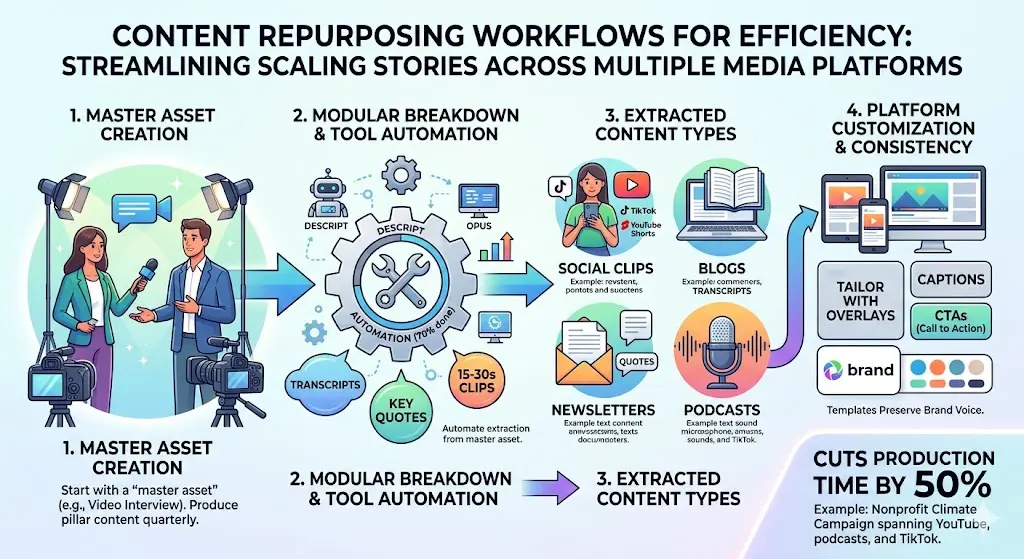
Efficient repurposing workflows streamline scaling stories across multiple media platforms. Start with a “master asset”—a video interview—then extract: clips for social, transcripts for blogs, quotes for newsletters. Tools like Descript or Opus automate 70% of this.
Workflow steps:
- Asset Creation: Produce pillar content quarterly.
- Modular Breakdown: Segment into 15-30 second bites.
- Platform Customization: Tailor with overlays, captions, and CTAs.
This approach cuts production time by 50%, as seen in a nonprofit’s climate campaign spanning YouTube, podcasts, and TikTok. Consistency via templates preserves brand voice.
Building Teams for Sustained Multi-Platform Scaling
Scaling requires cross-functional teams: content creators, platform specialists, and analysts collaborating via tools like Asana or Slack. Train on platform nuances—e.g., SEO for YouTube titles, hashtags for Instagram.
Outsource gaps via agencies specializing in media partnerships. Time Intelligence Media Group builds these capabilities, enabling in-house teams to focus on creativity.
Mastering how brands scale stories across multiple media platforms demands strategic frameworks, analytics, and adaptability. Time Intelligence Media Group offers professional Media Partnerships Solutions to operationalize these tactics, empowering brands to thrive in dynamic media landscapes.
